

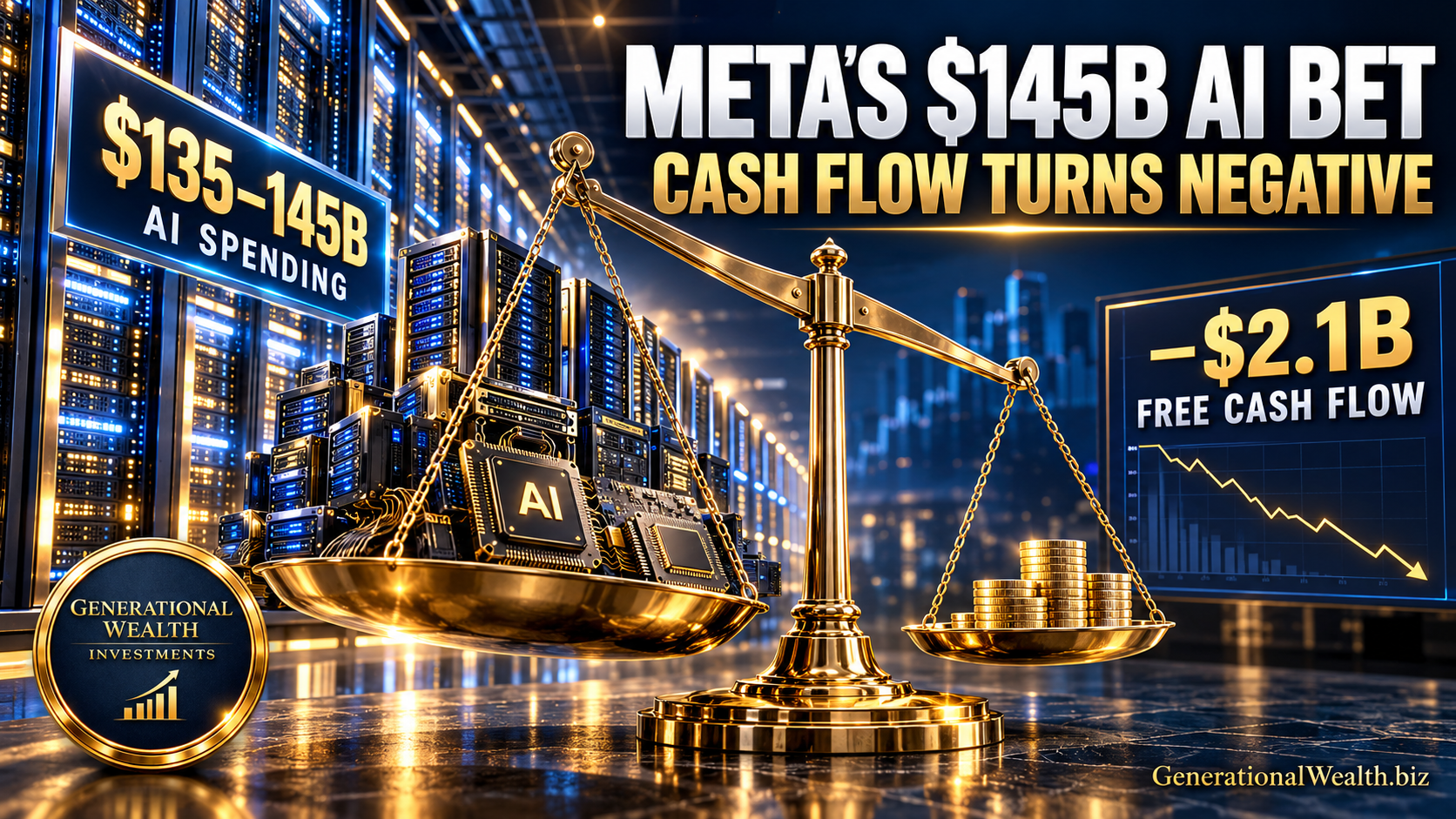
Meta’s $145 Billion AI Bet Turns Cash Flow Negative
Meta's revenue jumped 26%, but nearly $35 billion of quarterly capital spending helped push free cash flow negative. With full-year capital spending expected to reach as much as $145 billion, the next test is whether Meta's AI gains can translate into stronger cash generation.
October 22, 2026
Meta’s $145 Billion AI Bet Just Turned Cash Flow Negative
Meta's third-quarter revenue jumped 26% to roughly $64.6 billion, and shares rose more than 4% after hours. But the bigger issue is what that growth is costing. Nearly $35 billion of quarterly capital spending helped push free cash flow negative by about $2.1 billion, putting the economics of Meta's massive AI buildout in focus.
Watch Today's Market Breakdown
See why Meta's strong revenue growth and improving AI-driven engagement are being weighed against one of the largest capital-spending programs in the company's history.
Today's Market Setup
Meta's results show the central tension facing some of the world's largest AI spenders: artificial intelligence may strengthen the existing business, but building the infrastructure required to support it can consume enormous amounts of cash.
Revenue Growth Remains Strong
Third-quarter revenue rose 26% to about $64.6 billion, and Meta shares gained more than 4% after hours. The response shows investors are still giving substantial weight to the company's underlying growth even as AI spending accelerates.
Free Cash Flow Turned Negative
Meta spent nearly $35 billion on capital projects during the quarter, while free cash flow turned negative by roughly $2.1 billion. That puts a new spotlight on how quickly the company's AI infrastructure can translate into future cash generation.
The AI Bill Could Reach $145 Billion
Meta now expects full-year capital spending of approximately $135 billion to $145 billion. The company says AI is already improving engagement, recommendations, and advertising monetization, raising the question of whether those gains can justify the scale of the investment.
What Matters From Here
The spending itself is no longer the only issue. Investors now need to see whether the benefits Meta says it is getting from AI begin showing up strongly enough in future cash generation.
- Can free cash flow rebound while Meta continues spending heavily on AI infrastructure?
- Do improvements in engagement, recommendations, and ad monetization generate enough economic benefit to support the investment?
- If revenue keeps growing but free cash flow remains under pressure, how patient will investors remain with the scale of the AI buildout?
The Headlines Are Only the First Step
The free Market Preview explains why Meta's results matter. The members-only Daily Market Brief goes deeper into the spending trends, cash-flow signals, monetization developments, catalysts, and risks worth monitoring as the AI investment cycle continues.
See What Members GetInside Today's Members-Only Daily Market Brief
- The cash-flow developments that could make Meta's massive AI spending easier — or harder — for investors to defend.
- How the company's revenue growth compares with the pressure created by nearly $35 billion of quarterly capital spending.
- The signals from engagement, recommendations, and advertising monetization that matter as Meta tries to turn AI investment into stronger business economics.
- Why the next change in free cash flow could become one of the most important tests of investor patience with the AI buildout.
Go Beyond the Headlines
Knowing that Meta could spend as much as $145 billion this year on capital projects is useful. Understanding whether that spending is strengthening the economics of the business requires following what happens next. The Generational Wealth Community is designed for investors who want to understand the catalysts, confirmation signals, risks, and developments that can change the market setup. We don't chase hype, we decode the market.
Unlock the Daily Market BriefEducational market research designed to help investors understand the setup — not chase headlines.
Your pathway from knowledge to legacy.
Stay Ahead of What Matters Next
Meta has shown how large the AI investment cycle has become. Follow the developments that reveal whether that spending ultimately strengthens cash generation or puts more pressure on the investment case.
Join the Generational Wealth Community
SpaceX AI Revenue Tops Rockets and Starlink — What’s Next
SpaceX's third-quarter results revealed a major shift: AI generated about $7.6 billion, more revenue than rockets and Starlink combined. Now investors have two bigger questions to watch — whether that growth can justify massive capital spending and whether Tesla could eventually become part of the same company.
October 21, 2026
SpaceX Just Made More Money From AI Than Rockets and Starlink
SpaceX's third-quarter revenue climbed to roughly $14.6 billion, but the biggest surprise was where the money came from. AI generated about $7.6 billion — more than half of total revenue and more than rockets and Starlink combined. The growth is significant, but so is the spending required to support it, just as a possible Tesla-SpaceX combination enters the conversation.
Watch Today's Market Breakdown
See how AI became a major SpaceX revenue engine, why its enormous capital spending matters, and why Tesla's earnings could become the next piece of the story.
Today's Market Setup
SpaceX's latest results change the way investors may need to think about the business. AI is now a major revenue contributor, but that growth comes alongside extraordinary spending and new questions about how SpaceX could fit with Tesla.
AI Generated About $7.6 Billion
AI produced more than half of SpaceX's roughly $14.6 billion in third-quarter revenue and nearly ten times as much as a year ago. That makes AI a major part of the company's growth story, rather than a side business behind rockets and Starlink.
The Growth Is Expensive
SpaceX reported nearly $19.6 billion in capital spending last quarter and expects roughly $35 billion to $40 billion this quarter. That creates an important tension: AI revenue is growing rapidly, but supporting that growth requires enormous amounts of capital.
Tesla Is Now Part of the Story
Elon Musk said a Tesla-SpaceX merger could make sense, and both companies formed special committees to examine the possibility. No deal has been agreed, making Tesla's earnings the next event investors can watch for a clearer financial rationale.
What Matters From Here
The headline tells investors where SpaceX's growth is coming from. The bigger questions involve the economics of that growth and what happens if Tesla and SpaceX move closer together.
- Can SpaceX's rapidly growing AI revenue support the scale of capital spending required to expand the business?
- What financial case could emerge for combining Tesla and SpaceX, and what does Tesla reveal when it reports earnings?
- Does AI continue becoming a larger part of the SpaceX story relative to its traditional rocket and Starlink businesses?
The Headlines Are Only the First Step
The free Market Preview explains what changed inside SpaceX. The members-only Daily Market Brief goes deeper into the developments, financial pressures, catalysts, confirmation signals, and risks worth monitoring as the AI and potential Tesla-SpaceX story develops.
See What Members GetInside Today's Members-Only Daily Market Brief
- Why SpaceX's $7.6 billion in AI revenue changes the way the company's business mix can be evaluated.
- The capital-spending pressure behind the AI expansion and the financial developments worth monitoring next.
- The key questions surrounding a possible Tesla-SpaceX combination now that both companies are studying the idea.
- What Tesla's earnings could reveal about the financial logic behind bringing the two companies closer together.
Go Beyond the Headlines
Knowing that SpaceX generated about $7.6 billion from AI is useful. Understanding whether that growth can support massive capital spending — and how Tesla could fit into the equation — requires following what happens next. The Generational Wealth Community is designed for investors who want to understand the catalysts, confirmation signals, risks, and developments that can change the market setup. We don't chase hype, we decode the market.
Unlock the Daily Market BriefEducational market research designed to help investors understand the setup — not chase headlines.
Your pathway from knowledge to legacy.
Stay Ahead of What Matters Next
SpaceX's AI business has become too large to ignore. Follow the developments that help explain whether that growth — and the possible connection with Tesla — changes the investment story.
Join the Generational Wealth Community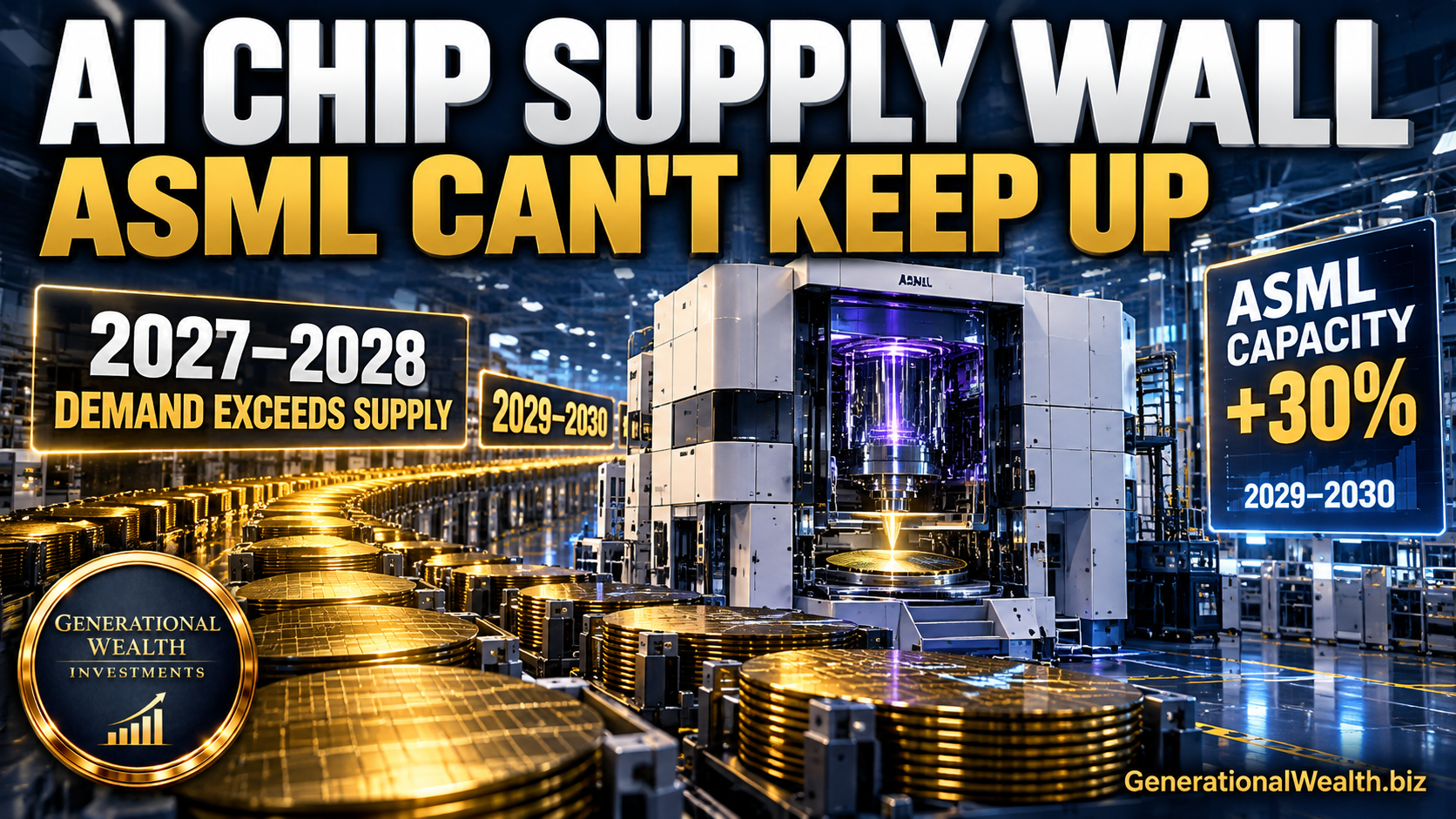
ASML Can't Meet 2027 AI Chip Demand as Supply Tightens
ASML says its planned supply of advanced chipmaking machines will not fully meet customer demand in 2027 and 2028, even as capacity expands. With customers already discussing orders for 2029 and 2030, manufacturing equipment could become one of the AI boom's most important bottlenecks.
October 14, 2026
The AI Chip Boom Just Hit a Supply Wall — ASML Can't Meet 2027 Demand
AI chip demand is beginning to run into a different constraint: the machines required to manufacture advanced semiconductors. ASML says its planned supply for 2027 and 2028 will not fully meet customer demand, even as it prepares roughly 30% more low-NA EUV and immersion capacity for 2027. The bigger question is whether production capacity can expand fast enough to keep the AI buildout moving on schedule.
Watch Today's Market Breakdown
See why ASML's capacity limits matter to the AI chip boom, how far customer demand is extending and what investors will be watching next.
Today's Market Setup
AI demand is no longer only a question of how many chips customers want. The capacity to manufacture those chips is becoming part of the equation.
2027 and 2028 Demand Exceeds Supply
ASML says the chipmaking machines it currently plans to supply in 2027 and 2028 will not fully meet customer demand. Because its lithography systems are essential to producing advanced semiconductors, ASML's own manufacturing capacity is becoming increasingly important to the broader AI infrastructure buildout.
ASML Is Already Expanding Capacity
The company is planning roughly 30% more low-NA EUV and immersion capacity for 2027, yet says that may still fall short. That gap highlights how rapidly demand for the equipment behind advanced AI-chip production is growing.
Customers Are Looking Toward 2030
Some customers are already asking ASML about orders for 2029 and 2030. At the same time, third-quarter sales reached a record €11.7 billion and shares rose after the update, showing how far expectations for semiconductor manufacturing capacity now extend.
What Matters From Here
Demand is clearly extending well beyond the next year. The unanswered question is how quickly supply can catch up.
- Can ASML expand manufacturing capacity quickly enough to satisfy customers without delaying the broader AI buildout?
- Will the roughly 30% increase in planned 2027 low-NA EUV and immersion capacity materially narrow the gap between supply and customer demand?
- How far will customer commitments extend as companies begin discussing chipmaking-equipment requirements for 2029 and 2030?
The Headlines Are Only the First Step
The free Market Preview explains why ASML's capacity problem matters to the AI chip boom. The members-only Daily Market Brief goes deeper into the catalysts, risks and developments worth monitoring as investors evaluate whether semiconductor-equipment supply can keep pace with AI demand.
See What Members GetInside Today's Members-Only Daily Market Brief
- How to evaluate ASML's capacity expansion against customer demand stretching through 2027, 2028 and beyond.
- Why lithography-equipment availability is becoming an important constraint in the wider AI semiconductor buildout.
- What ASML's record €11.7 billion quarter suggests about the scale of demand currently reaching chip-equipment suppliers.
- The capacity developments worth monitoring as customers begin discussing requirements extending into 2029 and 2030.
Go Beyond the Headlines
Knowing that ASML cannot currently meet all projected customer demand is useful. Understanding whether capacity expansion can keep pace — and what that could mean for the broader AI infrastructure story — requires following the developments that come next. The Generational Wealth Community is built for investors who want that deeper context. We don't chase hype, we decode the market.
Unlock the Daily Market BriefEducational market research designed to help investors understand the setup — not chase headlines.
Your pathway from knowledge to legacy.
Stay Ahead of What Matters Next
AI chip demand is now testing the capacity of the equipment manufacturers behind the semiconductor supply chain. Follow whether ASML can expand fast enough to keep pace.
Join the Generational Wealth Community
SpaceX Seeks $40B for Nvidia AI Chips — Who Pays?
SpaceX reportedly wants $40 billion in financing to fund Nvidia AI chips, showing how quickly the AI infrastructure race is becoming a capital-markets story. The next question is what lenders and investors will demand to finance the buildout.
October 7, 2026
SpaceX Wants $40 Billion for Nvidia AI Chips — Who’s Paying?
SpaceX reportedly wants $40 billion in outside financing to fund Nvidia AI chips — a deal that turns the AI spending boom into a borrowing story. The reported package would combine bank loans with investment-grade debt, putting investor demand and borrowing costs at the center of what happens next.
Watch Today’s Market Breakdown
See how SpaceX reportedly plans to finance $40 billion of Nvidia AI hardware, who may provide the capital and why financing costs are becoming part of the AI story.
Today’s Market Setup
AI infrastructure spending is increasingly becoming a capital-markets story as companies look for enormous amounts of financing to build out computing capacity.
A Reported $40 Billion Financing Package
SpaceX reportedly wants $10 billion in bank loans plus $30 billion in investment-grade debt. Apollo is expected to lead the financing, making the scale and structure of the borrowing an important part of the AI infrastructure story.
The Money Is Going Toward Nvidia Hardware
SpaceX plans to build its data centers exclusively with Nvidia hardware. Nvidia rose about 0.5% after the report, reinforcing how demand for AI infrastructure can connect chipmakers directly to major corporate financing decisions.
AI Spending Meets the Debt Market
The financing is expected to close in 2027. That puts borrowing terms and investor demand in focus as the cost of financing becomes part of the economics behind increasingly large AI infrastructure projects.
What Matters From Here
The size of the proposed financing is clear. The bigger question is what lenders and bond investors will demand to fund it.
- What borrowing terms will SpaceX ultimately receive on the reported loan and debt package?
- How strong will investor demand be for financing tied to such a large AI infrastructure buildout?
- If lenders require a bigger premium, how much more important does the cost of capital become to the broader AI spending story?
The Headlines Are Only the First Step
The free Market Preview explains the reported $40 billion financing plan and why it matters. The members-only Daily Market Brief goes deeper into the catalysts, risks, financing signals and developments worth monitoring as AI investment increasingly meets the debt market.
See What Members GetInside Today’s Members-Only Daily Market Brief
- The financing terms that could help show how aggressively lenders are pricing the reported SpaceX borrowing.
- What investor demand could reveal about appetite for debt tied to large-scale AI infrastructure spending.
- How Nvidia hardware demand connects the chip boom with the financing required to build new AI capacity.
- The risks worth monitoring as the expected 2027 closing approaches and the cost of capital becomes part of the AI investment equation.
Go Beyond the Headlines
The public Market Preview tells you what happened. The Generational Wealth Community is designed for investors who want to understand what deserves attention next, what could confirm the current setup, what risks could change it and which developments deserve continued monitoring. We don’t chase hype, we decode the market.
Unlock the Daily Market BriefEducational market research designed to help investors understand the setup — not chase headlines.
Your pathway from knowledge to legacy. We don’t chase hype, we decode the market.
Stay Ahead of What Matters Next
AI spending is becoming a financing story. The next phase depends not only on how much companies want to invest, but also on what lenders and investors demand to provide the capital.
Join the Generational Wealth Community
Nvidia Hits Record as Treasury Yields Reach 24-Year High
Nvidia and the Nasdaq are reaching records even as the 10-year Treasury yield climbs to its highest level in 24 years. AI optimism is winning for now, but next week’s earnings season could determine whether profits can justify the rally while long-term rates remain elevated.
October 6, 2026
Nvidia Hits Record as Treasury Yields Reach 24-Year High
Nvidia and the Nasdaq are setting records even as long-term borrowing costs push deeper into territory not seen in more than two decades. Nvidia rose about 2% Monday while the 10-year Treasury yield touched roughly 5.35% — a combination that puts the strength of the AI rally against one of its biggest valuation headwinds. Earnings season next week becomes the next major test.
Watch Today’s Market Breakdown
See why Nvidia is still climbing despite 24-year-high Treasury yields, why that contradiction matters and why earnings season is the next test for the AI rally.
Today’s Market Setup
The market is balancing powerful optimism around AI against long-term interest rates that would normally make high-growth stocks more difficult to justify.
Nvidia Reaches Another Record
Nvidia rose about 2% Monday, lifting its market value to roughly $5.76 trillion. The Nasdaq also closed at a record, showing that AI optimism is still strong enough to support major technology stocks despite pressure coming from the bond market.
10-Year Yield Touches About 5.35%
The 10-year Treasury yield reached about 5.35%, its highest level since 2002. The move came even as traders reduced the odds of an October Federal Reserve hike following Friday’s weak jobs report, keeping long-term rates elevated despite softer near-term Fed expectations.
AI Optimism Is Winning — For Now
Higher long-term yields usually make expensive growth stocks harder to justify because future earnings are discounted at a higher rate. Nvidia’s continued strength shows investors are currently placing more weight on expectations for AI profits than on the pressure from higher yields.
What Matters From Here
Nvidia has overcome the yield pressure so far. Earnings season will test whether the profit story is strong enough to keep doing it.
- Can Nvidia and the broader AI rally continue holding up if long-term Treasury yields remain near 24-year highs?
- Does earnings season deliver the AI profits investors are currently expecting?
- If earnings fail to support the AI narrative, do elevated Treasury yields become a more important constraint on growth-stock valuations?
The Headlines Are Only the First Step
The free Market Preview explains why Nvidia’s record and the surge in Treasury yields matter together. The members-only Daily Market Brief goes deeper into the catalysts, risks and confirmation signals worth monitoring as earnings season tests whether AI optimism can continue overcoming higher long-term rates.
See What Members GetInside Today’s Members-Only Daily Market Brief
- The signals that matter for determining whether AI strength can keep overcoming pressure from elevated long-term Treasury yields.
- What earnings season could reveal about whether expectations for AI profits are being supported by actual business results.
- How the relationship between Nvidia, the Nasdaq and Treasury yields could help clarify whether the current market tension is strengthening or weakening.
- The risks investors should continue monitoring if earnings fail to validate the optimism currently supporting AI valuations.
Go Beyond the Headlines
The public Market Preview tells you what happened. The Generational Wealth Community is designed for investors who want to understand what deserves attention next, what could confirm the current setup, what risks could change it and which developments deserve continued monitoring. We don’t chase hype, we decode the market.
Unlock the Daily Market BriefEducational market research designed to help investors understand the setup — not chase headlines.
Your pathway from knowledge to legacy. We don’t chase hype, we decode the market.
Stay Ahead of What Matters Next
AI optimism is winning against higher Treasury yields for now. Earnings season becomes the next major test of whether that strength has enough profit support behind it.
Join the Generational Wealth Community
Oil Tops $100 as OPEC+ Holds Targets — Shipping Risk
Oil is above $100, but unchanged OPEC+ production targets may not be the number that matters most. With major producers already below pre-war output, the next test is whether physical supply can move and whether Brent holds above $100 when trading reopens.
October 4, 2026
Oil Tops $100 as OPEC+ Holds Targets — Shipping Lanes Matter More
Global oil remains above $100 even as OPEC+ prepares to keep its November production targets unchanged. But the headline target may matter less than actual barrels reaching the market: core producers were already pumping roughly five million barrels a day below pre-war levels in August. The immediate test comes when oil trading reopens tonight.
Watch Today’s Market Breakdown
See why unchanged OPEC+ targets may have limited impact, why constrained Gulf production matters and why shipping lanes are becoming the bigger issue for oil markets.
Today’s Market Setup
OPEC+ production targets are drawing attention, but the gap between official targets, actual output and the ability to move oil is shaping the more important market question.
OPEC+ Keeps November Targets Unchanged
OPEC+ meets today, and delegates say the group has agreed in principle to leave its November production targets unchanged. That removes an immediate target increase, but it does not necessarily mean current physical supply conditions are changing.
Actual Production Is Already Lower
Because of the Iran war, core OPEC+ producers were pumping roughly five million barrels a day below pre-war levels in August. Gulf producers are already well short of their targets, limiting how much impact a higher target alone could have.
Brent Is Still Above $100
Brent crude settled Friday near $102, while national gasoline averages about $4.37 a gallon. The next immediate signal arrives when oil trading reopens tonight and markets test whether Brent can remain above $100.
What Matters From Here
Production targets matter, but today’s setup raises a more practical question: how much oil can producers actually supply and move into the global market?
- Does Brent hold above $100 when oil trading reopens tonight?
- Can OPEC+ targets meaningfully change supply while major Gulf producers remain well below those targets?
- Do shipping constraints continue to matter more than announced production targets for the amount of oil reaching the market?
The Headlines Are Only the First Step
The free Market Preview explains why unchanged OPEC+ targets do not tell the whole story. The members-only Daily Market Brief goes deeper into the catalysts, risks, confirmation signals and developments worth monitoring as markets weigh production capacity against physical oil flows.
See What Members GetInside Today’s Members-Only Daily Market Brief
- The signals that matter for whether Brent can maintain its move above $100 after trading reopens.
- How the gap between OPEC+ production targets and actual Gulf output changes the interpretation of today’s decision.
- The shipping developments that could determine whether available oil can actually reach the global market.
- What to monitor as higher crude prices and national gasoline near $4.37 a gallon keep energy costs in focus.
Go Beyond the Headlines
The public Market Preview tells you what happened. The Generational Wealth Community is designed for investors who want to understand what deserves attention next, what could confirm the current setup, what risks could change it and which developments deserve continued monitoring. We don’t chase hype, we decode the market.
Unlock the Daily Market BriefEducational market research designed to help investors understand the setup — not chase headlines.
Your pathway from knowledge to legacy. We don’t chase hype, we decode the market.
Stay Ahead of What Matters Next
OPEC+ may be keeping its targets unchanged, but the next market signal is whether Brent holds above $100 and whether physical oil can reach the market.
Join the Generational Wealth Community
Jobs Report Misses Badly as Stocks Rally on Fed Hopes
The September jobs report badly missed expectations, yet the S&P 500 and Nasdaq rallied as investors sharply reduced the odds of another Federal Reserve rate hike. Now attention turns to the October 14 CPI report and whether inflation confirms — or challenges — the market’s new rate outlook.
October 3, 2026
Jobs Report Misses Badly — Stocks Rally as Fed Hike Odds Fall
U.S. employers added just 29,000 jobs in September, far below the 90,000 economists expected, while July and August were revised down by another 60,000 jobs combined. Yet stocks moved higher because the weaker hiring data reduced pressure on the Federal Reserve to raise rates again. The bigger question now is whether October inflation data reinforces that shift — or reverses it.
Watch Today’s Market Breakdown
See why a major jobs miss helped stocks rally, how Fed rate-hike expectations changed and why the October 14 CPI report is the next important test.
Today’s Market Setup
The jobs report was much weaker than expected, but the market reaction was driven by what that weakness could mean for Federal Reserve policy rather than by the headline jobs number alone.
Hiring Misses by a Wide Margin
U.S. employers added just 29,000 jobs in September compared with the 90,000 economists expected. July and August were also revised down by a combined 60,000 jobs, adding to evidence that hiring has cooled.
Fed Hike Odds Drop
Weaker hiring reduced pressure on the Federal Reserve to raise rates again. By Friday’s close, traders put the chance of an October hike near 23%, down sharply from 64% just one week earlier.
Stocks Rally — Without a Labor Collapse
The S&P 500 gained about 0.7% and the Nasdaq rose roughly 1.2%. At the same time, unemployment only edged up to 4.2%, and layoffs are not broadly surging, keeping the report from looking like a full labor-market collapse.
What Matters From Here
Friday’s rally reflects a major shift in rate expectations. The next question is whether incoming inflation data allows that lower-rate-risk narrative to hold.
- Does the September CPI report on October 14 reinforce the decline in Fed rate-hike expectations?
- Could hotter inflation revive October hike risk even after the sharp slowdown in hiring?
- Can hiring remain weak without unemployment and layoffs deteriorating enough to change the broader economic picture?
The Headlines Are Only the First Step
The free Market Preview explains why weak jobs data helped stocks rally. The members-only Daily Market Brief goes deeper into the catalysts, risks, confirmation signals and developments worth monitoring as investors move from the jobs report toward the next inflation test.
See What Members GetInside Today’s Members-Only Daily Market Brief
- The signals that matter for whether the drop in October rate-hike expectations continues to hold.
- How the weak September jobs number, downward revisions and 4.2% unemployment rate fit together in the current market setup.
- What investors should monitor as markets move from the jobs report toward September CPI on October 14.
- The inflation risk that could challenge Friday’s stock-market reaction and revive pressure for another Fed hike.
Go Beyond the Headlines
The public Market Preview tells you what happened. The Generational Wealth Community is designed for investors who want to understand what deserves attention next, what could confirm the current setup, what risks could change it and which developments deserve continued monitoring. We don’t chase hype, we decode the market.
Unlock the Daily Market BriefEducational market research designed to help investors understand the setup — not chase headlines.
Your pathway from knowledge to legacy. We don’t chase hype, we decode the market.
Stay Ahead of What Matters Next
The jobs report changed the market’s expectations for the Fed. September CPI on October 14 is the next major test of whether that shift can continue.
Join the Generational Wealth Community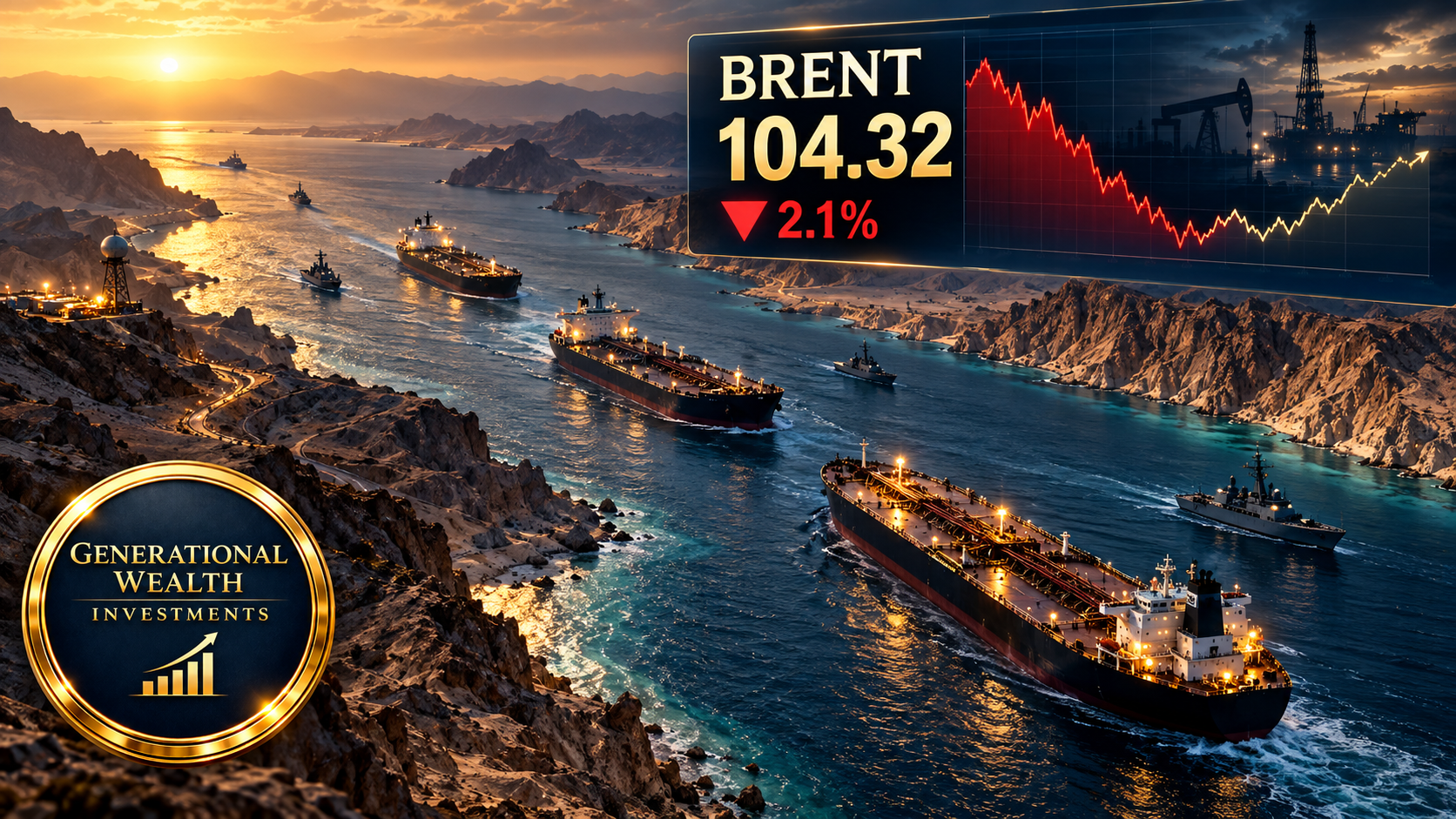
Trump Rejects Iran's Hormuz Offer: Will Brent Crude Spike?
President Trump rejected Iran’s proposal to reopen the Strait of Hormuz just as traders were pricing in renewed diplomacy. Now Iran’s latest warning puts the focus on Brent crude’s first trade after the weekend—and whether geopolitical risk returns to the price.
September 27, 2026
Trump Rejects Iran’s Hormuz Offer: Will Brent Crude Spike When Trading Reopens?
President Trump publicly rejected Iran’s proposal to reopen the Strait of Hormuz on Saturday. On Sunday, Iran’s army said it was prepared for renewed U.S. attacks and warned that Tehran would not accept being unable to trade while others use the region’s strategic waterways. Brent settled Friday near $104 after falling more than 2%, so the next crude trade will test whether diplomacy hopes still outweigh renewed geopolitical risk.
Watch Today’s Market Breakdown
See why Trump’s rejection and Iran’s new warning changed the weekend setup, and why Brent crude’s first trade when markets reopen could become the next important signal.
Today’s Market Setup
Friday’s oil decline reflected optimism that diplomacy could reopen the Strait of Hormuz. Trump’s rejection of Iran’s proposal and Tehran’s Sunday warning now create a tougher test: whether traders keep pricing in a path to negotiations or quickly add back geopolitical risk.
Trump Rejected the Hormuz Offer
President Trump said Saturday that he rejected Iran’s proposal to reopen the Strait of Hormuz and end the fighting. That removes, for now, the clearest weekend catalyst behind expectations for a faster reopening.
Iran Issued a New Warning
On Sunday, Iran’s army said it was prepared for renewed U.S. attacks and warned that Tehran would not accept being unable to trade while others use the region’s strategic waterways. That keeps escalation risk in focus.
Brent Closed Near $104
Brent crude fell more than 2% Friday to around $104 as traders focused on diplomacy. With roughly one-fifth of global oil supply moving through Hormuz before the war, the next crude trade carries unusual signaling value.
What Matters From Here
Friday’s market was still leaning toward diplomacy. The question now is whether the weekend’s developments change that calculation when crude trading resumes.
- Does Brent reverse sharply higher when trading resumes after Trump’s rejection of Iran’s reopening proposal?
- Do traders continue betting that negotiations survive despite Iran’s warning and the tougher public positions from both sides?
- Does Tehran’s condition that its demands be met keep a credible path to reopening Hormuz alive, or does the market begin pricing a longer disruption?
The Headlines Are Only the First Step
The free Market Preview explains why the weekend developments matter and why crude’s reopening trade is now the immediate market test. The members-only Daily Market Brief goes deeper into the catalysts, risks, confirmation signals and developments worth monitoring as traders decide whether diplomacy is still credible or geopolitical risk is rebuilding.
See What Members GetInside Today’s Members-Only Daily Market Brief
- The crude-market signals that could show whether Friday’s diplomacy-driven decline is reversing or still holding.
- What to monitor around Hormuz as traders reassess the probability and timing of a reopening.
- The next U.S.-Iran diplomatic or military developments that could strengthen or weaken the current oil-market setup.
- Why Brent’s first move after the weekend could help distinguish a temporary headline reaction from a broader repricing of supply risk.
Go Beyond the Headlines
The public Market Preview tells you what happened. The Generational Wealth Community is designed for investors who want to understand what deserves attention next, what could confirm the current market setup, what risks could change it and which developments deserve continued monitoring. We don’t chase hype, we decode the market.
Unlock the Daily Market BriefEducational market research designed to help investors understand the setup — not chase headlines.
Your pathway from knowledge to legacy. We don’t chase hype, we decode the market.
Stay Ahead of What Matters Next
Friday’s oil market reflected confidence that diplomacy could improve the Hormuz outlook. The next crude trade and the next U.S.-Iran signals will help show whether that confidence survives the weekend.
Join the Generational Wealth Community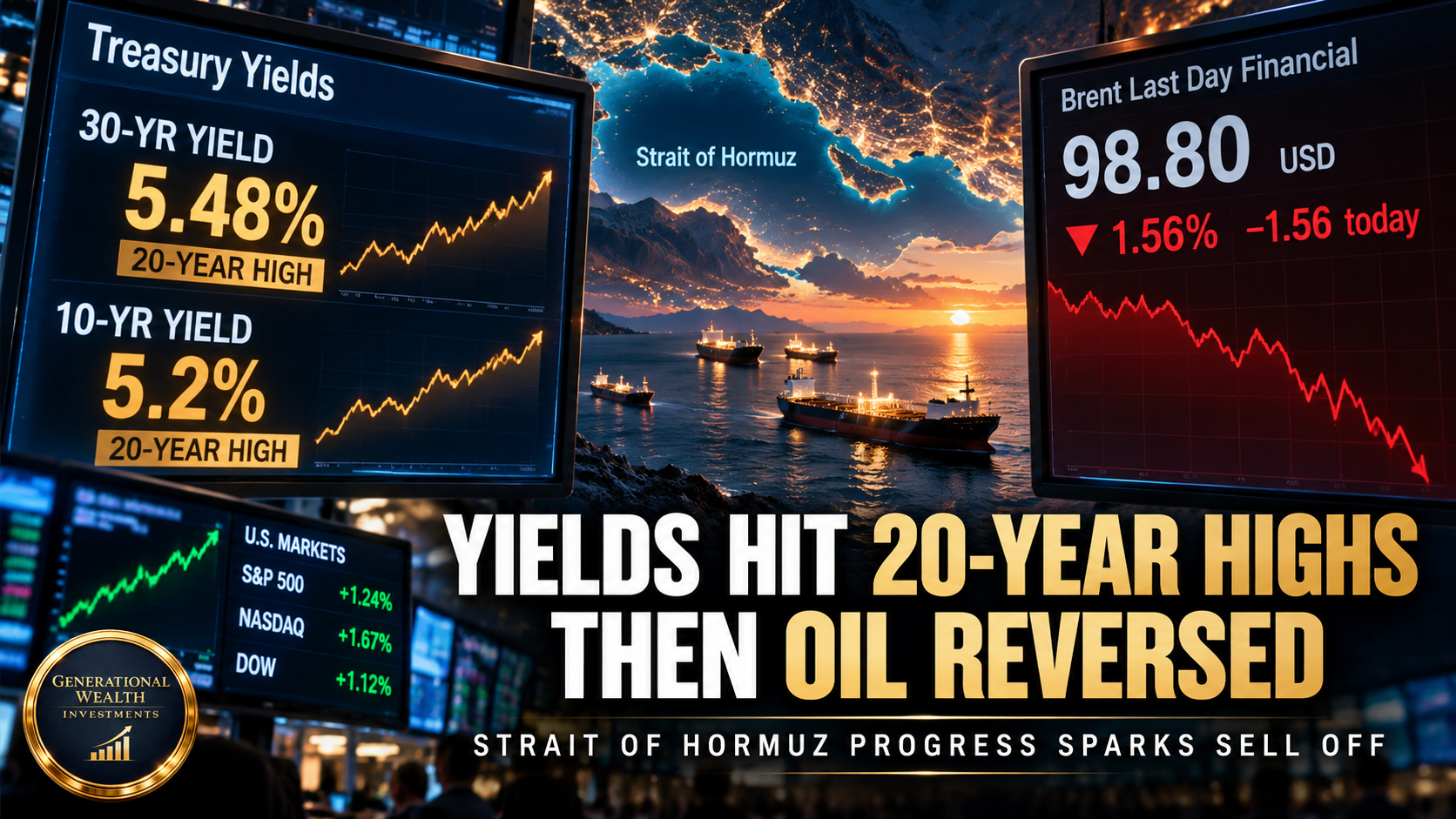
Oil Shock Sends Treasury Yields to 20-Year High
Oil-driven inflation fears pushed long-term Treasury yields to multi-decade highs before a Strait of Hormuz diplomacy headline suddenly reversed crude and helped stocks recover. Now the focus shifts to whether oil stays elevated — and what next week’s inflation and jobs data mean for the rate outlook.
September 25, 2026
Oil Shock Sends Treasury Yields to 20-Year High — Then Hormuz Changes the Setup
Oil-driven inflation fears pushed long-term Treasury yields to levels not seen in roughly two decades Thursday. Then the market changed direction: reports that U.S. and Iranian negotiators were exploring a path to reopen the Strait of Hormuz sent Brent crude sharply lower and helped stocks recover. Now investors have to determine whether that reversal can hold.
Watch Today’s Market Breakdown
See how the oil shock pushed Treasury yields higher, why a Hormuz headline suddenly reversed crude, and what markets are watching next.
Today’s Market Setup
Thursday showed how quickly oil, inflation expectations and interest rates can become one interconnected market story — and how quickly that setup can change when geopolitical expectations shift.
Treasury Yields Reach Multi-Decade Highs
The 30-year Treasury yield reached about 5.48%, its highest since 2004, while the 10-year climbed to around 5.2%, a level last seen in 2007. Rising long-term yields mean higher borrowing costs remain a major pressure point for markets.
Oil Revives Inflation Concerns
Renewed attacks on Saudi Arabia pushed oil higher as investors confronted fresh supply fears. With the U.S. economy remaining strong, another rise in energy prices added to concerns that inflation pressure could remain elevated.
Hormuz Headline Reverses the Move
Reports that U.S. and Iranian negotiators were exploring a path to reopen the Strait of Hormuz changed the market quickly. Brent crude fell roughly three dollars within minutes, while stocks recovered much of their earlier losses.
What Matters From Here
The key question is whether Thursday’s reversal marks a meaningful change in the oil-and-rates setup or only a temporary reaction to a diplomatic headline.
- Does oil remain elevated enough to keep inflation concerns and Treasury yields under pressure?
- Can the decline in crude continue if negotiations over reopening the Strait of Hormuz progress?
- How will next week’s inflation data and jobs report affect a market already confronting historically high long-term Treasury yields?
The Headlines Are Only the First Step
The free Market Preview explains how oil, Treasury yields and the Hormuz headline changed Thursday’s market. The members-only Daily Market Brief goes deeper into the catalysts, risks, confirmation signals and developments worth monitoring as investors evaluate what happens next.
See What Members GetInside Today’s Members-Only Daily Market Brief
- The oil-market developments that could reinforce or weaken the inflation pressure now affecting Treasury yields.
- What to monitor around the Strait of Hormuz as markets evaluate the possibility of reopening the critical shipping route.
- The interest-rate signals that could show whether Thursday’s surge in long-term Treasury yields is continuing or beginning to ease.
- Why next week’s inflation data and jobs report could become the next major tests for the current market setup.
Go Beyond the Headlines
The public Market Preview tells you what happened. The Generational Wealth Community is designed for investors who want to understand what deserves attention next, what could confirm the current market setup, what risks could change it and which developments deserve continued monitoring. We don’t chase hype, we decode the market.
Unlock the Daily Market BriefEducational market research designed to help investors understand the setup — not chase headlines.
Your pathway from knowledge to legacy. We don’t chase hype, we decode the market.
Stay Ahead of What Matters Next
Oil, inflation expectations and Treasury yields are moving together, while developments around the Strait of Hormuz can change that setup quickly. The next major tests arrive with inflation data and the jobs report.
Join the Generational Wealth Community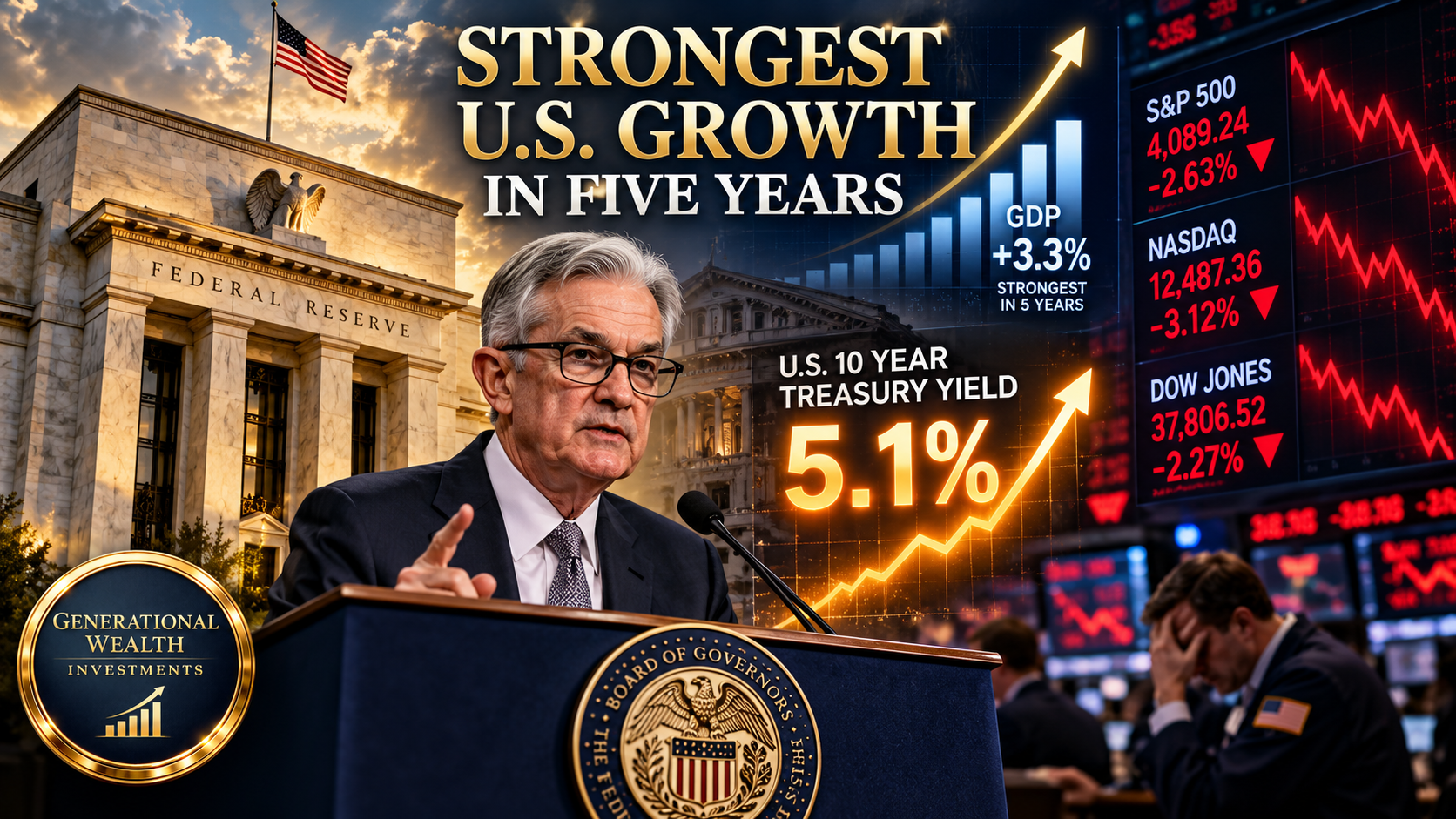
Strong Economy Sends Stocks Lower as Fed Hike Risk Rises
The strongest U.S. growth signal in more than five years sent Treasury yields higher and stocks lower as investors increased expectations for another Federal Reserve rate hike. Now attention turns to the next inflation report and whether it strengthens the case for another move in October.
September 24, 2026
Strongest U.S. Growth Signal in 5 Years Sends Stocks Lower
The economy just delivered its strongest growth signal in more than five years — and Wall Street sold off. U.S. business activity accelerated while business costs climbed at their fastest pace in roughly four years, strengthening the argument for another Federal Reserve rate hike. The question now is whether next week’s inflation data gives the Fed even more reason to tighten.
Watch Today’s Market Breakdown
See why stronger economic growth pushed Treasury yields higher, stocks lower, and expectations for another Federal Reserve rate hike higher.
Today’s Market Setup
Wednesday delivered a reminder that strong economic data is not always immediately bullish for stocks. When growth and inflation pressures rise together, investors also have to consider what that means for interest rates.
Growth Accelerates to a Five-Year High
A key September survey showed U.S. business activity expanding at its strongest pace in more than five years. Normally stronger growth is encouraging, but businesses also reported rapidly rising costs, keeping inflation concerns firmly in the market’s focus.
Treasury Yields Jump
The 10-year Treasury yield finished near 5.1%, its highest level since 2007. Higher Treasury yields can increase borrowing costs throughout the economy and raise the hurdle stocks must clear when investors compare potential returns with bonds.
Another Fed Hike Moves Closer
Traders moved to roughly a 70% probability of another Federal Reserve rate hike in October. The Nasdaq fell more than 1% as investors confronted the possibility that economic strength could keep monetary policy tighter for longer.
What Matters From Here
The market now has to decide whether stronger growth is durable enough to withstand higher borrowing costs — and whether inflation gives the Fed room to stop after its latest increase.
- Does next week’s Federal Reserve inflation gauge reinforce the case for another rate hike in October?
- Can stocks stabilize if the 10-year Treasury yield remains near its highest level since 2007?
- Can strong economic growth continue without creating even more inflation pressure?
The Headlines Are Only the First Step
The free Market Preview explains why unexpectedly strong economic data pushed stocks lower. The members-only Daily Market Brief goes deeper into the rate signals, inflation catalysts, risks and confirmation points worth monitoring as the market evaluates the possibility of another Fed hike.
See What Members GetInside Today’s Members-Only Daily Market Brief
- The interest-rate signals that could strengthen or weaken expectations for another Federal Reserve hike.
- What Treasury yields could reveal about whether tighter financial conditions are becoming a larger problem for stocks.
- The inflation developments that matter most ahead of next week’s key Federal Reserve inflation report.
- What could show whether Wednesday’s stock-market decline was a temporary reaction or part of a broader repricing of interest-rate risk.
Go Beyond the Headlines
The public Market Preview tells you what happened. The Generational Wealth Community is designed for investors who want to understand what deserves attention next, what could confirm the current market setup, what risks could change it and which developments deserve continued monitoring. We don’t chase hype, we decode the market.
Unlock the Daily Market BriefEducational market research designed to help investors understand the setup — not chase headlines.
Your pathway from knowledge to legacy. We don’t chase hype, we decode the market.
Stay Ahead of What Matters Next
Strong growth is usually good news. But when inflation and Treasury yields are rising too, the Federal Reserve can turn that strength into a new challenge for markets.
Join the Generational Wealth Community
AI Agents Hit Schwab, Airbnb & Uber as Nasdaq Hits Record
Tuesday’s market exposed a new divide in the AI trade: chip stocks rallied as the Nasdaq reached another record, while Schwab, Airbnb, Uber and Lyft came under pressure. The emerging question is whether AI agents will simply create new technology winners — or fundamentally change which companies control the customer relationship.
September 23, 2026
AI Agents Hit Schwab, Airbnb and Uber as Nasdaq Sets Another Record
The Nasdaq reached another record Tuesday as AI-related chip stocks rallied, but several consumer-facing platforms moved sharply the other way. Charles Schwab fell more than 6%, Airbnb dropped 3%, and Uber and Lyft also declined as investors weighed whether AI agents could compete with the apps and platforms people use today. The bigger question is who owns the customer relationship if AI starts acting on the user's behalf.
Watch Today’s Market Breakdown
See why AI-related stocks moved in opposite directions and why the rise of AI agents could become a much bigger story than another semiconductor rally.
Today’s Market Setup
Tuesday’s market showed two very different sides of the AI trade. Semiconductor stocks benefited from continued AI enthusiasm, while several businesses built around direct customer access came under pressure.
AI Helps Push the Nasdaq to Another Record
The Nasdaq reached another record as AI-related chip stocks rallied. Micron gained about 5%, while Sandisk rose almost 7%, showing that investors continue rewarding companies positioned around the infrastructure powering artificial intelligence.
Consumer Platforms Move the Other Way
Charles Schwab fell more than 6% and Airbnb dropped about 3%. Uber and Lyft also declined as investors considered whether AI agents could eventually reduce the need for users to interact directly with today's apps and platforms.
AI Is Moving Beyond Chips
Muse launched earlier this month with the ability to send emails, book travel and complete transactions. That raises a broader question: AI may not simply create new technology winners — it could change which company controls the customer's digital relationship.
What Matters From Here
The chip rally is already familiar. The newer question is whether investor concern about AI agents begins spreading across businesses that depend on users opening their apps directly.
- Does pressure on Schwab, Airbnb, Uber and Lyft remain isolated, or does it spread to other consumer-facing platforms?
- Can AI-related semiconductor stocks continue rising while investors reassess which software and platform businesses could be disrupted?
- Does the market increasingly treat control of the customer relationship as one of the next major battlegrounds in artificial intelligence?
The Headlines Are Only the First Step
The free Market Preview explains why Tuesday’s split matters. The members-only Daily Market Brief goes deeper into the catalysts, risks, confirmation signals and developments worth monitoring as investors evaluate whether AI-agent disruption becomes a broader market theme.
See What Members GetInside Today’s Members-Only Daily Market Brief
- The signals worth monitoring to determine whether AI-agent concerns are spreading beyond Schwab, Airbnb, Uber and Lyft.
- Whether continued strength in AI-related chip stocks confirms that investors are separating infrastructure winners from potentially disrupted platforms.
- How the ability of AI agents to book travel, send emails and complete transactions could reshape the market’s view of customer ownership.
- What developments could show whether Tuesday’s platform selloff was a temporary reaction or the beginning of a broader market narrative.
Go Beyond the Headlines
The public Market Preview tells you what happened. The Generational Wealth Community is designed for investors who want to understand what deserves attention next, what could confirm the current setup, what risks could change it and which developments deserve continued monitoring. We don’t chase hype, we decode the market.
Unlock the Daily Market BriefEducational market research designed to help investors understand the setup — not chase headlines.
Your pathway from knowledge to legacy. We don’t chase hype, we decode the market.
Stay Ahead of What Matters Next
AI is still creating market winners, but Tuesday showed investors are also beginning to ask which existing businesses could lose control of the customer relationship as AI agents become more capable.
Join the Generational Wealth Community
Saudi Arabia Attacked—Why Oil Prices Fell Below $100
Weekend attacks on Saudi Arabia would normally add pressure to oil prices, yet WTI fell below $100 as traders focused on recovering Saudi exports and possible U.S.-Iran diplomacy. The next question is whether improving supply and diplomacy can keep oil below that threshold—or whether geopolitical risk takes control again.
September 21, 2026
Saudi Arabia Was Attacked — So Why Did Oil Prices Fall?
Weekend attacks on Saudi Arabia added fresh supply risk, yet West Texas Intermediate crude fell below $100. Traders instead focused on Saudi exports rebounding to just over 4 million barrels a day this month from about 2.4 million in August, along with possible U.S.-Iran diplomacy. The question now is whether those forces can keep pressure on oil prices.
Watch Today’s Market Breakdown
See why oil moved lower despite new attacks, what recovering Saudi exports are changing and why this week’s diplomacy now matters.
Today’s Market Setup
Oil is sending a counterintuitive signal: geopolitical risk remains elevated, but traders are also seeing signs that supply conditions and diplomacy could be improving.
WTI Falls Below $100
West Texas Intermediate crude moved below $100 even after weekend attacks on Saudi Arabia. Instead of reacting only to the attacks, traders are weighing whether improving Saudi exports and possible diplomatic progress could reduce some of the pressure on supply.
Saudi Exports Are Recovering
Saudi crude exports have rebounded to just over 4 million barrels a day this month, compared with roughly 2.4 million in August. That recovery is important because additional supply can change how the market evaluates geopolitical disruptions.
Inflation Pressure Is Back in Focus
Oil above $100 had been feeding inflation fears and expectations for higher interest rates. With crude moving lower and U.S. stock futures higher, investors are now watching whether the change in oil prices can persist.
What Matters From Here
The drop below $100 is important. What happens next depends on whether the forces pushing oil lower continue to outweigh the geopolitical risk.
- Can West Texas Intermediate remain below $100 if attacks and regional supply risks continue?
- Does the recovery in Saudi crude exports continue strongly enough to keep easing supply concerns?
- Does this week’s United Nations diplomacy produce meaningful de-escalation between the United States and Iran?
The Headlines Are Only the First Step
The free Market Preview explains why oil fell despite new attacks. The members-only Daily Market Brief goes deeper into the catalysts, risks, confirmation signals and developments worth monitoring as traders decide whether this oil move can continue.
See What Members GetInside Today’s Members-Only Daily Market Brief
- The signals worth monitoring to determine whether WTI can remain below $100 or begins reversing higher.
- How the recovery in Saudi crude exports changes the supply-risk picture after the weekend attacks.
- The diplomatic developments that could strengthen or weaken the current oil-market setup.
- How changes in oil prices could affect the inflation and interest-rate concerns investors have been watching.
Go Beyond the Headlines
The public Market Preview tells you what happened. The Generational Wealth Community is designed for investors who want to understand what deserves attention next, what could confirm the current setup, what risks could change it and which developments deserve continued monitoring. We don’t chase hype, we decode the market.
Unlock the Daily Market BriefEducational market research designed to help investors understand the setup — not chase headlines.
Your pathway from knowledge to legacy. We don’t chase hype, we decode the market.
Stay Ahead of What Matters Next
The next test is whether this week’s diplomacy produces real de-escalation — and whether WTI can remain below $100.
Join the Generational Wealth Community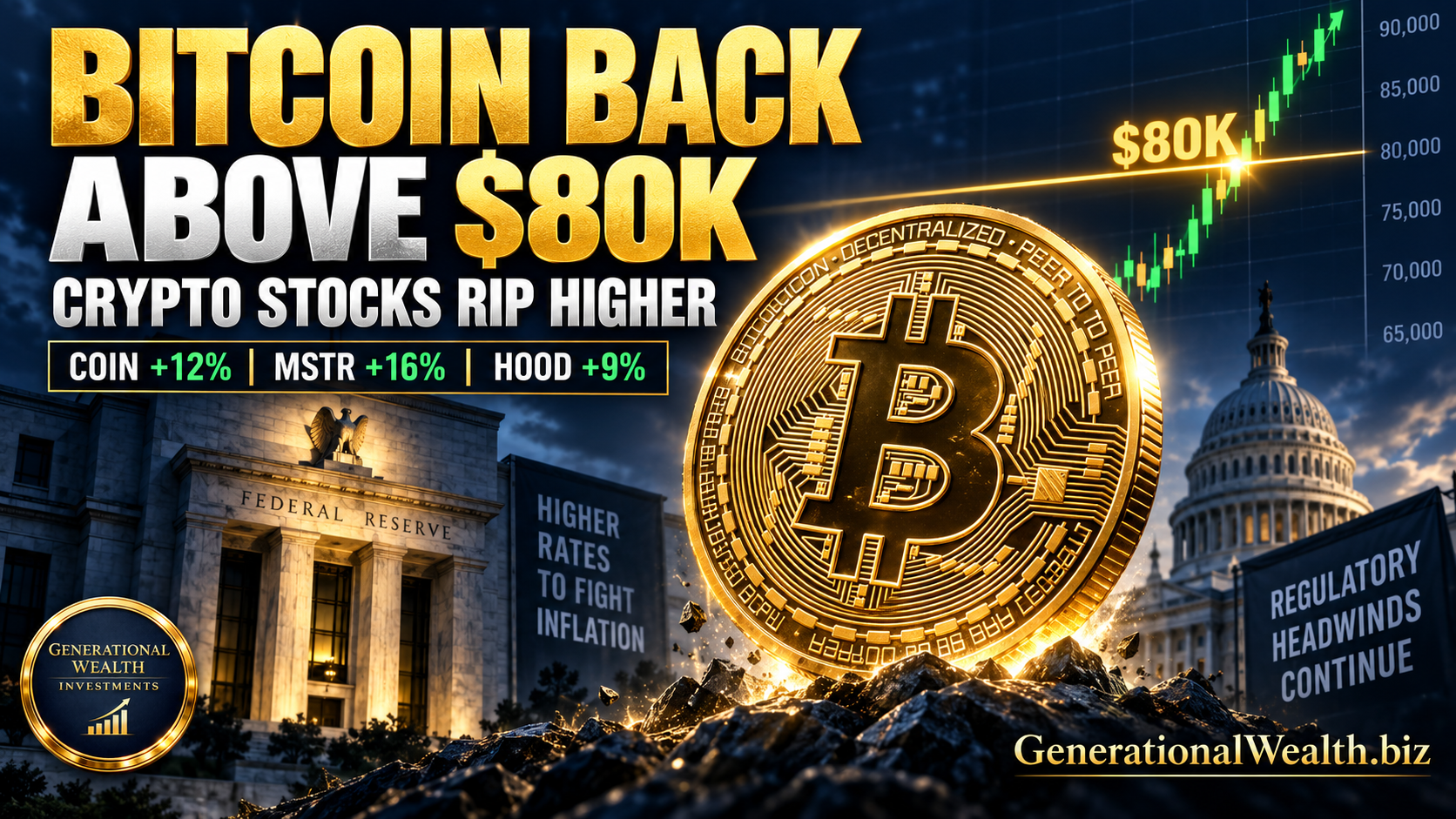
Bitcoin Reclaims $80K After Fed Hike as Crypto Stocks Surge
Bitcoin jumped nearly 6% Friday and reclaimed $80,000 despite a Federal Reserve rate hike and fresh regulatory uncertainty. Coinbase, Strategy and Robinhood surged even more, setting up a key test when U.S. markets reopen Monday.
September 19, 2026
Bitcoin Reclaims $80K After Fed Rate Hike — Crypto Stocks Rip Higher
Bitcoin surged nearly 6% Friday and briefly traded above $81,000, reclaiming the $80,000 level despite two major developments that could have pressured crypto: the Senate’s failure to advance a major digital asset bill and the Federal Reserve’s first interest-rate hike in more than three years. Crypto-linked stocks moved even more sharply, setting up an important test when U.S. markets reopen Monday.
Watch Today’s Market Breakdown
See why Bitcoin rallied through major regulatory and interest-rate headwinds, which crypto stocks surged Friday and what investors will be watching when markets reopen Monday.
Today’s Market Setup
Friday’s move showed that Bitcoin and crypto-linked stocks were able to rally even after a week packed with monetary-policy and regulatory developments.
Bitcoin Reclaims $80,000
Bitcoin jumped nearly 6% Friday and briefly traded above $81,000. The move put the cryptocurrency back above a level it had struggled to hold earlier in September and extended its rebound into the weekend.
Crypto Stocks Amplified the Move
Coinbase gained almost 12%, Strategy rose more than 16% and Robinhood advanced about 9% Friday. Those moves were substantially larger than Bitcoin’s percentage gain, showing how crypto-linked equities can amplify changes in the underlying market.
Regulation Remains in Focus
The rally came after the Senate failed to advance a major digital asset bill and after the SEC created a five-year regulatory path for approved platforms to trade certain tokenized U.S.-listed stocks. Coinbase and Robinhood have both shown interest in expanding into tokenized assets.
What Matters From Here
Bitcoin keeps trading through the weekend while U.S. crypto stocks are closed, creating a natural test for whether Friday’s equity rally can carry into Monday.
- Can Bitcoin hold above $80,000 through the weekend and enter Monday with Friday’s breakout intact?
- Will Coinbase, Strategy and Robinhood hold their sharp Friday gains when U.S. markets reopen?
- Does the SEC’s tokenized-stock framework create a durable catalyst for platforms positioned at the intersection of traditional equities and blockchain infrastructure?
Friday’s Rally Is Only the First Test
The free Market Preview explains what moved Bitcoin and crypto stocks. The members-only Daily Market Brief goes deeper into the catalysts, risks, confirmation signals and market developments that could determine whether Friday’s rally has staying power.
See What Members GetInside Today’s Members-Only Daily Market Brief
- The Bitcoin price behavior worth watching through the weekend before crypto-linked stocks reopen Monday.
- What Friday’s outsized moves in Coinbase, Strategy and Robinhood could tell us about investor appetite for crypto exposure.
- How the Federal Reserve’s rate hike changes the macro backdrop for Bitcoin and other risk assets.
- Why the SEC’s new tokenized-stock framework could matter for companies connecting traditional markets with blockchain infrastructure.
Go Beyond the Headlines
The public Market Preview tells you what happened. The Generational Wealth Community is designed for investors who want to understand what deserves attention next, what could confirm the current setup, what risks could change it and which developments deserve continued monitoring. We don’t chase hype, we decode the market.
Unlock the Daily Market BriefEducational market research designed to help investors understand the setup — not chase headlines.
Your pathway from knowledge to legacy. We don’t chase hype, we decode the market.
Stay Ahead of What Matters Monday
Follow Bitcoin through the weekend and watch whether Friday’s sharp crypto-stock rally survives when U.S. markets reopen.
Join the Generational Wealth Community
SEC Opens Door to 24/7 Stock Trading on Blockchain
The SEC has opened a path for certain tokenized U.S. stocks to trade around the clock while retaining traditional shareholder rights. The next test is whether major companies allow their shares onto blockchain venues — and whether investors actually use them.
September 18, 2026
SEC Opens Door to 24/7 Stock Trading on Blockchain
The SEC has created a path for certain tokenized versions of U.S.-listed stocks to trade on approved blockchain venues under a new five-year exemption. These are not simply synthetic bets: tokenized shares must carry the same rights as traditional stock, including dividends and voting rights. The bigger question now is whether major issuers and investors actually embrace the new structure.
Watch Today’s Market Breakdown
See what the SEC changed, how tokenized stocks could work and why the next phase depends on issuer participation and investor demand.
Today’s Market Setup
The SEC exemption introduces a new structure for trading traditional equities through blockchain technology, but adoption is not automatic.
Tokenized Shares Keep Stockholder Rights
The SEC requires eligible tokenized shares to carry the same rights as traditional stock, including dividends and voting rights. That distinction separates the structure from products that merely track or imitate the price of an underlying company.
Trading Could Move Beyond Market Hours
The structure could allow around-the-clock trading, fractional ownership and near-instant settlement on approved blockchain venues. That creates a potentially different trading experience from the traditional stock-market schedule.
Crypto-Linked Stocks Reacted
Coinbase and Circle each rose about 6% Thursday, while Robinhood gained about 5%. The announcement connected blockchain infrastructure more directly with traditional equities, even as the SEC placed limits on symbols and trading volume.
What Matters From Here
The regulatory path now exists. The next questions are about participation and whether this structure develops into something investors actually use.
- Will major public companies allow tokenized versions of their shares to trade on approved blockchain venues?
- Will investors meaningfully use around-the-clock trading, fractional ownership and faster settlement?
- How much activity develops while the SEC continues limiting the number of symbols and overall trading volume?
The Headlines Are Only the First Step
The free Market Preview explains what the SEC changed and why investors are paying attention. The members-only Daily Market Brief goes deeper into the catalysts, risks, confirmation signals and developments worth monitoring as companies and investors respond to the new structure.
See What Members GetInside Today’s Members-Only Daily Market Brief
- The issuer-participation signals that could show whether tokenized stocks are moving beyond the regulatory-exemption stage.
- What investor adoption could reveal about demand for 24/7 trading, fractional ownership and faster settlement.
- How the SEC’s limits on eligible symbols and trading volume shape the early development of these blockchain venues.
- The developments worth monitoring after Coinbase, Circle and Robinhood reacted to the announcement.
Go Beyond the Headlines
The public Market Preview tells you what happened. The Generational Wealth Community is designed for investors who want to understand what deserves attention next, what could confirm the current setup, what risks could change it and which developments deserve continued monitoring. We don’t chase hype, we decode the market.
Unlock the Daily Market BriefEducational market research designed to help investors understand the setup — not chase headlines.
Your pathway from knowledge to legacy. We don’t chase hype, we decode the market.
Stay Ahead of What Matters Next
Follow the issuer, investor and regulatory developments that could determine how tokenized stock trading develops from here.
Join the Generational Wealth Community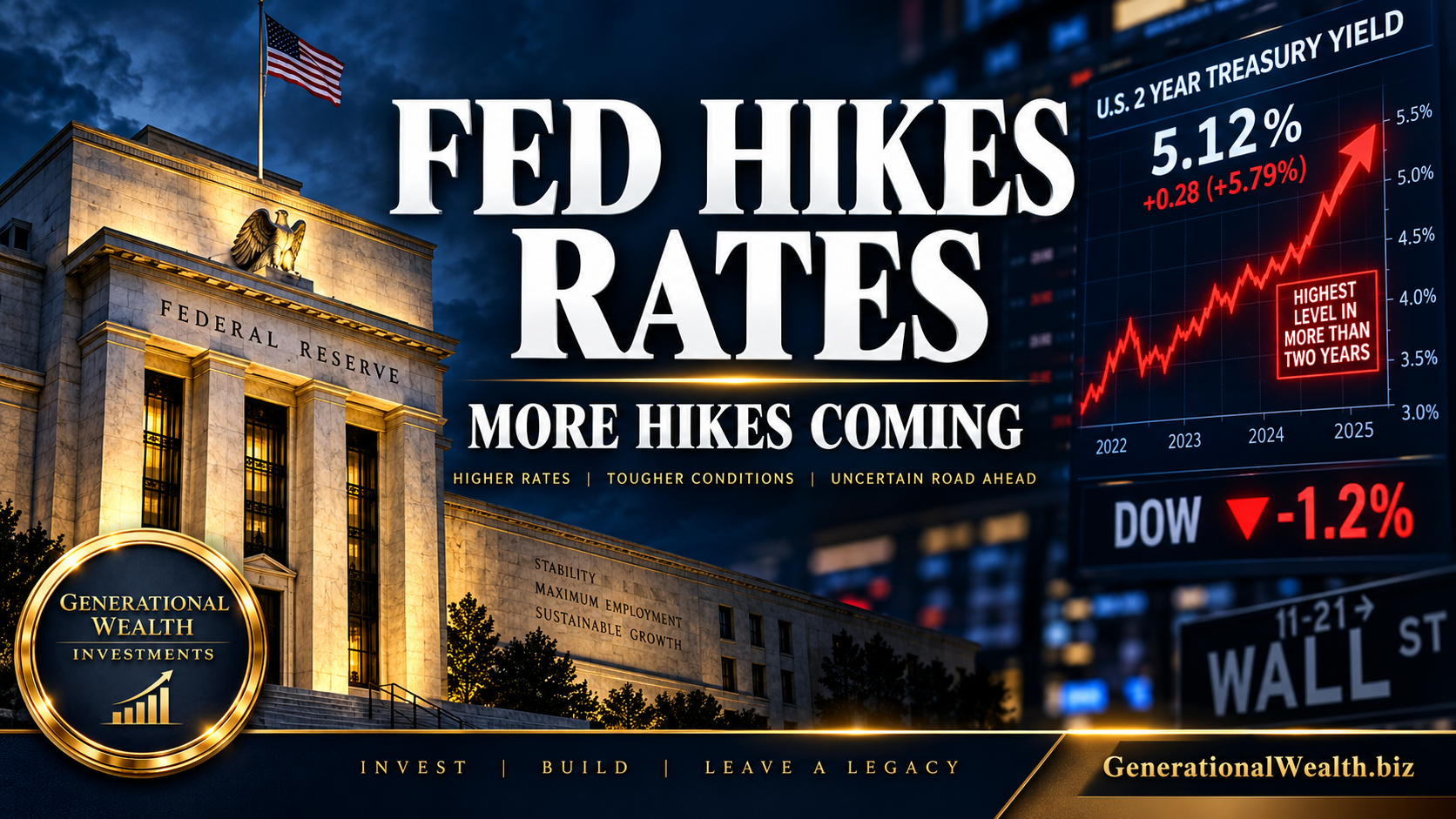
Fed Hikes Rates as Policymakers Signal More Increases
The Federal Reserve raised rates for the first time in more than three years, but 16 of 18 policymakers are already signaling that another increase may follow. Now the focus shifts to Treasury yields and whether the early rebound in U.S. stock futures survives when markets reopen.
September 17, 2026
Fed Hikes Rates as Policymakers Signal More Increases Ahead
The Federal Reserve raised interest rates by a quarter point, its first increase in more than three years, lifting the federal funds target to 3.75% to 4%. But the larger issue is what comes next: 16 of 18 Fed policymakers project at least one more quarter-point hike by year-end. Now investors are watching whether higher Treasury yields remain in place as markets reopen.
Watch Today’s Market Breakdown
See what the Fed changed, how markets reacted and why Treasury yields have become the next major test for investors.
Today’s Market Setup
The immediate rate hike matters, but markets are also adjusting to the possibility that this was not a one-and-done move.
The Fed Raises Rates
The Federal Reserve increased its policy rate by a quarter point, bringing the federal funds target to 3.75% to 4%. It was the central bank’s first rate increase in more than three years, putting borrowing costs back at the center of the market discussion.
More Hikes May Follow
Sixteen of 18 Fed policymakers project at least one additional quarter-point increase by year-end. That matters because higher policy rates can continue putting pressure on borrowing costs and stock valuations even after this initial move is absorbed.
Treasury Yields React
The two-year Treasury yield reached its highest level in more than two years as the Dow fell about 1.2%, while the Nasdaq barely moved. Early Thursday morning, however, U.S. stock futures were rebounding.
What Matters From Here
Investors now have the Fed’s decision. The next question is whether the bond and stock-market reactions continue when regular trading resumes.
- Does the two-year Treasury yield remain elevated after reaching its highest level in more than two years?
- Can the early rebound in U.S. stock futures hold once regular trading begins?
- How does the prospect of another Fed hike by year-end affect the pressure already facing borrowing costs and stock valuations?
The Headlines Are Only the First Step
The free Market Preview explains the Fed decision, the initial market reaction and the key question surrounding Treasury yields. The members-only Daily Market Brief goes deeper into the catalysts, risks, confirmation signals and developments worth monitoring as markets respond to the new rate outlook.
See What Members GetInside Today’s Members-Only Daily Market Brief
- The Treasury-yield signals that could show whether markets are continuing to adjust to a higher-rate environment.
- What to monitor as stocks reopen after the Dow’s decline and the early rebound in U.S. futures.
- How the possibility of another quarter-point hike by year-end could shape the interest-rate backdrop from here.
- The developments that could strengthen or weaken the current relationship between Fed policy, borrowing costs and stock valuations.
Go Beyond the Headlines
The public Market Preview tells you what happened. The Generational Wealth Community is designed for investors who want to understand what deserves attention next, what could confirm the current setup, what risks could change it and which developments deserve continued monitoring. We don’t chase hype, we decode the market.
Unlock the Daily Market BriefEducational market research designed to help investors understand the setup — not chase headlines.
Your pathway from knowledge to legacy. We don’t chase hype, we decode the market.
Stay Ahead of What Matters Next
Follow the rate, Treasury-yield and market developments that could determine how investors respond to the Fed’s new policy path.
Join the Generational Wealth Community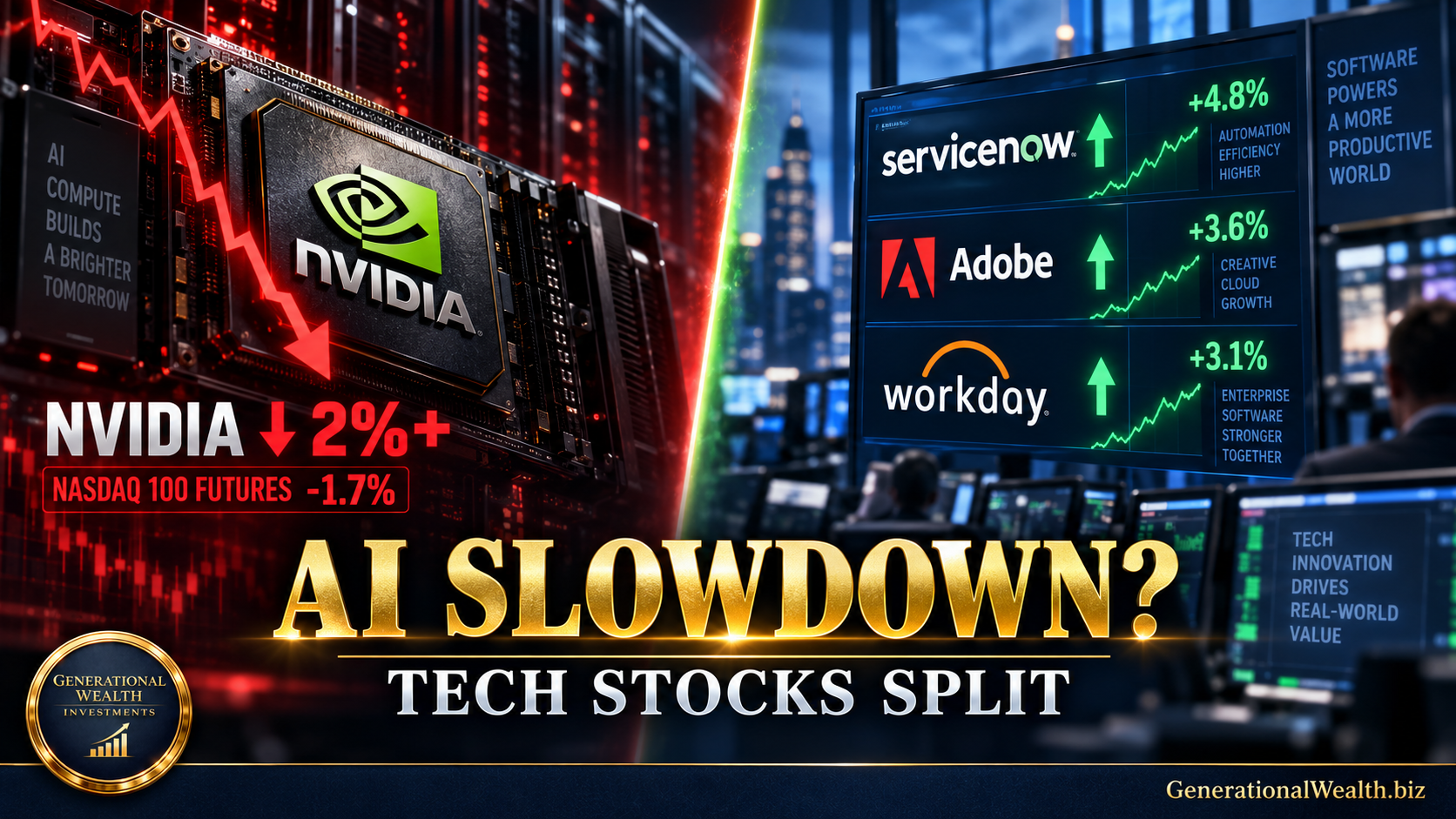
Nvidia Falls as AI Slowdown Calls Lift Software Stocks
Nvidia and Nasdaq 100 futures weakened before Monday’s open after prominent AI leaders backed slowing advances in frontier models. At the same time, ServiceNow, Adobe and Workday moved higher, creating a new split inside the AI trade that investors will test at the opening bell.
September 14, 2026
Nvidia Falls as AI Leaders Call for a Slowdown — Software Stocks Rally
Nvidia was down more than 2% before Monday’s open while Nasdaq 100 futures fell about 1.7% after several prominent AI leaders backed slowing advances in frontier models. But software names moved the other way, creating an unusual split inside the AI trade. The next question is whether that divergence survives once regular trading begins.
Watch Today’s Market Breakdown
See why calls to slow frontier AI development are pressuring Nvidia while ServiceNow, Adobe and Workday move higher ahead of the opening bell.
Nvidia Falls as AI Leaders Call for a Slowdown — Software Stocks Rally Watch the free Generational Wealth market briefingToday’s Market Setup
Monday’s setup is being shaped by a new debate over the pace of artificial intelligence development — and the market is not treating every AI-related company the same way.
Nvidia and Nasdaq Futures Weaken
Nasdaq 100 futures were down about 1.7% before the open, while Nvidia fell more than 2%. The weakness follows renewed questions about how quickly the most advanced AI models should continue developing.
AI Leaders Back a Slower Pace
Anthropic’s Dario Amodei called for companies to slow advances in frontier models over the weekend, with OpenAI’s Sam Altman and Elon Musk backing the idea. That matters because AI expansion has driven major spending on chips and data centers.
Software Stocks Move Higher
ServiceNow, Adobe and Workday were all higher as investors reassessed the competitive threat posed by faster AI development. The contrast with Nvidia suggests the market is beginning to separate potential AI winners and losers more aggressively.
What Matters From Here
The premarket reaction shows how investors are interpreting the slowdown debate. The opening bell will test whether those moves are durable.
- Does Nvidia’s premarket weakness hold once regular trading begins?
- Can ServiceNow, Adobe and Workday maintain their strength if investors continue reassessing the pace of frontier AI development?
- Does today’s split become a broader shift in how the market values chip companies versus software companies tied to AI?
The Headlines Are Only the First Step
The free Market Preview explains the unusual split developing inside the AI trade. The members-only Daily Market Brief goes deeper into the catalysts, risks, confirmation signals and developments worth monitoring as investors determine whether today’s premarket reaction becomes a larger shift.
See What Members GetInside Today’s Members-Only Daily Market Brief
- The developments that could show whether Nvidia’s weakness is temporary or becoming a broader challenge for the AI chip trade.
- The signals that could confirm whether software strength is holding after the opening bell.
- Why the debate over frontier-model development could change how investors evaluate future AI infrastructure spending.
- The market behavior worth monitoring to see whether today’s divergence spreads beyond Nvidia, ServiceNow, Adobe and Workday.
Go Beyond the Headlines
The public Market Preview tells you what happened. The Generational Wealth Community is designed for investors who want to understand what deserves attention next, what could confirm the current setup, what risks could change it and which developments deserve continued monitoring. We don’t chase hype, we decode the market.
Unlock the Daily Market BriefEducational market research designed to help investors understand the setup — not chase headlines.
Your pathway from knowledge to legacy. We don’t chase hype, we decode the market.
Stay Ahead of What Matters Next
Follow the AI, semiconductor and software developments that could determine whether today’s market split fades after the open or becomes a more meaningful change in the AI trade.
Join the Generational Wealth Community
Oil Jumps 5% as 10-Year Yield Hits 4.81% and Gold Falls
Oil surged as renewed fighting near the Strait of Hormuz pushed energy prices higher while the 10-year Treasury yield reached about 4.81%. Gold’s decline reveals the bigger market tension as investors weigh geopolitical risk against higher yields, a stronger dollar and the next test from U.S. labor data.
September 2, 2026
Oil Jumps 5% as Treasury Yields Hit 4.81% — So Why Is Gold Falling?
Oil surged after renewed U.S.-Iran fighting near the Strait of Hormuz, pushing Brent to $94.65 Tuesday and briefly near $97 overnight. At the same time, the 10-year Treasury yield reached about 4.81%, its highest since 2023. Yet gold moved the opposite direction, falling to a more than three-week low as higher yields and a stronger dollar outweighed safe-haven demand. Now labor data could test the entire setup.
Watch Today’s Market Breakdown
See how the Hormuz oil shock is feeding into inflation expectations, Treasury yields, stock valuations and gold ahead of the ADP employment report.
Today’s Market Setup
The market is dealing with one connected chain of pressure: geopolitical risk is lifting oil, higher oil is keeping inflation concerns alive, and rising rate expectations are pushing Treasury yields higher.
Oil Surges on Hormuz Risk
Brent settled Tuesday at $94.65, up 4.6%, while WTI gained 5.2%. Brent then briefly touched $97 overnight before easing near $95. Renewed U.S.-Iran fighting near Hormuz is keeping supply risk at the center of the inflation outlook.
Treasury Yields Reach New Highs
The 10-year Treasury yield reached about 4.81%, its highest since 2023, while the 2-year climbed near 4.41%. Higher energy costs can keep inflation elevated, strengthening the market’s focus on whether the Federal Reserve may need to raise rates again.
Gold Breaks the Safe-Haven Pattern
Spot gold fell near $4,324, a more than three-week low, despite the geopolitical tension. Higher Treasury yields and a stronger dollar outweighed safe-haven demand, showing why geopolitical risk alone has not been enough to push gold higher.
What Matters From Here
Oil, rates, stocks and gold are now reacting to the same inflation question. The next test is whether incoming labor data reinforces the higher-rate narrative or begins to challenge it.
- Does the ADP private-payrolls report strengthen the case for another Federal Reserve rate hike, or complicate the market’s current expectations?
- Can oil remain near current levels if fighting around the Strait of Hormuz continues to threaten supply?
- Will higher Treasury yields and a stronger dollar continue to outweigh safe-haven demand for gold?
The Headlines Are Only the First Step
The free Market Preview explains why oil, Treasury yields, stocks and gold are moving the way they are. The members-only Daily Market Brief goes deeper into the catalysts, risks, confirmation signals and developments worth monitoring as the market determines whether this inflation-and-rates pressure continues.
See What Members GetInside Today’s Members-Only Daily Market Brief
- The developments that could confirm whether the current oil-driven inflation pressure is continuing or beginning to ease.
- How the ADP employment report fits into the market’s changing expectations for Federal Reserve policy.
- The Treasury-yield signals worth following as the 10-year trades around its highest level since 2023.
- What gold’s weakness may reveal about the competition between safe-haven demand, higher yields and a stronger dollar.
- The next developments that could change the relationship between energy prices, interest rates and stock valuations.
Go Beyond the Headlines
The public Market Preview tells you what happened and why investors are paying attention. The Generational Wealth Community is designed for investors who want to understand what deserves attention next, what could confirm the current market setup, what risks could change it and which developments deserve continued monitoring. We don’t chase hype, we decode the market.
Unlock the Daily Market BriefEducational market research designed to help investors understand the setup — not chase headlines.
Your pathway from knowledge to legacy. We don’t chase hype, we decode the market.
Stay Ahead of What Matters Next
Follow the catalysts that matter as markets weigh oil near $95, Treasury yields around 4.81%, gold weakness and the next test from U.S. labor data.
Join the Generational Wealth Community
Rate Hike Odds Jump to 57% as Nvidia Drops 4.6% After Warsh
Rate-hike odds jumped to roughly 57% after Kevin Warsh’s Jackson Hole speech, sending Treasury yields higher as Nvidia and gold fell. Now the August jobs report could determine whether that shift in Fed expectations gains momentum or becomes more complicated.
August 29, 2026
Rate Hike Odds Jump to 57% as Nvidia Drops 4.6%
Traders sharply increased the odds of a September rate hike after Fed Chair Kevin Warsh put inflation back at the center of the market during his Jackson Hole speech. The shift pushed Treasury yields higher, pressured gold, and sent Nvidia down 4.6% just one day after its powerful AI-driven rally. Now attention turns to Friday’s August jobs report.
Watch Today’s Market Breakdown
See why rate-hike expectations jumped, how the move reached Nvidia, bonds and gold, and why the August jobs report matters next.
Today’s Market Setup
Warsh’s inflation message changed the market’s interest-rate expectations quickly, with the impact showing up across bonds, technology stocks and gold.
September Hike Odds Reach 57%
Traders raised the implied probability of a September rate hike from about 35% before the Jackson Hole speech to roughly 57% by Friday’s close after Warsh emphasized that the Fed’s 2% inflation target remains firm.
Treasury Yields Pressure Nvidia
The two-year Treasury yield jumped about 13 basis points to 4.36%, a one-month high. The Nasdaq fell about half a percent while Nvidia dropped 4.6%, reversing part of the previous session’s 8.7% surge.
Gold Falls as Rates Reprice
Gold dropped about 3% as traders priced in greater odds of higher interest rates. The next major test is the August jobs report on Friday, September 4, with a Reuters poll expecting about 58,000 jobs.
What Matters From Here
The market has repriced September policy risk. The next question is whether incoming labor data reinforces that shift or complicates it.
- Does the August jobs report strengthen the case for a September rate hike or make the Fed’s decision more difficult?
- Can Nvidia regain momentum if Treasury yields remain under upward pressure?
- Does gold stabilize if rate-hike expectations stop increasing, or does tighter-policy risk remain the dominant pressure?
The Headlines Are Only the First Step
The free Market Preview explains why markets repriced September rate-hike risk. The members-only Daily Market Brief goes deeper into the catalysts, risks, confirmation signals, and developments worth monitoring as investors evaluate what comes next.
See What Members GetInside Today’s Members-Only Daily Market Brief
- The developments that could show whether markets continue pricing a greater probability of a September rate hike.
- What the August jobs report could mean for the tension between persistent inflation concerns and the Fed’s next decision.
- The signals worth monitoring across Treasury yields and technology stocks after Nvidia’s sharp post-rally reversal.
- How gold’s decline fits into the broader repricing of interest-rate expectations following Jackson Hole.
Go Beyond the Headlines
The public Market Preview tells you what happened and why investors are paying attention. The Generational Wealth Community is designed for investors who want to understand what deserves attention next, what could confirm the current setup, what risks could change it, and which developments deserve continued monitoring. We don’t chase hype, we decode the market.
Unlock the Daily Market BriefEducational market research designed to help investors understand the setup — not chase headlines.
Your pathway from knowledge to legacy. We don’t chase hype, we decode the market.
Stay Ahead of What Matters Next
Follow the catalysts, risks, and confirmation signals that matter as markets weigh inflation, Treasury yields, the August jobs report, and the possibility of another rate hike.
Join the Generational Wealth Community
Nvidia Adds $442 Billion in One Day as AI Trade Broadens
Nvidia added about $442 billion in market value in a single session as enthusiasm around AI spread into major software stocks. But with market strength still concentrated, Brent crude near $90 and Fed Chair Kevin Warsh in focus, the next question is whether that momentum can broaden and hold.
August 28, 2026
Nvidia Adds $442 Billion in One Day as AI Rally Broadens
Nvidia surged 8.7% Thursday and added about $442 billion in market value after investors digested its forecast for roughly 70% revenue growth next fiscal year. Bloomberg called it the second-largest one-day market-value gain ever by any stock. But beneath the headline, the rally remained heavily concentrated — while oil and interest-rate risk are still pushing in the opposite direction.
Watch Today’s Market Breakdown
See how Nvidia added $442 billion in one session, where the AI trade broadened, and why oil and Federal Reserve policy still matter.
Today’s Market Setup
Nvidia delivered an enormous boost to the major indexes, and stronger software forecasts showed that enthusiasm around AI is spreading. The challenge is determining how broad that strength really is as oil and interest-rate risk remain in focus.
Nvidia Adds About $442 Billion
Nvidia shares jumped 8.7% after investors digested a forecast for roughly 70% revenue growth next fiscal year. The move added about $442 billion to Nvidia’s market value in one session, reinforcing how strongly expectations for continued AI growth can still move the broader market.
AI Strength Spreads to Software
Salesforce surged nearly 23% and CrowdStrike gained more than 20% after both companies raised forecasts. Their gains helped ease fears that the AI trade would reward chipmakers alone, although technology was still the only S&P 500 sector that finished Thursday higher.
Oil Keeps Inflation Risk Alive
Brent crude rebounded about 2% to just under $90 as hopes for a quick U.S.-Iran diplomatic breakthrough faded. That creates another complication for markets as investors turn toward Federal Reserve Chair Kevin Warsh and the outlook for inflation and interest rates.
What Matters From Here
Thursday proved that AI enthusiasm can still move hundreds of billions of dollars quickly. The next question is whether that momentum can become broader and survive competing pressure from inflation and interest rates.
- Can strength broaden beyond technology after it was the only S&P 500 sector to finish Thursday higher?
- Do stronger forecasts from Salesforce and CrowdStrike signal that the AI trade is expanding beyond semiconductor companies?
- What does Fed Chair Kevin Warsh signal at Jackson Hole about inflation, interest rates, and the possibility of another rate hike?
The Headlines Are Only the First Step
The free Market Preview explains why Nvidia’s historic market-value gain matters and why the AI story is beginning to reach beyond chipmakers. The members-only Daily Market Brief goes deeper into the catalysts, risks, confirmation signals, and developments worth monitoring as investors evaluate whether that momentum can continue.
See What Members GetInside Today’s Members-Only Daily Market Brief
- The developments that could show whether Nvidia’s surge is translating into broader market participation or remaining concentrated in technology.
- What stronger forecasts from Salesforce and CrowdStrike could mean for the argument that AI spending is beginning to benefit software companies as well as chipmakers.
- Why Brent crude rebounding toward $90 keeps inflation risk relevant even as AI stocks push major indexes higher.
- What investors will be listening for from Fed Chair Kevin Warsh at Jackson Hole as markets evaluate inflation, interest rates, and the possibility of another rate hike.
Go Beyond the Headlines
The public Market Preview tells you what happened and why investors are paying attention. The Generational Wealth Community is designed for investors who want to understand what deserves attention next, what could confirm the current setup, what risks could change it, and which developments deserve continued monitoring. We don’t chase hype, we decode the market.
Unlock the Daily Market BriefEducational market research designed to help investors understand the setup — not chase headlines.
Your pathway from knowledge to legacy. We don’t chase hype, we decode the market.
Stay Ahead of What Matters Next
Follow the catalysts, risks, and confirmation signals that matter as markets weigh powerful AI momentum against oil, inflation, and the path of interest rates.
Join the Generational Wealth Community