


Trump Rejects Iran's Hormuz Offer: Will Brent Crude Spike?
President Trump rejected Iran’s proposal to reopen the Strait of Hormuz just as traders were pricing in renewed diplomacy. Now Iran’s latest warning puts the focus on Brent crude’s first trade after the weekend—and whether geopolitical risk returns to the price.
September 27, 2026
Trump Rejects Iran’s Hormuz Offer: Will Brent Crude Spike When Trading Reopens?
President Trump publicly rejected Iran’s proposal to reopen the Strait of Hormuz on Saturday. On Sunday, Iran’s army said it was prepared for renewed U.S. attacks and warned that Tehran would not accept being unable to trade while others use the region’s strategic waterways. Brent settled Friday near $104 after falling more than 2%, so the next crude trade will test whether diplomacy hopes still outweigh renewed geopolitical risk.
Watch Today’s Market Breakdown
See why Trump’s rejection and Iran’s new warning changed the weekend setup, and why Brent crude’s first trade when markets reopen could become the next important signal.
Today’s Market Setup
Friday’s oil decline reflected optimism that diplomacy could reopen the Strait of Hormuz. Trump’s rejection of Iran’s proposal and Tehran’s Sunday warning now create a tougher test: whether traders keep pricing in a path to negotiations or quickly add back geopolitical risk.
Trump Rejected the Hormuz Offer
President Trump said Saturday that he rejected Iran’s proposal to reopen the Strait of Hormuz and end the fighting. That removes, for now, the clearest weekend catalyst behind expectations for a faster reopening.
Iran Issued a New Warning
On Sunday, Iran’s army said it was prepared for renewed U.S. attacks and warned that Tehran would not accept being unable to trade while others use the region’s strategic waterways. That keeps escalation risk in focus.
Brent Closed Near $104
Brent crude fell more than 2% Friday to around $104 as traders focused on diplomacy. With roughly one-fifth of global oil supply moving through Hormuz before the war, the next crude trade carries unusual signaling value.
What Matters From Here
Friday’s market was still leaning toward diplomacy. The question now is whether the weekend’s developments change that calculation when crude trading resumes.
- Does Brent reverse sharply higher when trading resumes after Trump’s rejection of Iran’s reopening proposal?
- Do traders continue betting that negotiations survive despite Iran’s warning and the tougher public positions from both sides?
- Does Tehran’s condition that its demands be met keep a credible path to reopening Hormuz alive, or does the market begin pricing a longer disruption?
The Headlines Are Only the First Step
The free Market Preview explains why the weekend developments matter and why crude’s reopening trade is now the immediate market test. The members-only Daily Market Brief goes deeper into the catalysts, risks, confirmation signals and developments worth monitoring as traders decide whether diplomacy is still credible or geopolitical risk is rebuilding.
See What Members GetInside Today’s Members-Only Daily Market Brief
- The crude-market signals that could show whether Friday’s diplomacy-driven decline is reversing or still holding.
- What to monitor around Hormuz as traders reassess the probability and timing of a reopening.
- The next U.S.-Iran diplomatic or military developments that could strengthen or weaken the current oil-market setup.
- Why Brent’s first move after the weekend could help distinguish a temporary headline reaction from a broader repricing of supply risk.
Go Beyond the Headlines
The public Market Preview tells you what happened. The Generational Wealth Community is designed for investors who want to understand what deserves attention next, what could confirm the current market setup, what risks could change it and which developments deserve continued monitoring. We don’t chase hype, we decode the market.
Unlock the Daily Market BriefEducational market research designed to help investors understand the setup — not chase headlines.
Your pathway from knowledge to legacy. We don’t chase hype, we decode the market.
Stay Ahead of What Matters Next
Friday’s oil market reflected confidence that diplomacy could improve the Hormuz outlook. The next crude trade and the next U.S.-Iran signals will help show whether that confidence survives the weekend.
Join the Generational Wealth Community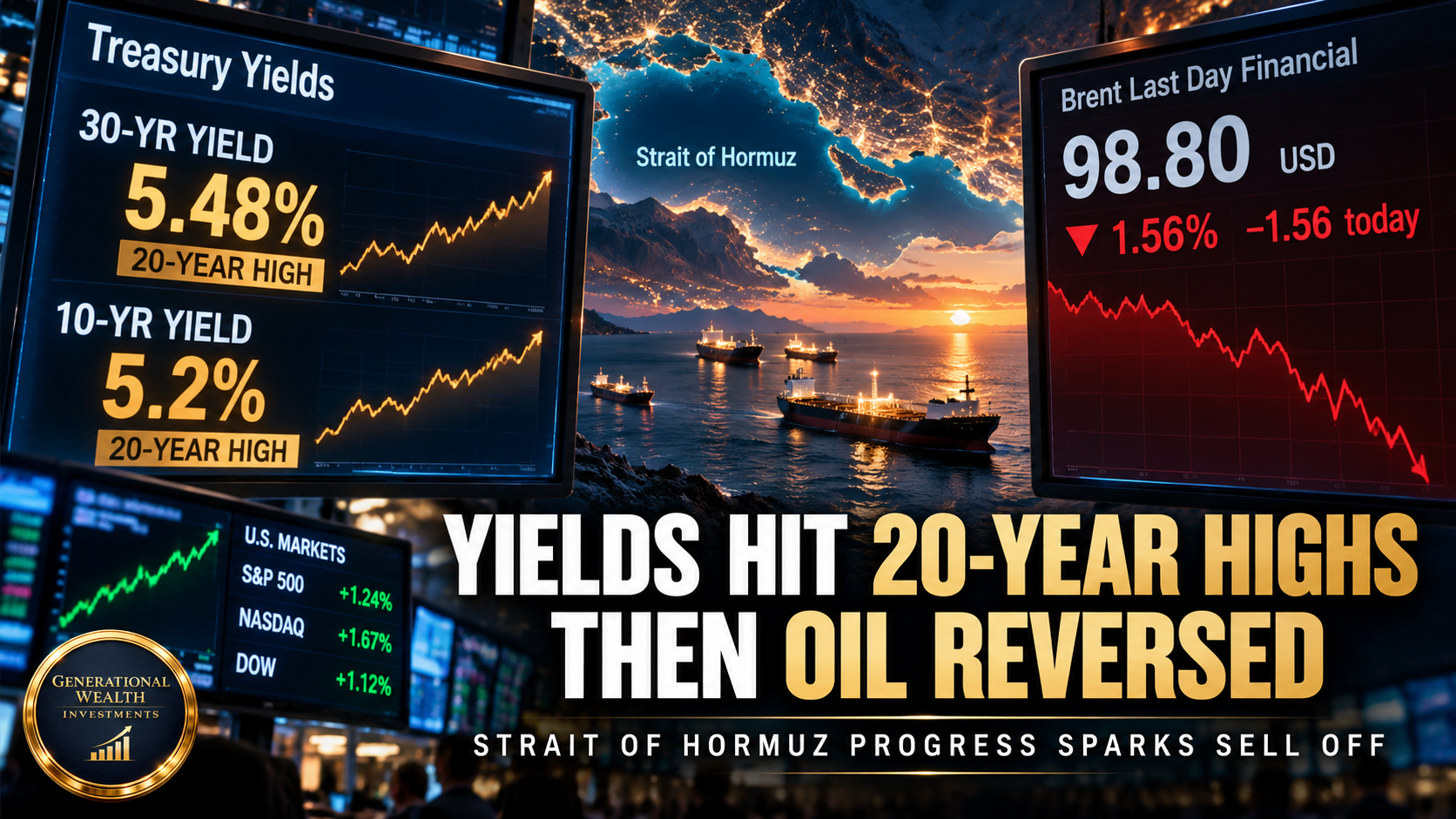
Oil Shock Sends Treasury Yields to 20-Year High
Oil-driven inflation fears pushed long-term Treasury yields to multi-decade highs before a Strait of Hormuz diplomacy headline suddenly reversed crude and helped stocks recover. Now the focus shifts to whether oil stays elevated — and what next week’s inflation and jobs data mean for the rate outlook.
September 25, 2026
Oil Shock Sends Treasury Yields to 20-Year High — Then Hormuz Changes the Setup
Oil-driven inflation fears pushed long-term Treasury yields to levels not seen in roughly two decades Thursday. Then the market changed direction: reports that U.S. and Iranian negotiators were exploring a path to reopen the Strait of Hormuz sent Brent crude sharply lower and helped stocks recover. Now investors have to determine whether that reversal can hold.
Watch Today’s Market Breakdown
See how the oil shock pushed Treasury yields higher, why a Hormuz headline suddenly reversed crude, and what markets are watching next.
Today’s Market Setup
Thursday showed how quickly oil, inflation expectations and interest rates can become one interconnected market story — and how quickly that setup can change when geopolitical expectations shift.
Treasury Yields Reach Multi-Decade Highs
The 30-year Treasury yield reached about 5.48%, its highest since 2004, while the 10-year climbed to around 5.2%, a level last seen in 2007. Rising long-term yields mean higher borrowing costs remain a major pressure point for markets.
Oil Revives Inflation Concerns
Renewed attacks on Saudi Arabia pushed oil higher as investors confronted fresh supply fears. With the U.S. economy remaining strong, another rise in energy prices added to concerns that inflation pressure could remain elevated.
Hormuz Headline Reverses the Move
Reports that U.S. and Iranian negotiators were exploring a path to reopen the Strait of Hormuz changed the market quickly. Brent crude fell roughly three dollars within minutes, while stocks recovered much of their earlier losses.
What Matters From Here
The key question is whether Thursday’s reversal marks a meaningful change in the oil-and-rates setup or only a temporary reaction to a diplomatic headline.
- Does oil remain elevated enough to keep inflation concerns and Treasury yields under pressure?
- Can the decline in crude continue if negotiations over reopening the Strait of Hormuz progress?
- How will next week’s inflation data and jobs report affect a market already confronting historically high long-term Treasury yields?
The Headlines Are Only the First Step
The free Market Preview explains how oil, Treasury yields and the Hormuz headline changed Thursday’s market. The members-only Daily Market Brief goes deeper into the catalysts, risks, confirmation signals and developments worth monitoring as investors evaluate what happens next.
See What Members GetInside Today’s Members-Only Daily Market Brief
- The oil-market developments that could reinforce or weaken the inflation pressure now affecting Treasury yields.
- What to monitor around the Strait of Hormuz as markets evaluate the possibility of reopening the critical shipping route.
- The interest-rate signals that could show whether Thursday’s surge in long-term Treasury yields is continuing or beginning to ease.
- Why next week’s inflation data and jobs report could become the next major tests for the current market setup.
Go Beyond the Headlines
The public Market Preview tells you what happened. The Generational Wealth Community is designed for investors who want to understand what deserves attention next, what could confirm the current market setup, what risks could change it and which developments deserve continued monitoring. We don’t chase hype, we decode the market.
Unlock the Daily Market BriefEducational market research designed to help investors understand the setup — not chase headlines.
Your pathway from knowledge to legacy. We don’t chase hype, we decode the market.
Stay Ahead of What Matters Next
Oil, inflation expectations and Treasury yields are moving together, while developments around the Strait of Hormuz can change that setup quickly. The next major tests arrive with inflation data and the jobs report.
Join the Generational Wealth Community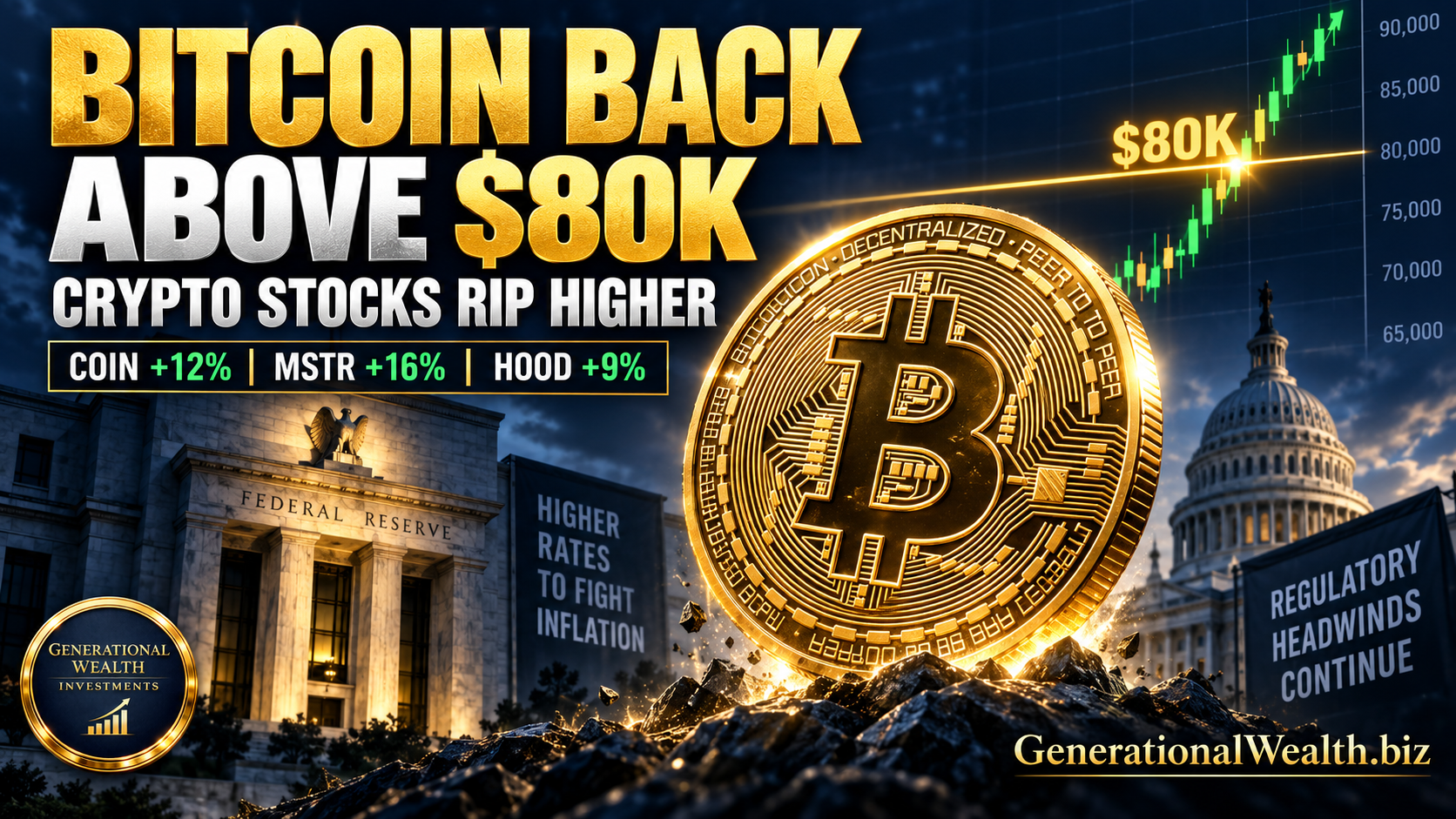
Bitcoin Reclaims $80K After Fed Hike as Crypto Stocks Surge
Bitcoin jumped nearly 6% Friday and reclaimed $80,000 despite a Federal Reserve rate hike and fresh regulatory uncertainty. Coinbase, Strategy and Robinhood surged even more, setting up a key test when U.S. markets reopen Monday.
September 19, 2026
Bitcoin Reclaims $80K After Fed Rate Hike — Crypto Stocks Rip Higher
Bitcoin surged nearly 6% Friday and briefly traded above $81,000, reclaiming the $80,000 level despite two major developments that could have pressured crypto: the Senate’s failure to advance a major digital asset bill and the Federal Reserve’s first interest-rate hike in more than three years. Crypto-linked stocks moved even more sharply, setting up an important test when U.S. markets reopen Monday.
Watch Today’s Market Breakdown
See why Bitcoin rallied through major regulatory and interest-rate headwinds, which crypto stocks surged Friday and what investors will be watching when markets reopen Monday.
Today’s Market Setup
Friday’s move showed that Bitcoin and crypto-linked stocks were able to rally even after a week packed with monetary-policy and regulatory developments.
Bitcoin Reclaims $80,000
Bitcoin jumped nearly 6% Friday and briefly traded above $81,000. The move put the cryptocurrency back above a level it had struggled to hold earlier in September and extended its rebound into the weekend.
Crypto Stocks Amplified the Move
Coinbase gained almost 12%, Strategy rose more than 16% and Robinhood advanced about 9% Friday. Those moves were substantially larger than Bitcoin’s percentage gain, showing how crypto-linked equities can amplify changes in the underlying market.
Regulation Remains in Focus
The rally came after the Senate failed to advance a major digital asset bill and after the SEC created a five-year regulatory path for approved platforms to trade certain tokenized U.S.-listed stocks. Coinbase and Robinhood have both shown interest in expanding into tokenized assets.
What Matters From Here
Bitcoin keeps trading through the weekend while U.S. crypto stocks are closed, creating a natural test for whether Friday’s equity rally can carry into Monday.
- Can Bitcoin hold above $80,000 through the weekend and enter Monday with Friday’s breakout intact?
- Will Coinbase, Strategy and Robinhood hold their sharp Friday gains when U.S. markets reopen?
- Does the SEC’s tokenized-stock framework create a durable catalyst for platforms positioned at the intersection of traditional equities and blockchain infrastructure?
Friday’s Rally Is Only the First Test
The free Market Preview explains what moved Bitcoin and crypto stocks. The members-only Daily Market Brief goes deeper into the catalysts, risks, confirmation signals and market developments that could determine whether Friday’s rally has staying power.
See What Members GetInside Today’s Members-Only Daily Market Brief
- The Bitcoin price behavior worth watching through the weekend before crypto-linked stocks reopen Monday.
- What Friday’s outsized moves in Coinbase, Strategy and Robinhood could tell us about investor appetite for crypto exposure.
- How the Federal Reserve’s rate hike changes the macro backdrop for Bitcoin and other risk assets.
- Why the SEC’s new tokenized-stock framework could matter for companies connecting traditional markets with blockchain infrastructure.
Go Beyond the Headlines
The public Market Preview tells you what happened. The Generational Wealth Community is designed for investors who want to understand what deserves attention next, what could confirm the current setup, what risks could change it and which developments deserve continued monitoring. We don’t chase hype, we decode the market.
Unlock the Daily Market BriefEducational market research designed to help investors understand the setup — not chase headlines.
Your pathway from knowledge to legacy. We don’t chase hype, we decode the market.
Stay Ahead of What Matters Monday
Follow Bitcoin through the weekend and watch whether Friday’s sharp crypto-stock rally survives when U.S. markets reopen.
Join the Generational Wealth Community
Venezuela’s 1.5M-Barrel Oil Deal: Why Gas Won’t Drop Yet
Venezuela’s new U.S. oil project targets more than 1.5 million barrels a day, but years of underinvestment mean those barrels may not reach the market quickly. At the same time, Russia’s diesel export ban and shifting Strait of Hormuz flows are creating a much more complicated near-term oil setup.
August 30, 2026
Venezuela Targets 1.5M Barrels a Day — Why Cheap Gas Isn’t Here Yet
Venezuela’s new U.S. oil project is targeting more than 1.5 million barrels a day and covers over 65 billion barrels of proven reserves. But years of underinvestment mean substantial new production could still take years, while Russia’s diesel export ban is tightening fuel availability now. The opportunity is enormous — but timing is what matters.
Watch Today’s Market Breakdown
See why Venezuela’s massive oil agreement does not automatically mean cheaper gasoline now, and how Russia, Hormuz and Brent crude complicate the near-term setup.
Today’s Market Setup
The oil market is balancing enormous potential future supply from Venezuela against infrastructure problems and fuel constraints that remain important right now.
Venezuela Targets 1.5M Barrels a Day
Venezuela says the 25-year bilateral project will develop 17 strategic oilfields and targets more than 1.5 million barrels of daily production. The original agreement covers more than 65 billion barrels of proven reserves, creating substantial long-term supply potential.
Infrastructure Is the Near-Term Constraint
Venezuela’s oil industry has suffered from years of underinvestment. Experts cited in the supplied research say major repairs could take years before production rises substantially, meaning headline production targets and actual new barrels may arrive on very different timelines.
Russia Keeps Pressure on Fuel Supply
Russia extended its diesel export ban through September 30 after drone attacks left several refineries offline. Meanwhile, Brent settled Friday at $89.31, down more than 5% for the week as traders weighed improving Hormuz flows and a more hawkish Federal Reserve.
What Matters From Here
The size of Venezuela’s agreement is clear. The bigger issue is how quickly the long-term supply story begins turning into actual production while current fuel constraints remain in place.
- How quickly can Venezuela repair infrastructure and translate the 1.5-million-barrel-a-day target into meaningful new production?
- Does Russia’s diesel export ban offset some of the near-term pressure lower from improving oil flows through the Strait of Hormuz?
- Do the new company agreements expected next week, including talks involving Chevron, begin moving the project from announcement toward execution?
The Headlines Are Only the First Step
The free Market Preview explains why Venezuela’s oil agreement matters and why it does not immediately solve today’s fuel constraints. The members-only Daily Market Brief goes deeper into the catalysts, risks, confirmation signals, and developments worth monitoring as this supply story moves from announcement toward execution.
See What Members GetInside Today’s Members-Only Daily Market Brief
- The developments that could show whether Venezuela’s 1.5-million- barrel-a-day target is beginning to move from headline to execution.
- Why the timing of infrastructure repairs matters to the long-term supply narrative and expectations around future production.
- How Russia’s diesel restrictions and improving Strait of Hormuz flows are pulling the near-term fuel market in opposite directions.
- What the company agreements expected next week could clarify about the pace and credibility of Venezuela’s oil expansion.
Go Beyond the Headlines
The public Market Preview tells you what happened and why investors are paying attention. The Generational Wealth Community is designed for investors who want to understand what deserves attention next, what could confirm the current setup, what risks could change it, and which developments deserve continued monitoring. We don’t chase hype, we decode the market.
Unlock the Daily Market BriefEducational market research designed to help investors understand the setup — not chase headlines.
Your pathway from knowledge to legacy. We don’t chase hype, we decode the market.
Stay Ahead of What Matters Next
Follow the catalysts and risks that matter as Venezuela moves toward new company agreements while Russia, Hormuz and infrastructure constraints continue shaping the oil-market setup.
Join the Generational Wealth Community
Rate Hike Odds Jump to 57% as Nvidia Drops 4.6% After Warsh
Rate-hike odds jumped to roughly 57% after Kevin Warsh’s Jackson Hole speech, sending Treasury yields higher as Nvidia and gold fell. Now the August jobs report could determine whether that shift in Fed expectations gains momentum or becomes more complicated.
August 29, 2026
Rate Hike Odds Jump to 57% as Nvidia Drops 4.6%
Traders sharply increased the odds of a September rate hike after Fed Chair Kevin Warsh put inflation back at the center of the market during his Jackson Hole speech. The shift pushed Treasury yields higher, pressured gold, and sent Nvidia down 4.6% just one day after its powerful AI-driven rally. Now attention turns to Friday’s August jobs report.
Watch Today’s Market Breakdown
See why rate-hike expectations jumped, how the move reached Nvidia, bonds and gold, and why the August jobs report matters next.
Today’s Market Setup
Warsh’s inflation message changed the market’s interest-rate expectations quickly, with the impact showing up across bonds, technology stocks and gold.
September Hike Odds Reach 57%
Traders raised the implied probability of a September rate hike from about 35% before the Jackson Hole speech to roughly 57% by Friday’s close after Warsh emphasized that the Fed’s 2% inflation target remains firm.
Treasury Yields Pressure Nvidia
The two-year Treasury yield jumped about 13 basis points to 4.36%, a one-month high. The Nasdaq fell about half a percent while Nvidia dropped 4.6%, reversing part of the previous session’s 8.7% surge.
Gold Falls as Rates Reprice
Gold dropped about 3% as traders priced in greater odds of higher interest rates. The next major test is the August jobs report on Friday, September 4, with a Reuters poll expecting about 58,000 jobs.
What Matters From Here
The market has repriced September policy risk. The next question is whether incoming labor data reinforces that shift or complicates it.
- Does the August jobs report strengthen the case for a September rate hike or make the Fed’s decision more difficult?
- Can Nvidia regain momentum if Treasury yields remain under upward pressure?
- Does gold stabilize if rate-hike expectations stop increasing, or does tighter-policy risk remain the dominant pressure?
The Headlines Are Only the First Step
The free Market Preview explains why markets repriced September rate-hike risk. The members-only Daily Market Brief goes deeper into the catalysts, risks, confirmation signals, and developments worth monitoring as investors evaluate what comes next.
See What Members GetInside Today’s Members-Only Daily Market Brief
- The developments that could show whether markets continue pricing a greater probability of a September rate hike.
- What the August jobs report could mean for the tension between persistent inflation concerns and the Fed’s next decision.
- The signals worth monitoring across Treasury yields and technology stocks after Nvidia’s sharp post-rally reversal.
- How gold’s decline fits into the broader repricing of interest-rate expectations following Jackson Hole.
Go Beyond the Headlines
The public Market Preview tells you what happened and why investors are paying attention. The Generational Wealth Community is designed for investors who want to understand what deserves attention next, what could confirm the current setup, what risks could change it, and which developments deserve continued monitoring. We don’t chase hype, we decode the market.
Unlock the Daily Market BriefEducational market research designed to help investors understand the setup — not chase headlines.
Your pathway from knowledge to legacy. We don’t chase hype, we decode the market.
Stay Ahead of What Matters Next
Follow the catalysts, risks, and confirmation signals that matter as markets weigh inflation, Treasury yields, the August jobs report, and the possibility of another rate hike.
Join the Generational Wealth Community
Applied Materials Falls on Margins as S&P 500 Hits Record
Applied Materials posted the biggest quarter-to-quarter revenue jump in its history and the stock fell about 5% anyway — the second straight day a beat-and-raise was punished over margins. Today's preview breaks down what that pattern says about the AI trade, and why the S&P 500 still closed at a record.
Market Preview: Applied Materials Posts Record Revenue and Drops Anyway as the S&P 500 Closes at a High
Applied Materials just reported the biggest quarter-to-quarter revenue jump in its history — and the stock fell about 5% after hours. That's two days running where a company beat, raised guidance, and sold off anyway, and both times the market pointed at the same line item. Today's video explains what margins are saying about the AI trade, and why the index closed at a record regardless.

Today's Market Snapshot
Record Revenue, Falling Stock
Applied Materials posted record revenue just over $9 billion, up 25% from a year ago, beat on earnings, and raised its outlook. The stock still fell about 5% after hours. Management guided to flat gross margins next quarter, and that single line outweighed everything else in the report.
Two Days, Same Story
Cisco beat and guided above estimates, then dropped 8.4% Thursday. Analysts kept returning to margins: gross margin slipped to roughly 66% from 68%, partly because the memory inside AI hardware has grown more expensive. Investors aren't questioning AI demand — they're questioning what it costs to meet it.
The Index Barely Blinked
Micron, which sells that memory, rose more than 4% the same day — the cost is moving through the AI trade, not ending it. Meanwhile the S&P 500 closed at a record just under 7,800 after wholesale inflation came in flat for July and traders trimmed September rate-hike odds.
What Investors Should Be Watching
- July retail sales at 8:30 Eastern — the read on the consumer landing right after a flat wholesale inflation print already pulled September rate-hike odds lower.
- The SEC votes at 10 on its first formal crypto rulemaking, with Bitcoin near $63,000.
- Whether the Applied Materials drop holds at the open, or whether buyers treat a margin warning inside record revenue differently in daylight.
Inside Today's Members-Only Daily Market Brief
- The levels members are tracking on Applied Materials as an after-hours drop meets the cash open.
- How to read a margin squeeze that travels through the AI supply chain — and which side of it is absorbing the cost.
- What each retail sales outcome would do to September rate expectations now that a hike has been trimmed back.
- Why the SEC's first formal crypto rulemaking deserves attention beyond today's headline.
- Where the strongest and weakest parts of the market sit with the index at a record.
Go Beyond the Headlines
The public video explains what happened. The Generational Wealth Community helps members understand what matters next, where the risks are, and which developments deserve continued attention.
Unlock the Daily Market Brief
Oil's Biggest Build in 3.5 Years — And Prices Rose Anyway
U.S. crude inventories posted their biggest weekly build in three and a half years — 17.4 million barrels, against expectations for a drawdown — and oil closed higher anyway. Today's preview breaks down why the barrels piled up, what the Strait of Hormuz has to do with it, and why the Fed's next move may be a hike.
Market Preview: Oil Posts Its Biggest Build in 3.5 Years as Prices Climb Anyway
America's oil stockpile just posted its biggest weekly jump in three and a half years — 17.4 million barrels, when forecasters were looking for a drawdown — and crude still closed higher. That combination usually signals something other than weak demand. Today's video explains what the headline inventory number misses, and why it points toward the Federal Reserve.

Today's Market Snapshot
A Record Build, and a Higher Close
Government data showed U.S. crude inventories rose 17.4 million barrels in a single week, the largest build in three and a half years. Forecasters had expected a drawdown. Crude closed slightly higher anyway — the kind of divergence that says the inventory number is measuring something other than demand.
Hormuz Is the Bottleneck
American crude exports fell to their lowest level since the war with Iran began, while imports surged. Barrels piled up because they couldn't ship out. The Strait of Hormuz remains effectively closed, and the IEA now sees the world short roughly 1.8 million barrels a day this quarter.
Energy Reaches the Rate Path
July inflation cooled to 3.4%, but energy is still up nearly 15% from a year ago — which is why September odds now favor a hike near 42% rather than a cut. This morning crude finally cracked, with WTI near $81.60, down about 2%, snapping a five-day run on reopening-deal chatter.
What Investors Should Be Watching
- Wholesale inflation at 8:30 Eastern — the last read before September rate odds firm up, and the number most likely to move a hike-versus-cut debate that is already leaning one way.
- Whether talk of a deal to reopen the Strait of Hormuz can keep pressure on crude, or whether a shortfall the IEA puts near 1.8 million barrels a day reasserts itself.
- Whether the AI trade steadies after the S&P 500 closed at 7,748 on AI earnings, with Cerebras down roughly 17% before the bell — a sign the leadership may be narrowing.
Inside Today's Members-Only Daily Market Brief
- The specific crude levels members are tracking now that WTI has broken a five-day run, and what would confirm the move.
- Both sides of this morning's wholesale inflation print, and what each outcome does to a September decision priced near a coin flip.
- How to read an inventory build that reflects logistics rather than demand — and the tell that separates the two.
- What the shipping response signals about how long the Hormuz constraint is expected to last.
- Where capital is rotating as energy costs, not growth, become the pressure point on the rate path.
Go Beyond the Headlines
The public video explains what happened. The Generational Wealth Community helps members understand what matters next, where the risks are, and which developments deserve continued attention.
Unlock the Daily Market Brief