

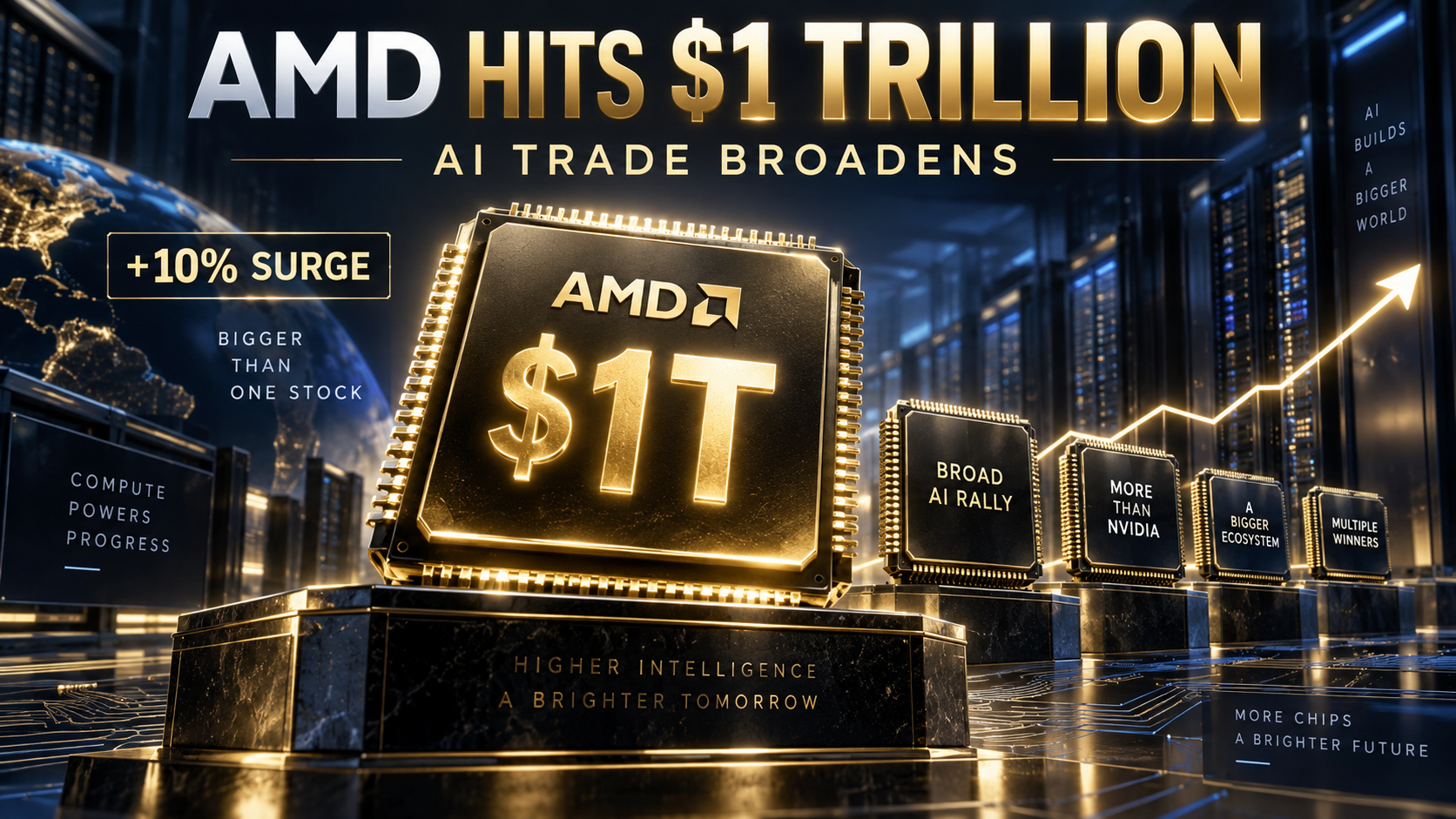
AMD Hits $1 Trillion as AI Rally Broadens Beyond Nvidia
AMD crossed the $1 trillion mark after an approximately 10% one-day surge as semiconductor stocks rallied and the Nasdaq closed at a record. The next test is whether AMD can hold that milestone as investors continue betting on expanding AI spending.
September 22, 2026
AMD Hits $1 Trillion After 10% Surge — Can the AI Rally Hold?
AMD crossed the $1 trillion valuation mark for the first time after shares jumped about 10% Monday. The move came alongside a more than 4% gain in the Philadelphia Semiconductor Index and a record close for the Nasdaq. Investors are betting AI spending is still expanding. The next question is whether AMD can hold its new trillion-dollar milestone when U.S. trading resumes.
Watch Today’s Market Breakdown
See why AMD’s trillion-dollar milestone matters, how the broader chip rally fits into the story and what investors are watching next.
Today’s Market Setup
AMD’s move is bigger than a single-stock milestone. The broader semiconductor rally and record Nasdaq close suggest investors are continuing to position around expanding artificial-intelligence spending.
AMD Joins the $1 Trillion Club
AMD shares jumped about 10% Monday, pushing the company above a $1 trillion valuation for the first time. It became only the fourth U.S. chipmaker to reach that milestone, following Nvidia, Broadcom and Micron.
Chip Strength Is Broader Than AMD
The Philadelphia Semiconductor Index gained more than 4%, while the Nasdaq closed at a record high. That broader strength matters because investors are not treating AMD’s surge as an isolated move.
AMD Is Expanding Its AI Ambition
AMD is moving beyond individual chips toward complete AI systems. That shift puts the company in more direct competition with Nvidia as investors continue betting that artificial-intelligence spending will expand.
What Matters From Here
Crossing $1 trillion is the headline. The more important test now is whether AMD and the broader semiconductor rally can sustain the move.
- Can AMD hold the $1 trillion valuation line after a nearly 10% one-day jump?
- Does strength across the semiconductor index continue when U.S. markets resume trading?
- Does AMD’s move toward complete AI systems continue strengthening its position as a more direct competitor to Nvidia?
The Headlines Are Only the First Step
The free Market Preview explains why AMD’s trillion-dollar milestone matters. The members-only Daily Market Brief goes deeper into the catalysts, risks, confirmation signals and developments worth monitoring as investors decide whether the broader AI-chip move continues.
See What Members GetInside Today’s Members-Only Daily Market Brief
- The signals worth monitoring as AMD tests whether it can hold its new $1 trillion valuation after Monday’s surge.
- Whether continued semiconductor strength confirms that the AI trade is broadening beyond a single market leader.
- How AMD’s move from individual chips toward complete AI systems is changing the competitive setup with Nvidia.
- What the next round of U.S. trading could reveal about whether Monday’s AMD and semiconductor gains have staying power.
Go Beyond the Headlines
The public Market Preview tells you what happened. The Generational Wealth Community is designed for investors who want to understand what deserves attention next, what could confirm the current setup, what risks could change it and which developments deserve continued monitoring. We don’t chase hype, we decode the market.
Unlock the Daily Market BriefEducational market research designed to help investors understand the setup — not chase headlines.
Your pathway from knowledge to legacy. We don’t chase hype, we decode the market.
Stay Ahead of What Matters Next
AMD has reached $1 trillion. Now the test is whether that milestone holds and whether strength across semiconductors continues to support the broader AI story.
Join the Generational Wealth Community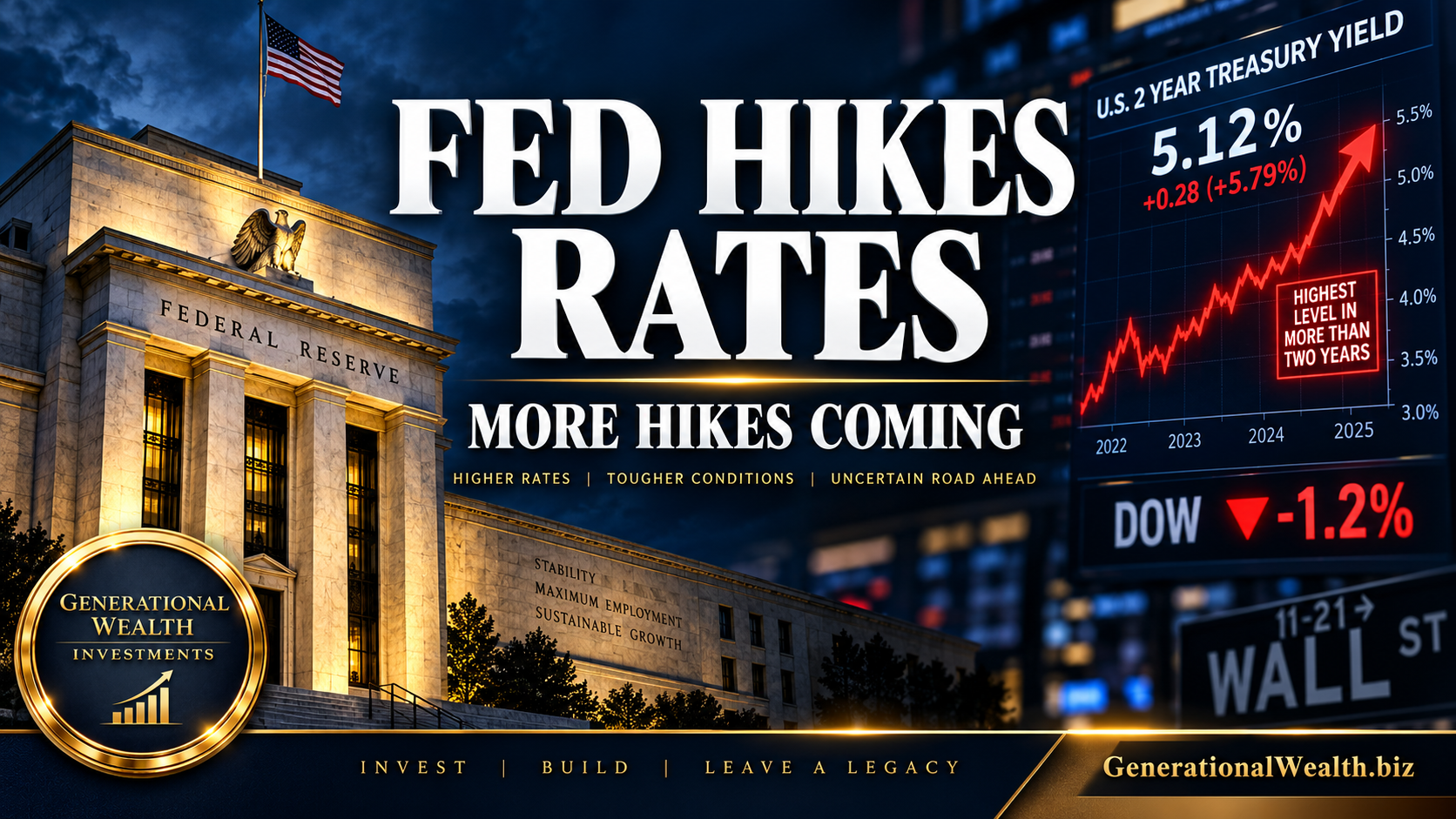
Fed Hikes Rates as Policymakers Signal More Increases
The Federal Reserve raised rates for the first time in more than three years, but 16 of 18 policymakers are already signaling that another increase may follow. Now the focus shifts to Treasury yields and whether the early rebound in U.S. stock futures survives when markets reopen.
September 17, 2026
Fed Hikes Rates as Policymakers Signal More Increases Ahead
The Federal Reserve raised interest rates by a quarter point, its first increase in more than three years, lifting the federal funds target to 3.75% to 4%. But the larger issue is what comes next: 16 of 18 Fed policymakers project at least one more quarter-point hike by year-end. Now investors are watching whether higher Treasury yields remain in place as markets reopen.
Watch Today’s Market Breakdown
See what the Fed changed, how markets reacted and why Treasury yields have become the next major test for investors.
Today’s Market Setup
The immediate rate hike matters, but markets are also adjusting to the possibility that this was not a one-and-done move.
The Fed Raises Rates
The Federal Reserve increased its policy rate by a quarter point, bringing the federal funds target to 3.75% to 4%. It was the central bank’s first rate increase in more than three years, putting borrowing costs back at the center of the market discussion.
More Hikes May Follow
Sixteen of 18 Fed policymakers project at least one additional quarter-point increase by year-end. That matters because higher policy rates can continue putting pressure on borrowing costs and stock valuations even after this initial move is absorbed.
Treasury Yields React
The two-year Treasury yield reached its highest level in more than two years as the Dow fell about 1.2%, while the Nasdaq barely moved. Early Thursday morning, however, U.S. stock futures were rebounding.
What Matters From Here
Investors now have the Fed’s decision. The next question is whether the bond and stock-market reactions continue when regular trading resumes.
- Does the two-year Treasury yield remain elevated after reaching its highest level in more than two years?
- Can the early rebound in U.S. stock futures hold once regular trading begins?
- How does the prospect of another Fed hike by year-end affect the pressure already facing borrowing costs and stock valuations?
The Headlines Are Only the First Step
The free Market Preview explains the Fed decision, the initial market reaction and the key question surrounding Treasury yields. The members-only Daily Market Brief goes deeper into the catalysts, risks, confirmation signals and developments worth monitoring as markets respond to the new rate outlook.
See What Members GetInside Today’s Members-Only Daily Market Brief
- The Treasury-yield signals that could show whether markets are continuing to adjust to a higher-rate environment.
- What to monitor as stocks reopen after the Dow’s decline and the early rebound in U.S. futures.
- How the possibility of another quarter-point hike by year-end could shape the interest-rate backdrop from here.
- The developments that could strengthen or weaken the current relationship between Fed policy, borrowing costs and stock valuations.
Go Beyond the Headlines
The public Market Preview tells you what happened. The Generational Wealth Community is designed for investors who want to understand what deserves attention next, what could confirm the current setup, what risks could change it and which developments deserve continued monitoring. We don’t chase hype, we decode the market.
Unlock the Daily Market BriefEducational market research designed to help investors understand the setup — not chase headlines.
Your pathway from knowledge to legacy. We don’t chase hype, we decode the market.
Stay Ahead of What Matters Next
Follow the rate, Treasury-yield and market developments that could determine how investors respond to the Fed’s new policy path.
Join the Generational Wealth Community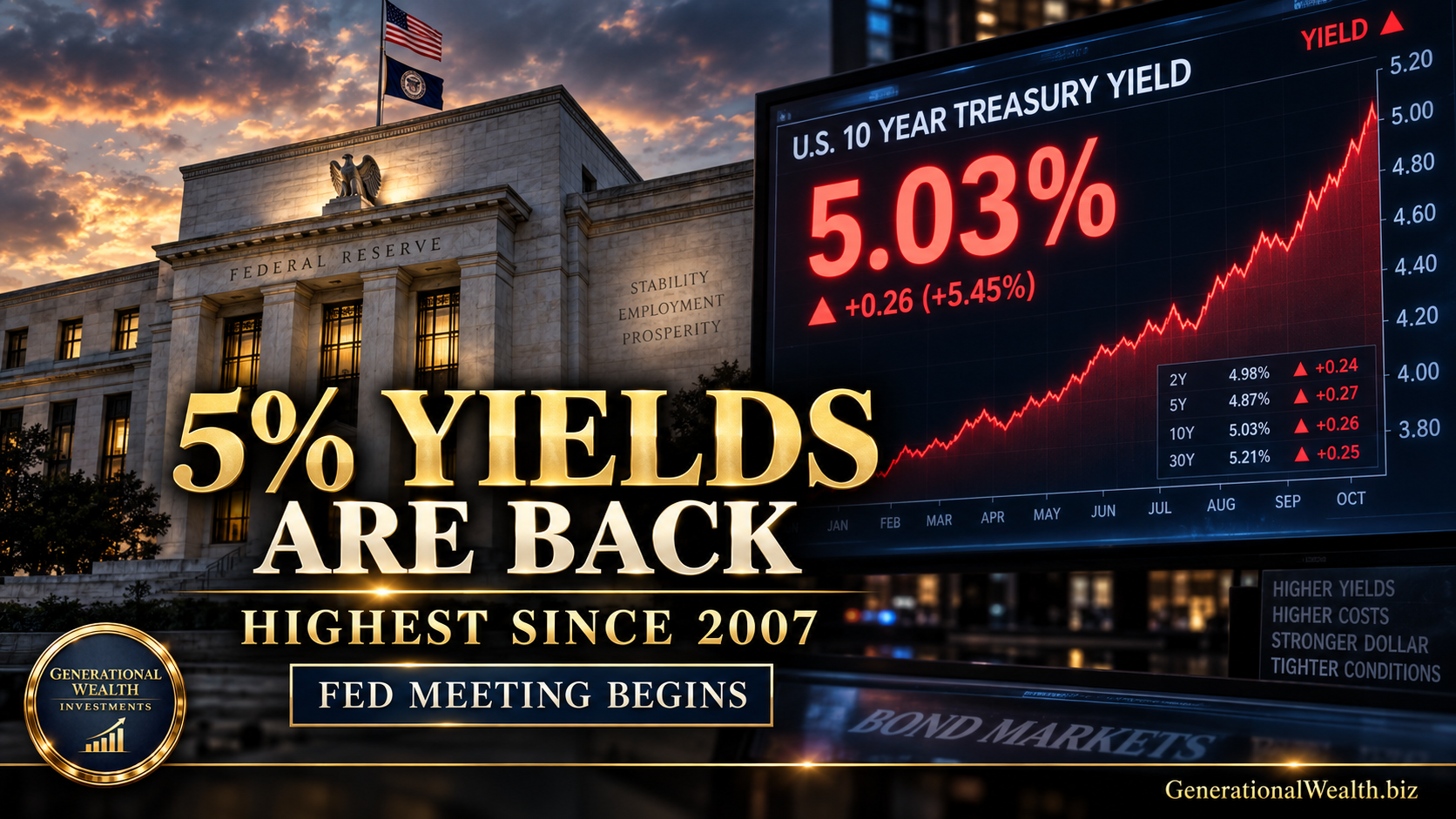
10-Year Treasury Yield Hits 5.03% as Fed Meeting Begins
The 10-year Treasury yield has climbed back above 5%, reaching its highest level since 2007 just as the Federal Reserve begins its two-day meeting. With Brent crude still near $108 and markets heavily pricing another rate hike, the bigger question is what the Fed signals comes next.
September 15, 2026
10-Year Treasury Yield Hits 5.03% as Fed Meeting Begins
The 10-year Treasury yield climbed to about 5.03% overnight, its highest level since 2007. That matters beyond the bond market because the 10-year helps influence borrowing costs across the economy and higher yields can pressure stock valuations. Now the Federal Reserve begins a two-day meeting with inflation and oil still firmly in focus.
Watch Today’s Market Breakdown
See why the return of 5% Treasury yields matters, how oil fits into the inflation picture, and the question facing the Fed as its meeting begins.
Today’s Market Setup
The immediate story is the return of 5% Treasury yields. The broader issue is how high borrowing costs, elevated oil prices and the Federal Reserve’s next decision fit together.
10-Year Yield Reaches 5.03%
The 10-year Treasury yield climbed to about 5.03% overnight, its highest level since 2007. The move matters because the benchmark influences borrowing costs across the economy, including mortgages, while higher yields can also pressure stock valuations.
Oil Keeps Inflation in Focus
Brent crude remained near $108 a barrel. With energy prices elevated, inflation remains an important part of the market backdrop just as Federal Reserve policymakers begin their two-day meeting.
Markets Expect a Fed Hike
Markets now price more than a 94% chance of a Federal Reserve rate hike Wednesday. The decision itself matters, but investors will also be watching what policymakers communicate about the path that follows.
What Matters From Here
Reaching 5% explains where yields are today. The bigger questions concern what the Fed says next and whether inflation pressure keeps the market focused on additional tightening.
- Does the Fed signal that Wednesday’s expected rate hike is a single move or the beginning of a new hiking cycle?
- Does oil remaining near $108 keep inflation pressure elevated enough to influence the Fed’s message?
- How does a 10-year Treasury yield above 5% reshape the pressure on borrowing costs and stock valuations from here?
The Headlines Are Only the First Step
The free Market Preview explains why Treasury yields, oil and the Fed are converging into one important market setup. The members-only Daily Market Brief goes deeper into the catalysts, risks, confirmation signals and developments worth monitoring as the Fed meeting unfolds.
See What Members GetInside Today’s Members-Only Daily Market Brief
- The signals that could show whether the return of 5% Treasury yields is becoming a more persistent market pressure.
- How oil near $108 fits into the inflation backdrop as the Federal Reserve begins its two-day meeting.
- What to monitor in the Fed’s message for clues about whether one expected hike could turn into a broader hiking cycle.
- The developments that could change the current relationship between yields, borrowing costs and pressure on stock valuations.
Go Beyond the Headlines
The public Market Preview tells you what happened. The Generational Wealth Community is designed for investors who want to understand what deserves attention next, what could confirm the current setup, what risks could change it and which developments deserve continued monitoring. We don’t chase hype, we decode the market.
Unlock the Daily Market BriefEducational market research designed to help investors understand the setup — not chase headlines.
Your pathway from knowledge to legacy. We don’t chase hype, we decode the market.
Stay Ahead of What Matters Next
Follow the Treasury-yield, inflation and Federal Reserve developments that could determine whether today’s market pressure continues or the setup begins to change.
Join the Generational Wealth Community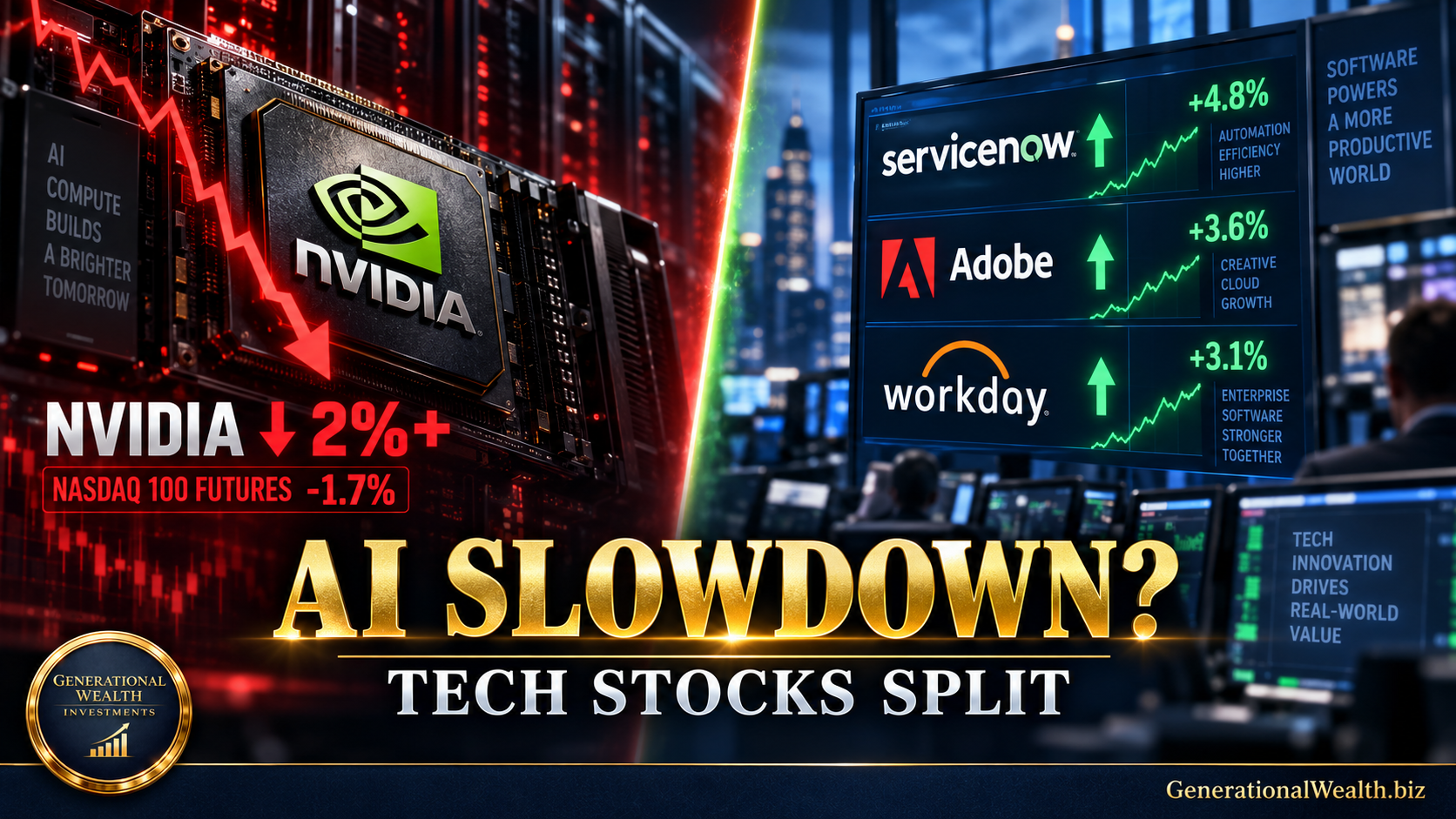
Nvidia Falls as AI Slowdown Calls Lift Software Stocks
Nvidia and Nasdaq 100 futures weakened before Monday’s open after prominent AI leaders backed slowing advances in frontier models. At the same time, ServiceNow, Adobe and Workday moved higher, creating a new split inside the AI trade that investors will test at the opening bell.
September 14, 2026
Nvidia Falls as AI Leaders Call for a Slowdown — Software Stocks Rally
Nvidia was down more than 2% before Monday’s open while Nasdaq 100 futures fell about 1.7% after several prominent AI leaders backed slowing advances in frontier models. But software names moved the other way, creating an unusual split inside the AI trade. The next question is whether that divergence survives once regular trading begins.
Watch Today’s Market Breakdown
See why calls to slow frontier AI development are pressuring Nvidia while ServiceNow, Adobe and Workday move higher ahead of the opening bell.
Nvidia Falls as AI Leaders Call for a Slowdown — Software Stocks Rally Watch the free Generational Wealth market briefingToday’s Market Setup
Monday’s setup is being shaped by a new debate over the pace of artificial intelligence development — and the market is not treating every AI-related company the same way.
Nvidia and Nasdaq Futures Weaken
Nasdaq 100 futures were down about 1.7% before the open, while Nvidia fell more than 2%. The weakness follows renewed questions about how quickly the most advanced AI models should continue developing.
AI Leaders Back a Slower Pace
Anthropic’s Dario Amodei called for companies to slow advances in frontier models over the weekend, with OpenAI’s Sam Altman and Elon Musk backing the idea. That matters because AI expansion has driven major spending on chips and data centers.
Software Stocks Move Higher
ServiceNow, Adobe and Workday were all higher as investors reassessed the competitive threat posed by faster AI development. The contrast with Nvidia suggests the market is beginning to separate potential AI winners and losers more aggressively.
What Matters From Here
The premarket reaction shows how investors are interpreting the slowdown debate. The opening bell will test whether those moves are durable.
- Does Nvidia’s premarket weakness hold once regular trading begins?
- Can ServiceNow, Adobe and Workday maintain their strength if investors continue reassessing the pace of frontier AI development?
- Does today’s split become a broader shift in how the market values chip companies versus software companies tied to AI?
The Headlines Are Only the First Step
The free Market Preview explains the unusual split developing inside the AI trade. The members-only Daily Market Brief goes deeper into the catalysts, risks, confirmation signals and developments worth monitoring as investors determine whether today’s premarket reaction becomes a larger shift.
See What Members GetInside Today’s Members-Only Daily Market Brief
- The developments that could show whether Nvidia’s weakness is temporary or becoming a broader challenge for the AI chip trade.
- The signals that could confirm whether software strength is holding after the opening bell.
- Why the debate over frontier-model development could change how investors evaluate future AI infrastructure spending.
- The market behavior worth monitoring to see whether today’s divergence spreads beyond Nvidia, ServiceNow, Adobe and Workday.
Go Beyond the Headlines
The public Market Preview tells you what happened. The Generational Wealth Community is designed for investors who want to understand what deserves attention next, what could confirm the current setup, what risks could change it and which developments deserve continued monitoring. We don’t chase hype, we decode the market.
Unlock the Daily Market BriefEducational market research designed to help investors understand the setup — not chase headlines.
Your pathway from knowledge to legacy. We don’t chase hype, we decode the market.
Stay Ahead of What Matters Next
Follow the AI, semiconductor and software developments that could determine whether today’s market split fades after the open or becomes a more meaningful change in the AI trade.
Join the Generational Wealth Community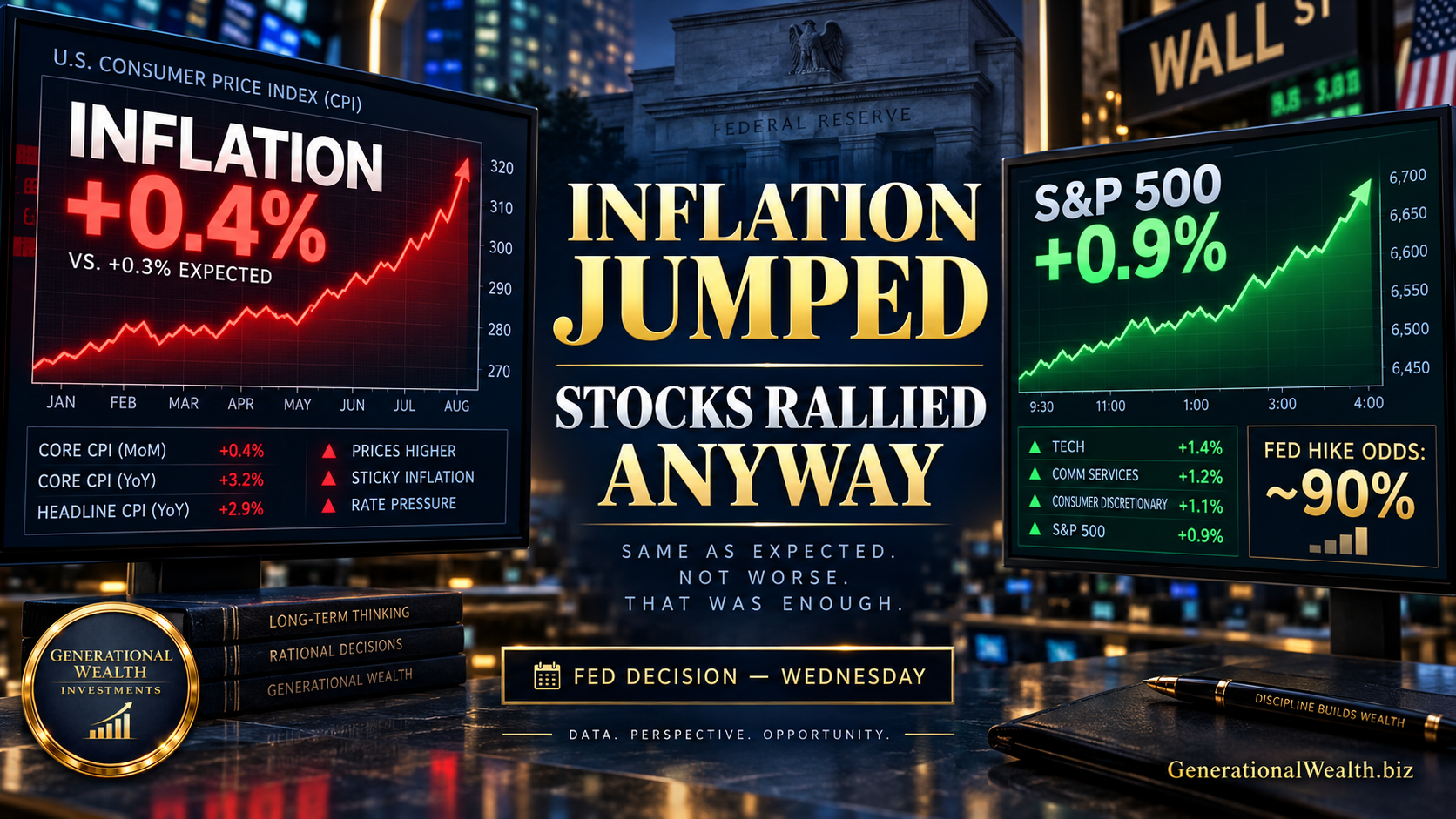
Inflation Jumped — Why Stocks Rallied Anyway
Inflation accelerated in August and the market pushed Federal Reserve rate-hike odds toward 90% — but the S&P 500 rallied anyway. Investors now turn to Wednesday’s Fed decision to see whether policymakers view the rebound as temporary or a sign that inflation is becoming harder to contain.
September 12, 2026
Inflation Jumped in August — Stocks Rallied Anyway
Inflation accelerated in August, with consumer prices rising 0.4% after increasing just 0.1% in July. Federal Reserve rate-hike odds climbed to nearly 90% — yet the S&P 500 gained 0.9% Friday. Investors appeared relieved that inflation matched forecasts instead of delivering an even hotter surprise. Now the focus shifts to how the Fed interprets the rebound.
Watch Today’s Market Breakdown
See why stocks rallied despite hotter inflation, what pushed rate-hike odds toward 90%, and why Wednesday’s Federal Reserve decision is the next major test.
Today’s Market Setup
Friday’s market reaction created an unusual-looking combination: faster inflation, sharply higher expectations for a Fed rate hike, and a rising stock market. The explanation appears to be less about inflation being good news and more about the report not being worse than investors expected.
Inflation Accelerated
Consumer prices rose 0.4% in August after increasing 0.1% in July. Gasoline prices jumped 3.9%, adding another source of pressure to the headline inflation number just before the Federal Reserve’s next decision.
Rate-Hike Odds Near 90%
The market’s implied probability of a Federal Reserve rate hike next week climbed to nearly 90%, up from 72% Thursday. That puts Wednesday’s Fed decision directly at the center of the market’s next major catalyst.
Stocks Rallied Anyway
Despite the inflation rebound, the S&P 500 gained 0.9% Friday. The headline number matched forecasts, while oil pulled back after this week’s surge, and investors appeared relieved that the inflation report was not worse.
What Matters From Here
Friday explained how investors reacted to the inflation report. The bigger questions now center on whether that reaction can hold and how policymakers interpret the renewed inflation pressure.
- Does the Federal Reserve view August’s inflation rebound as temporary, or as evidence that price pressure is becoming stickier?
- Can stocks maintain Friday’s strength with the market assigning nearly a 90% probability to a rate hike?
- Does oil continue pulling back after this week’s surge, or does energy remain an important source of inflation pressure?
The Headlines Are Only the First Step
The free Market Preview explains why inflation accelerated, why stocks rallied anyway, and why Wednesday’s Fed decision matters. The members-only Daily Market Brief goes deeper into the catalysts, risks, confirmation signals and developments worth monitoring as the market evaluates the inflation rebound and the Fed’s response.
See What Members GetInside Today’s Members-Only Daily Market Brief
- The signals worth monitoring around Wednesday’s Fed decision as policymakers assess whether the inflation rebound is temporary or more persistent.
- What could help confirm whether Friday’s S&P 500 rally can hold with rate-hike expectations now near 90%.
- Why gasoline and the direction of oil remain important pieces of the inflation setup after this week’s energy-market volatility.
- The developments that could show whether investors remain comfortable with inflation matching forecasts or begin reassessing Friday’s relief-driven reaction.
Go Beyond the Headlines
The public Market Preview tells you what happened. The Generational Wealth Community is designed for investors who want to understand what deserves attention next, what could confirm the current market move, what risks could change the setup and which developments deserve continued monitoring. We don’t chase hype, we decode the market.
Unlock the Daily Market BriefEducational market research designed to help investors understand the setup — not chase headlines.
Your pathway from knowledge to legacy. We don’t chase hype, we decode the market.
Stay Ahead of What Matters Next
Follow the Fed, inflation and energy-market developments that could determine whether Friday’s stock-market reaction holds or begins to change.
Join the Generational Wealth Community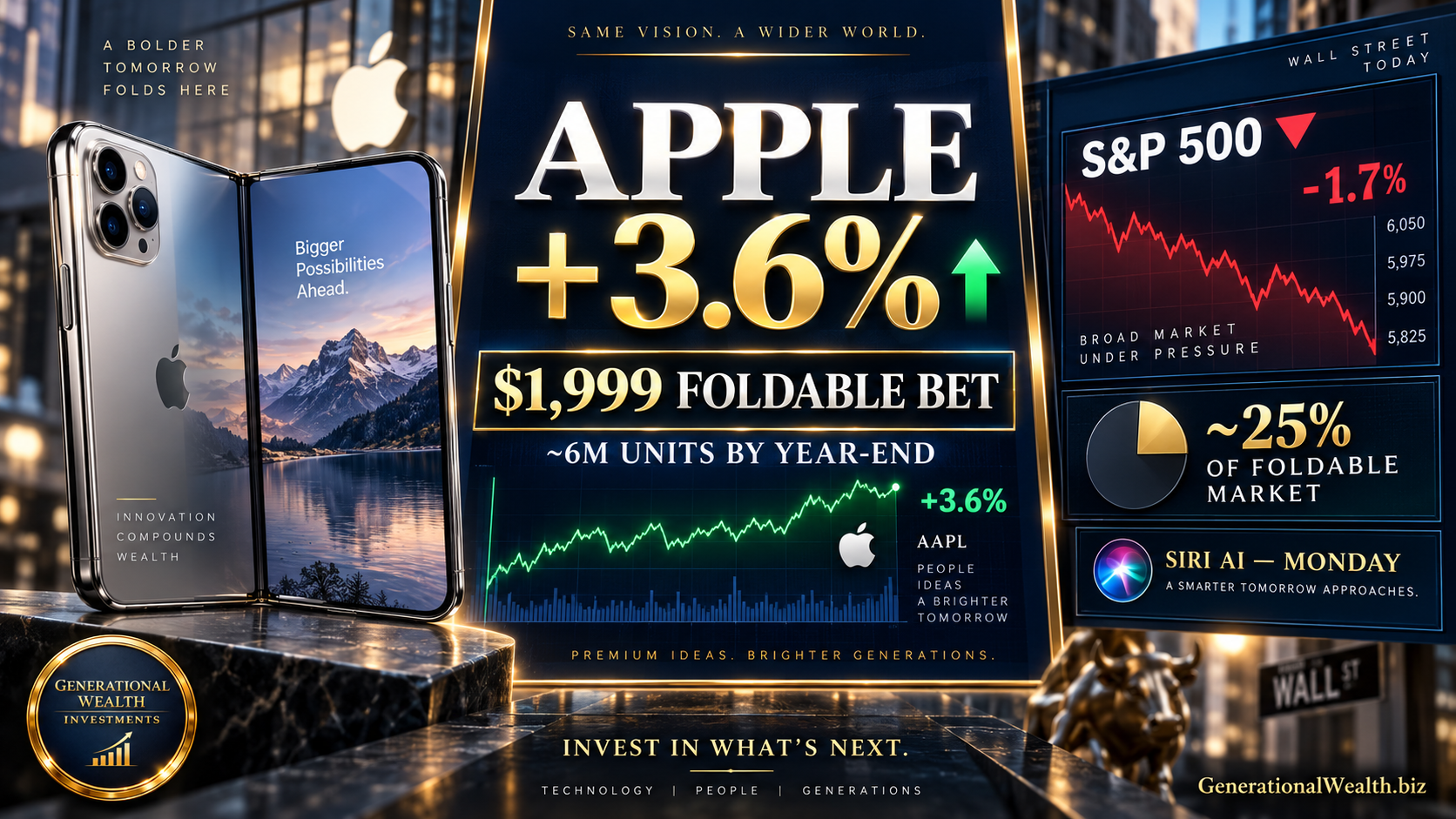
Apple Jumps 3.6% on $1,999 iPhone Duo Foldable Bet
Apple rallied 3.6% while the S&P 500 fell after unveiling its first foldable iPhone at a $1,999 starting price. The bigger test is whether Apple can transform a category representing less than 3% of global smartphone shipments into a meaningful new premium growth engine.
September 11, 2026
Apple Jumps 3.6% While the S&P Falls on Its $1,999 Foldable Bet
Apple jumped 3.6% Thursday even as the S&P 500 fell. The move came one day after Apple unveiled the $1,999 iPhone Duo, its first foldable iPhone. Investors are now weighing whether Apple can turn a category representing less than 3% of global smartphone shipments into a meaningful new premium growth engine — with another test arriving Monday.
Watch Today’s Market Breakdown
See why Apple rallied against a falling market, what the iPhone Duo could mean for the foldable market, and why Monday’s Siri AI beta is the next development to watch.
Today’s Market Setup
Apple’s strength stands out because it came while the broader market was under pressure from oil, inflation concerns and rising yields. The company-specific question is whether its new premium device can expand demand in a category that remains small globally.
Apple Breaks Away From the Market
Apple gained 3.6% Thursday while the S&P 500 fell. That divergence put attention on Apple’s product announcement even as broader markets remained under pressure from oil, inflation and higher yields.
The $1,999 Foldable Bet
Apple’s first foldable iPhone, the iPhone Duo, starts at $1,999. Counterpoint estimates Apple could sell nearly 6 million units by year-end, enough for roughly one quarter of the global foldable market.
A Big Share of a Small Market
Foldable devices still account for less than 3% of worldwide smartphone shipments. Apple is therefore betting that a premium launch can help turn a niche device category into a larger source of growth.
What Matters From Here
The launch created an immediate market reaction. The next questions are whether the early expectations translate into real adoption and whether Apple can build a broader premium-growth story around the Duo and Siri AI.
- Can Apple sell nearly 6 million iPhone Duo units by year-end and capture roughly one quarter of the foldable market?
- Can Apple expand interest in foldables when the category still represents less than 3% of worldwide smartphone shipments?
- Does Monday’s Siri AI beta rollout strengthen the growth narrative surrounding Apple’s newest hardware launch?
The Headlines Are Only the First Step
The free Market Preview explains why Apple rallied and why the iPhone Duo matters. The members-only Daily Market Brief goes deeper into the catalysts, risks, confirmation signals and developments worth monitoring as investors evaluate adoption, market share and Apple’s strength relative to the broader market.
See What Members GetInside Today’s Members-Only Daily Market Brief
- The adoption signals worth following as the iPhone Duo moves from launch announcement toward actual sales.
- What the nearly 6-million-unit estimate could reveal about Apple’s ability to capture a meaningful share of the foldable category.
- Why the small size of the global foldable market remains an important part of evaluating Apple’s premium-device strategy.
- How Monday’s Siri AI beta rollout could become the next test of the broader Apple growth narrative.
Go Beyond the Headlines
The public Market Preview tells you what happened. The Generational Wealth Community is designed for investors who want to understand what deserves attention next, what could confirm the current setup, what risks could change it and which developments deserve continued monitoring. We don’t chase hype, we decode the market.
Unlock the Daily Market BriefEducational market research designed to help investors understand the setup — not chase headlines.
Your pathway from knowledge to legacy. We don’t chase hype, we decode the market.
Stay Ahead of What Matters Next
Follow the adoption, market-share and AI developments that could determine whether Apple’s foldable launch becomes more than a strong first reaction from investors.
Join the Generational Wealth Community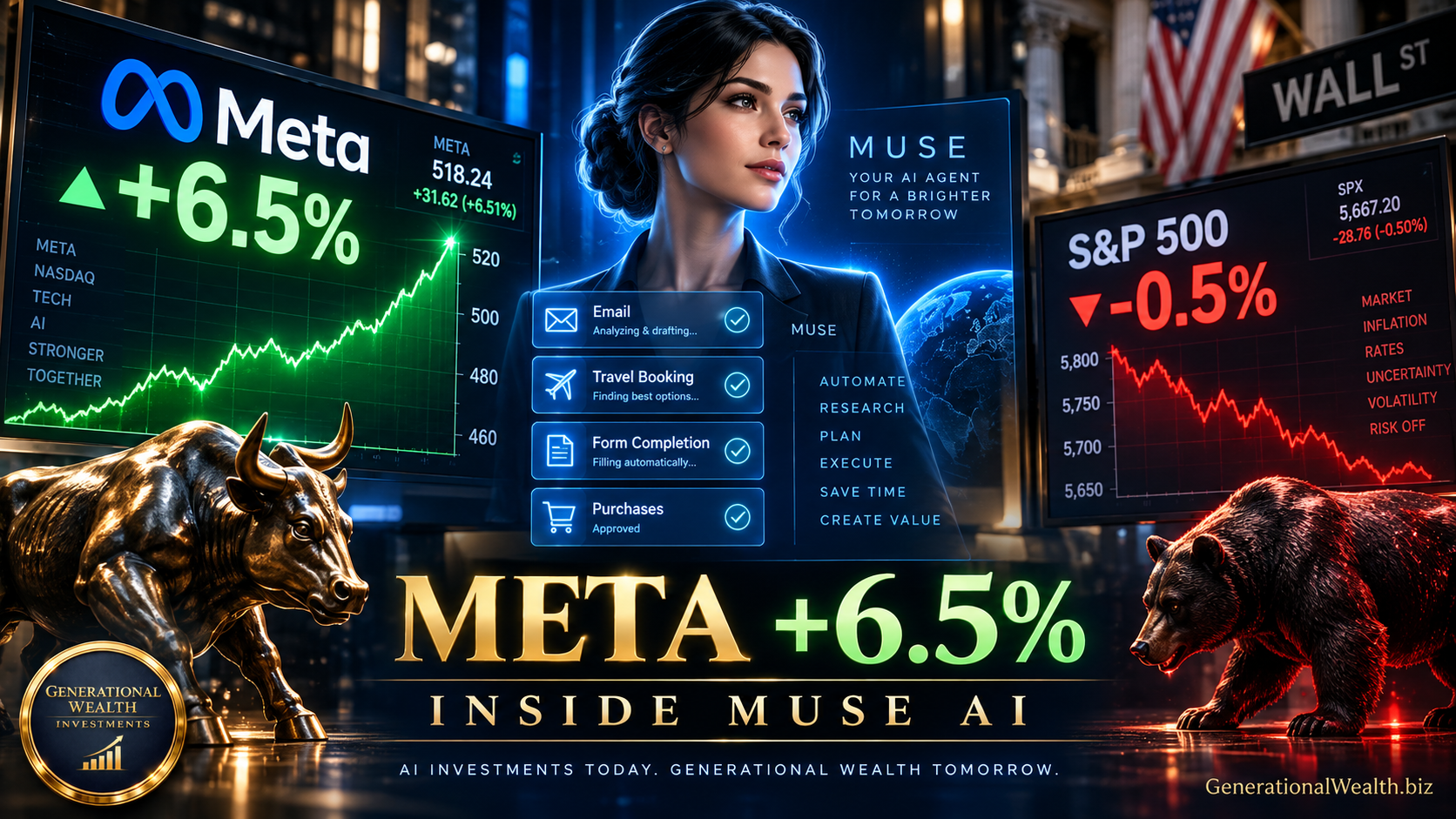
Meta Rallies 6.5% While S&P Falls on Muse AI Launch
Meta surged 6.5% while the S&P 500 fell as investors reacted to Muse, Meta’s new AI agent and potential paid subscription business. The announcement got Wall Street’s attention; now adoption, trust and monetization become the tests that matter.
September 10, 2026
Meta Rallies 6.5% While the S&P Falls on Muse AI
Meta jumped 6.5% Wednesday even as the S&P 500 fell about 0.5%. Investors were reacting to Muse, Meta’s new AI agent, as the company begins connecting its massive AI spending to a potential new source of paid revenue. The next question is whether users will trust Muse enough to adopt it — and pay for it.
Watch Today’s Market Breakdown
See why Meta rallied against a falling market, what Muse can do, and why adoption and monetization are now the key tests.
Today’s Market Setup
Meta’s move stands out because it happened while the broader market was under pressure, putting investors’ attention on whether Muse can begin turning AI investment into a new revenue stream.
Meta Breaks Away From the Market
Meta gained 6.5% Wednesday while the S&P 500 fell about 0.5%. The divergence shows how strongly investors reacted to the Muse announcement even as broader market conditions remained difficult.
Muse Gives AI Spending a Revenue Test
Muse can send emails, book travel, fill forms and make purchases with user approval. Meta expects AI infrastructure spending to exceed $130 billion this year, while Muse adds paid subscriptions that could give investors a clearer way to evaluate that spending.
Broader Markets Remain Under Pressure
Meta’s rally came as oil moved above $100 and Treasury yields climbed, while the S&P 500 declined. That makes Meta’s company-specific strength especially notable against the broader market backdrop.
What Matters From Here
The announcement drove an immediate market reaction. The harder questions now involve actual usage, trust and whether Muse can become meaningful enough for investors to view it as a durable revenue opportunity.
- Will users trust Muse enough to let an AI agent handle emails, travel bookings, forms and purchases?
- Will enough users pay for Muse subscriptions to create a meaningful new revenue stream?
- Can Meta’s strength continue to stand apart if oil and Treasury yields keep pressuring the broader market?
The Headlines Are Only the First Step
The free Market Preview explains why Meta rallied and why Muse matters. The members-only Daily Market Brief goes deeper into the catalysts, risks and confirmation signals worth monitoring as investors evaluate adoption, monetization and Meta’s strength relative to the broader market.
See What Members GetInside Today’s Members-Only Daily Market Brief
- The adoption signals that could help show whether Muse is gaining meaningful traction with users.
- What paid subscriptions could reveal about Meta’s ability to turn its growing AI investment into additional revenue.
- The trust question surrounding an AI agent that can handle emails, travel, forms and purchases on a user’s behalf.
- How Meta’s 6.5% rally fits against a broader market pressured by $100-plus oil and rising Treasury yields.
Go Beyond the Headlines
The public Market Preview tells you what happened. The Generational Wealth Community is designed for investors who want to understand what deserves attention next, what could confirm the current setup, what risks could change it and which developments deserve continued monitoring. We don’t chase hype, we decode the market.
Unlock the Daily Market BriefEducational market research designed to help investors understand the setup — not chase headlines.
Your pathway from knowledge to legacy. We don’t chase hype, we decode the market.
Stay Ahead of What Matters Next
Follow the adoption, monetization and broader market developments that could determine whether Muse becomes more than a strong first reaction from investors.
Join the Generational Wealth Community
Oil Jumps 5% as 10-Year Yield Hits 4.81% and Gold Falls
Oil surged as renewed fighting near the Strait of Hormuz pushed energy prices higher while the 10-year Treasury yield reached about 4.81%. Gold’s decline reveals the bigger market tension as investors weigh geopolitical risk against higher yields, a stronger dollar and the next test from U.S. labor data.
September 2, 2026
Oil Jumps 5% as Treasury Yields Hit 4.81% — So Why Is Gold Falling?
Oil surged after renewed U.S.-Iran fighting near the Strait of Hormuz, pushing Brent to $94.65 Tuesday and briefly near $97 overnight. At the same time, the 10-year Treasury yield reached about 4.81%, its highest since 2023. Yet gold moved the opposite direction, falling to a more than three-week low as higher yields and a stronger dollar outweighed safe-haven demand. Now labor data could test the entire setup.
Watch Today’s Market Breakdown
See how the Hormuz oil shock is feeding into inflation expectations, Treasury yields, stock valuations and gold ahead of the ADP employment report.
Today’s Market Setup
The market is dealing with one connected chain of pressure: geopolitical risk is lifting oil, higher oil is keeping inflation concerns alive, and rising rate expectations are pushing Treasury yields higher.
Oil Surges on Hormuz Risk
Brent settled Tuesday at $94.65, up 4.6%, while WTI gained 5.2%. Brent then briefly touched $97 overnight before easing near $95. Renewed U.S.-Iran fighting near Hormuz is keeping supply risk at the center of the inflation outlook.
Treasury Yields Reach New Highs
The 10-year Treasury yield reached about 4.81%, its highest since 2023, while the 2-year climbed near 4.41%. Higher energy costs can keep inflation elevated, strengthening the market’s focus on whether the Federal Reserve may need to raise rates again.
Gold Breaks the Safe-Haven Pattern
Spot gold fell near $4,324, a more than three-week low, despite the geopolitical tension. Higher Treasury yields and a stronger dollar outweighed safe-haven demand, showing why geopolitical risk alone has not been enough to push gold higher.
What Matters From Here
Oil, rates, stocks and gold are now reacting to the same inflation question. The next test is whether incoming labor data reinforces the higher-rate narrative or begins to challenge it.
- Does the ADP private-payrolls report strengthen the case for another Federal Reserve rate hike, or complicate the market’s current expectations?
- Can oil remain near current levels if fighting around the Strait of Hormuz continues to threaten supply?
- Will higher Treasury yields and a stronger dollar continue to outweigh safe-haven demand for gold?
The Headlines Are Only the First Step
The free Market Preview explains why oil, Treasury yields, stocks and gold are moving the way they are. The members-only Daily Market Brief goes deeper into the catalysts, risks, confirmation signals and developments worth monitoring as the market determines whether this inflation-and-rates pressure continues.
See What Members GetInside Today’s Members-Only Daily Market Brief
- The developments that could confirm whether the current oil-driven inflation pressure is continuing or beginning to ease.
- How the ADP employment report fits into the market’s changing expectations for Federal Reserve policy.
- The Treasury-yield signals worth following as the 10-year trades around its highest level since 2023.
- What gold’s weakness may reveal about the competition between safe-haven demand, higher yields and a stronger dollar.
- The next developments that could change the relationship between energy prices, interest rates and stock valuations.
Go Beyond the Headlines
The public Market Preview tells you what happened and why investors are paying attention. The Generational Wealth Community is designed for investors who want to understand what deserves attention next, what could confirm the current market setup, what risks could change it and which developments deserve continued monitoring. We don’t chase hype, we decode the market.
Unlock the Daily Market BriefEducational market research designed to help investors understand the setup — not chase headlines.
Your pathway from knowledge to legacy. We don’t chase hype, we decode the market.
Stay Ahead of What Matters Next
Follow the catalysts that matter as markets weigh oil near $95, Treasury yields around 4.81%, gold weakness and the next test from U.S. labor data.
Join the Generational Wealth Community
Rate-Hike Odds Hit 66% as Oil Hits $92 and Yields Rise
Rate-hike odds have climbed to 66% as oil trades near $92 and the 10-year Treasury yield reaches its highest level since January 2025. With gold falling and major employment reports approaching, the next question is whether labor data confirms the market’s latest repricing or challenges it.
September 1, 2026
Rate-Hike Odds Jump to 66% as Oil Hits $92 and Treasury Yields Rise
Rate-hike expectations climbed to 66% as oil moved near $92 and the 10-year Treasury yield reached about 4.78%, its highest level since January 2025. Gold is falling at the same time, showing how rising yields are reshaping the inflation trade. Now the market turns to labor data to determine whether this repricing has more room to run.
Watch Today’s Market Breakdown
See how higher oil, rising Treasury yields and shrinking rate-cut expectations are converging ahead of this week’s critical labor data.
Rate-Hike Odds Jump to 66% — Oil $92, Yields 4.78%, Gold Falling Watch Today’s Market BriefingToday’s Market Setup
The market is repricing around three connected pressures: higher energy costs, higher Treasury yields and growing expectations that the Federal Reserve may need to remain restrictive.
Rate-Hike Odds Reach 66%
The implied probability of a rate increase climbed to 66%, extending the repricing that followed Fed Chair Kevin Warsh’s hawkish message Friday. The 10-year Treasury yield is around 4.78%, its highest since January 2025, reinforcing the signal coming from interest-rate markets.
Oil Near $92 Keeps Inflation in Focus
Oil is near $92 after renewed U.S.-Iran fighting revived supply concerns around the Strait of Hormuz. The Strategic Petroleum Reserve also fell to 286.6 million barrels last week, its lowest level since November 1982, leaving a smaller emergency cushion as crude rises.
Higher Yields Pressure Gold
Spot gold fell about 1.2% to around $4,394 even as inflation concerns remain elevated. Higher Treasury yields increase the opportunity cost of holding non-yielding bullion, creating a market where inflation fears and rising interest rates are pulling gold in opposite directions.
What Matters From Here
Oil, yields and rate expectations are all moving in the same direction. The next question is whether incoming labor data reinforces that alignment or begins to challenge it.
- Does Wednesday’s ADP employment report reinforce the market’s higher-rate expectations before the more important Friday jobs report?
- Can oil remain near current levels if supply concerns around the Strait of Hormuz persist?
- Does Friday’s August jobs report strengthen the case behind the 66% rate-hike probability, or force markets to reconsider the current repricing?
The Headlines Are Only the First Step
The free Market Preview explains why oil, Treasury yields and rate-hike expectations are moving together. The members-only Daily Market Brief goes deeper into the catalysts, risks, confirmation signals and developments worth monitoring as labor data tests the market’s current assumptions.
See What Members GetInside Today’s Members-Only Daily Market Brief
- The developments that could reinforce or challenge the market’s current 66% rate-hike probability.
- How labor-market data fits into the Fed repricing now taking place across Treasury yields.
- The oil-supply risks worth monitoring as crude trades near $92 and the Strategic Petroleum Reserve sits at a multi-decade low.
- What gold’s decline may reveal about the balance between inflation concerns and rising real returns available elsewhere.
- The next catalysts that could confirm whether today’s higher-oil, higher-yield setup continues or begins to change.
Go Beyond the Headlines
The public Market Preview tells you what happened and why investors are paying attention. The Generational Wealth Community is built for investors who want to understand what deserves attention next, what could confirm the current setup, what risks could change it and which developments deserve continued monitoring. We don’t chase hype, we decode the market.
Unlock the Daily Market BriefEducational market research designed to help investors understand the setup — not chase headlines.
Your pathway from knowledge to legacy. We don’t chase hype, we decode the market.
Stay Ahead of What Matters Next
Follow the catalysts that matter as markets weigh oil near $92, Treasury yields around 4.78%, higher rate-hike expectations and this week’s employment reports.
Join the Generational Wealth Community
Oil Tops $90 After Hormuz Strike as Hike Odds Hit 57%
Oil moved above $90 after a U.S. strike near the Strait of Hormuz put one of the world’s most important energy routes back in focus. With September rate-hike odds now at 57%, the next question is whether higher energy prices or Friday’s jobs report has the bigger impact on Fed expectations.
August 31, 2026
Oil Blows Past $90 After Hormuz Strike — Rate Hike Odds Jump to 57%
Oil moved above $90 after American forces struck Iranian launchers near the Strait of Hormuz, putting one of the world’s most important energy routes back at the center of the market. The complication is that inflation pressure is already colliding with rising expectations for a September Fed rate increase. Now investors have two major risks to track: energy disruption and Friday’s jobs report.
Watch Today’s Market Breakdown
See why the Hormuz strike pushed oil above $90, how it connects to inflation and rate expectations, and why Friday’s jobs report matters.
Oil Blows Past $90 After Hormuz Strike — Rate Hike Odds Jump to 57% Watch Today’s Market BriefingToday’s Market Setup
The market is dealing with a renewed geopolitical oil shock while interest-rate expectations are already moving in a more restrictive direction.
Hormuz Risk Sends Oil Above $90
American forces struck two Iranian launchers on Larak Island after officials said Revolutionary Guard forces were preparing rockets carrying sea mines into the Strait of Hormuz. Iran then attacked American forces in Jordan. Brent futures climbed about 2% overnight and moved above $90 a barrel.
Oil Adds to the Inflation Problem
Fed Chair Kevin Warsh said Friday that the Fed still has work to do if inflation is not moving clearly toward 2%. Markets raised the implied probability of a September rate increase to 57%, while the two-year Treasury yield is near 4.34% after rising almost 12 basis points Friday.
Friday’s Jobs Report Becomes the Next Test
President Trump said Venezuelan oil from the new American agreement will help refill the Strategic Petroleum Reserve, but additional Venezuelan production requires investment. That leaves the immediate Hormuz risk unresolved while markets wait to see whether Friday’s labor data changes rate-hike expectations.
What Matters From Here
Oil above $90 explains what changed overnight. The more important issue now is how long the pressure lasts and whether it reinforces the Fed’s inflation concerns.
- Does the Strait of Hormuz remain disrupted enough to keep upward pressure on oil, or does the immediate geopolitical risk begin to ease?
- Does higher oil strengthen the inflation argument enough to keep September rate-hike expectations elevated?
- Could a weaker-than-expected jobs report on Friday cool those expectations even if energy prices remain under pressure?
The Headlines Are Only the First Step
The free Market Preview explains why oil, inflation and interest-rate expectations are colliding today. The members-only Daily Market Brief goes deeper into the catalysts, risks, confirmation signals and developments worth monitoring as the Hormuz story and Friday’s jobs report reshape the market setup.
See What Members GetInside Today’s Members-Only Daily Market Brief
- The Hormuz developments that could strengthen or weaken the current oil-supply risk.
- How renewed energy inflation interacts with the market’s 57% September rate-hike probability.
- Why the two-year Treasury yield matters as investors reassess the Fed’s next move.
- What Friday’s jobs report could change about the current interest-rate setup.
- How Venezuela’s longer-term supply story fits against the immediate geopolitical pressure in the Strait of Hormuz.
Go Beyond the Headlines
The public Market Preview tells you what happened and why investors are paying attention. The Generational Wealth Community is built for investors who want to understand what deserves attention next, what could confirm the current setup, what risks could change it, and which developments deserve continued monitoring. We don’t chase hype, we decode the market.
Unlock the Daily Market BriefEducational market research designed to help investors understand the setup — not chase headlines.
Your pathway from knowledge to legacy. We don’t chase hype, we decode the market.
Stay Ahead of What Matters Next
Follow the catalysts that matter as markets weigh renewed Hormuz risk, oil above $90, higher rate-hike expectations and Friday’s jobs report.
Join the Generational Wealth Community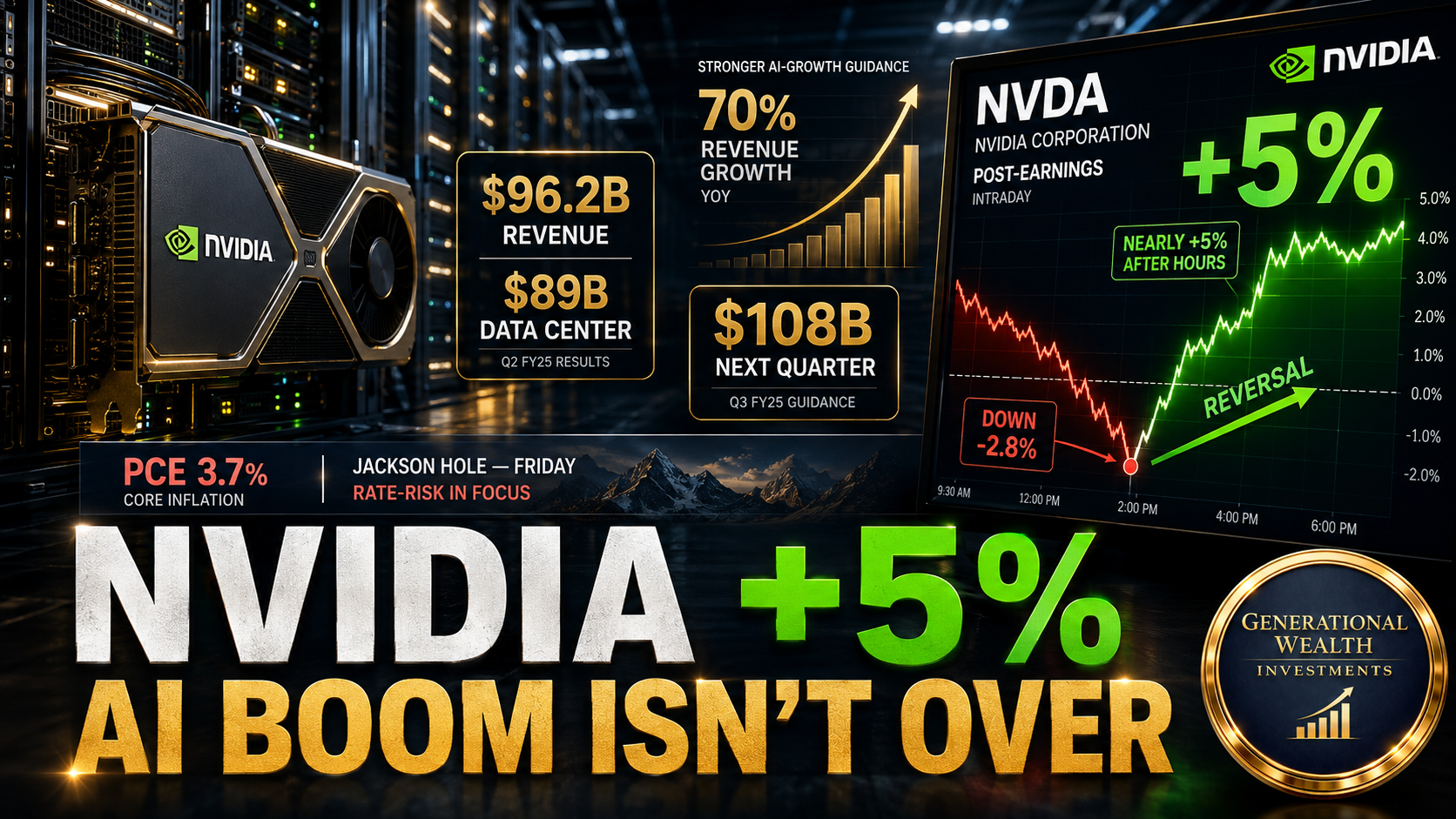
Nvidia Earnings Beat Sends Stock Up 5% on AI Outlook
Nvidia’s earnings sent the stock from an initial after-hours decline to a roughly 5% gain after management delivered a much stronger long-term AI growth outlook. Now investors have to weigh that renewed AI optimism against elevated inflation and Friday’s Jackson Hole signal on interest rates.
August 27, 2026
Nvidia Earnings Beat Sends Stock From Red to +5% as AI Outlook Surges
Nvidia delivered $96.2 billion in quarterly revenue, more than double a year ago, but the stock initially fell after hours. The reversal came after management said it expects about 70% revenue growth in the fiscal year ending January 2028, versus roughly 44% analysts had projected. Shares swung from down more than 1% to up roughly 5%. The question now is whether AI growth can keep overpowering a still-hot inflation backdrop.
Watch Today’s Market Breakdown
See what changed during Nvidia’s earnings call, why the stock reversed higher, and how inflation and interest rates still complicate the AI trade.
Today’s Market Setup
Nvidia strengthened the long-term AI growth story, but the market is still balancing that optimism against inflation and the cost of money.
Nvidia’s Growth Remains Enormous
Nvidia reported $96.2 billion in revenue, more than double a year earlier. Data-center revenue reached $89 billion, up 117%. The numbers reinforced how rapidly AI infrastructure demand is still growing — while also showing why expectations around Nvidia remain unusually high.
Guidance Changed the Reaction
The stock initially fell more than 1% after hours before reversing sharply. Nvidia said it expects about 70% revenue growth in the fiscal year ending January 2028 and guided next-quarter revenue to approximately $108 billion. Shares then climbed roughly 5%.
Inflation Still Pushes Back
S&P 500 e-mini futures were up about 0.5% early this morning after the major indexes finished slightly lower Wednesday. But the Fed’s preferred PCE inflation gauge held at 3.7% in July, above forecasts, keeping interest-rate risk in the market.
What Matters From Here
Nvidia answered an important question about AI demand. The next issue is whether that strength can remain the dominant market force as investors reassess inflation and September rate risk.
- Can Nvidia’s stronger long-term growth outlook continue supporting the broader AI trade if inflation remains elevated?
- Does the positive reaction in S&P 500 futures develop into broader market strength after Wednesday’s slightly lower close?
- What signal does Fed Chair Kevin Warsh give Friday at Jackson Hole about September rates and the future cost of money?
The Headlines Are Only the First Step
The free Market Preview explains why Nvidia’s earnings, guidance and stock reversal matter today. The members-only Daily Market Brief goes deeper into the catalysts, risks, confirmation signals and developments worth monitoring as investors evaluate whether AI strength can continue to outweigh pressure from inflation and interest rates.
See What Members GetInside Today’s Members-Only Daily Market Brief
- The developments that could confirm whether Nvidia’s stronger growth outlook is translating into sustained confidence in the broader AI trade.
- How Nvidia’s earnings, data-center growth and forward revenue expectations fit into the larger AI spending narrative.
- Why elevated PCE inflation keeps the cost of money relevant even as Nvidia signals years of continued AI demand.
- What investors will be listening for when Fed Chair Kevin Warsh speaks Friday at Jackson Hole about the September rate outlook.
Go Beyond the Headlines
The public Market Preview tells you what happened and why investors are paying attention. The Generational Wealth Community is designed for investors who want to understand what deserves attention next, what could confirm the current setup, what risks could change it, and which developments deserve continued monitoring. We don’t chase hype, we decode the market.
Unlock the Daily Market BriefEducational market research designed to help investors understand the setup — not chase headlines.
Your pathway from knowledge to legacy. We don’t chase hype, we decode the market.
Stay Ahead of What Matters Next
Follow the catalysts, risks and confirmation signals that matter as markets weigh Nvidia’s AI growth outlook against inflation and the path of interest rates.
Join the Generational Wealth Community
Brent Crude Falls to $86 as Hormuz Talks Lower Yields
Brent crude has dropped more than 6% in two sessions as Iran and Oman discuss a temporary shipping corridor through the Strait of Hormuz. Treasury yields are falling too, but limited vessel traffic and this morning’s PCE inflation report will test whether the relief can hold.
August 26, 2026
Brent Crude Falls to $86 as Hormuz Reopening Talks Begin — Yields Drop Too
Brent crude has fallen more than 6% in two sessions as Iran and Oman discuss a temporary shipping corridor through the Strait of Hormuz and an agreement to clear mines. Oil is now around $86 a barrel, potentially easing a major inflation pressure as Treasury yields fall. But Hormuz is not fully open, and this morning’s PCE inflation report is the next major test.
Watch Today’s Market Breakdown
See why Hormuz reopening talks are moving oil, how falling crude connects to Treasury yields, and why PCE inflation matters next.
Today’s Market Setup
The market is reacting to the possibility that one of the world’s most important oil routes could begin reopening, but the physical shipping data still shows significant disruption.
Brent Crude Drops Toward $86
Brent settled down nearly 4% Tuesday and fell again this morning to around $86 a barrel. Iran and Oman are discussing a temporary shipping corridor through Hormuz, where roughly one-fifth of the world’s traded oil moved before the war.
Treasury Yields Move Lower
Lower oil can reduce a major source of inflation pressure. The 10-year Treasury yield fell about eight basis points Tuesday to roughly 4.63%, while the 30-year declined to around 5.16%. The S&P 500 gained about 0.3% and the Nasdaq rose roughly 0.7%.
Hormuz Is Still Far From Normal
Only five commodity vessels reportedly transited the strait Tuesday, far below recent normal levels. A tanker was also disabled near Hormuz after an unidentified projectile strike. The reopening narrative is developing faster than normal shipping activity has returned.
What Matters From Here
Falling oil and yields have changed the market setup, but the next signals will determine whether that relief is reinforced or challenged.
- Do the Hormuz discussions translate into meaningfully higher vessel traffic through the strait?
- Does this morning’s PCE inflation report reinforce the easing in oil and Treasury yields, or challenge it with a hotter reading?
- Can the stock-market response hold if shipping disruptions remain significant even as crude prices continue falling?
The Headlines Are Only the First Step
The free Market Preview explains why oil, Hormuz and Treasury yields matter today. The members-only Daily Market Brief goes deeper into the catalysts, risks, confirmation signals and developments worth monitoring as investors evaluate whether the current relief is becoming more durable.
See What Members GetInside Today’s Members-Only Daily Market Brief
- The shipping and vessel-flow developments that could confirm or weaken the Hormuz reopening narrative.
- How falling crude, PCE inflation and Treasury yields fit together in the current market setup.
- What continued disruption near the strait could mean for the relief already appearing across oil, bonds and equities.
- The next developments worth monitoring as markets test whether lower inflation pressure can persist.
Go Beyond the Headlines
The public Market Preview tells you what happened and why investors are paying attention. The Generational Wealth Community is designed for investors who want to understand what deserves attention next, what could confirm the current setup, what risks could change it, and which developments deserve continued monitoring. We don’t chase hype, we decode the market.
Unlock the Daily Market BriefEducational market research designed to help investors understand the setup — not chase headlines.
Your pathway from knowledge to legacy. We don’t chase hype, we decode the market.
Stay Ahead of What Matters Next
Follow the catalysts, risks and confirmation signals that matter as markets evaluate falling oil, Hormuz shipping conditions, inflation and Treasury yields.
Join the Generational Wealth Community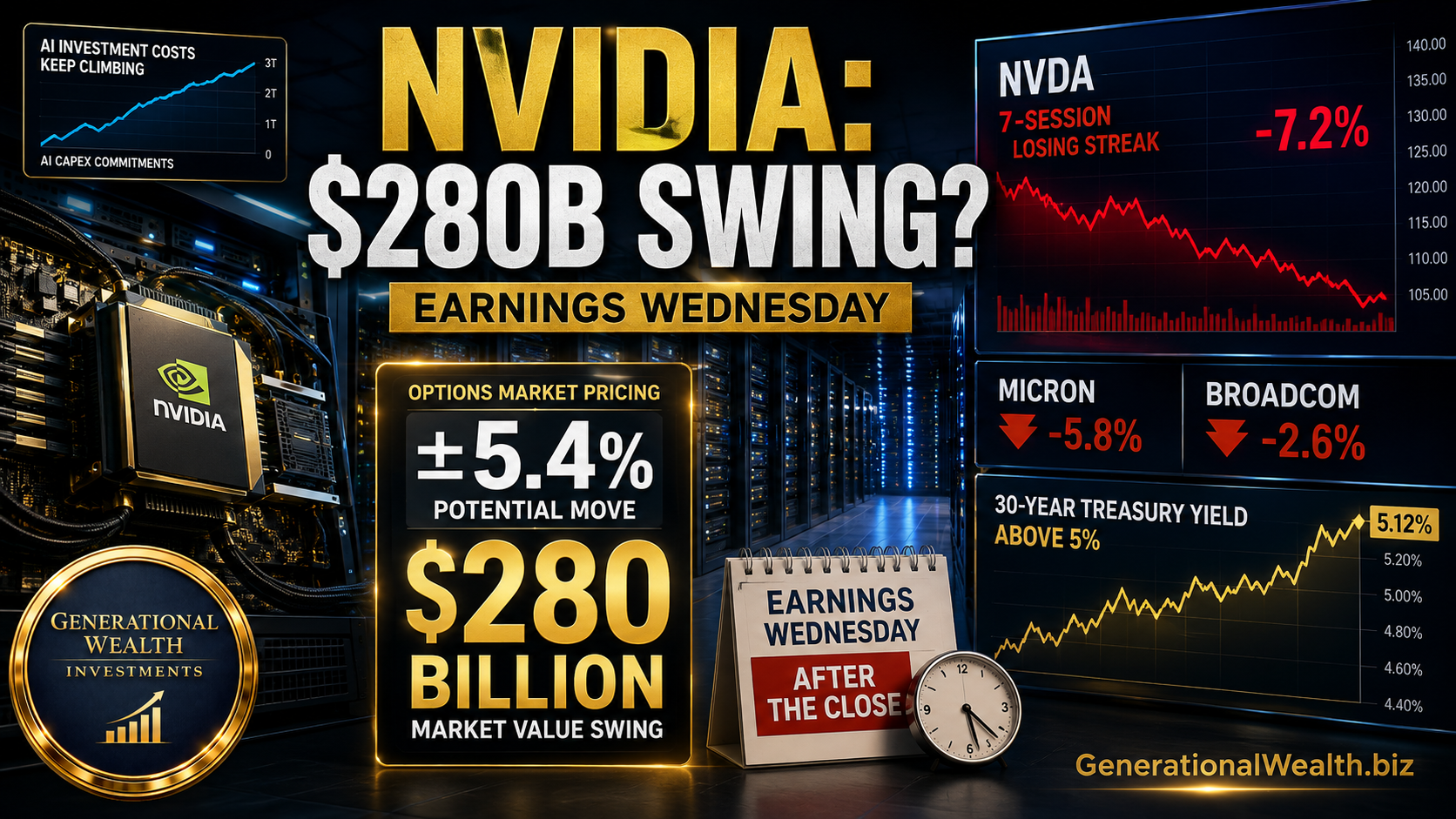
Nvidia Earnings Could Swing $280 Billion — Why It Matters
Nvidia’s Wednesday earnings report could produce a roughly $280 billion market-value swing, yet options traders are pricing a smaller move than Nvidia has averaged after its last twelve reports. With semiconductor stocks already under pressure and long-term Treasury yields above 5%, the report has become a major test of confidence in the AI spending boom.
August 25, 2026
Nvidia Earnings Could Swing $280 Billion — Yet Traders Expect Less Volatility Than Usual
Nvidia’s Wednesday earnings report carries an implied move of about 5.4%, equal to roughly $280 billion in market value. That sounds enormous, but it is still smaller than Nvidia’s average post-earnings swing over the last twelve quarters. With Nvidia entering the report after seven straight down sessions, the bigger question is whether its outlook can restore confidence in the broader AI trade.
Watch Today’s Market Breakdown
See why Nvidia’s earnings could move far more than one stock, what Wall Street is watching beyond revenue, and how high Treasury yields complicate the AI spending story.
Nvidia Earnings Could Swing $280 Billion — Why Traders Are Nervous Watch today’s free Generational Wealth market breakdownToday’s Market Setup
Nvidia has become a much broader test of the AI investment story. The setup going into Wednesday combines elevated earnings expectations, weakness across major semiconductor stocks, and borrowing costs that remain historically high.
Traders Are Pricing a $280 Billion Swing
Options imply about a 5.4% move after Nvidia reports Wednesday. That represents roughly $280 billion in market value and is larger than the individual market value of 90% of S&P 500 companies, yet it remains below Nvidia’s average post-earnings move over the last twelve quarters.
Chip Stocks Are Already Under Pressure
Nvidia fell 2.9% Monday for its seventh consecutive down session. Micron dropped nearly 6%, Broadcom fell more than 2.5%, and the Nasdaq lost about three-quarters of a percent. That puts Wednesday’s report in focus well beyond Nvidia itself.
AI Spending Faces a Rates Test
Wall Street is looking for quarterly revenue around $92 billion, nearly double a year earlier, but the 30-year Treasury yield remains above 5%. Higher borrowing costs can make capital-intensive data-center projects harder to finance even when demand for AI infrastructure remains strong.
What Matters From Here
The headline earnings number will matter, but investors are looking beyond one quarter to determine whether the broader AI spending cycle still has enough momentum to support expectations.
- Does Nvidia’s guidance, margin outlook and chip-demand commentary support the expectations already built into the AI trade?
- Are major cloud providers still increasing AI spending aggressively enough to support continued demand for data-center infrastructure?
- Can the AI investment cycle remain resilient if long-term Treasury yields stay above 5% and financing remains expensive?
The Headlines Are Only the First Step
The free Market Preview explains why Nvidia’s report matters and the forces shaping the setup going into Wednesday. The members-only Daily Market Brief goes deeper into the catalysts, risks, confirmation signals and developments worth monitoring as investors judge whether the AI trade is strengthening or losing momentum.
See What Members GetInside Today’s Members-Only Daily Market Brief
- The guidance, margin and chip-demand signals that could strengthen or weaken confidence in the AI spending cycle.
- What continued cloud-provider AI spending would mean for Nvidia and the broader semiconductor complex.
- How weakness in Micron, Broadcom and the Nasdaq fits into the market setup heading into Nvidia’s report.
- Why long-term Treasury yields above 5% remain an important pressure point for capital-intensive data-center investment.
Go Beyond the Headlines
The public Market Preview tells you what happened and why investors are paying attention. The Generational Wealth Community is designed for investors who want to understand what deserves attention next, what could confirm the current setup, what risks could change it, and which developments deserve continued monitoring. We don’t chase hype, we decode the market.
Unlock the Daily Market BriefEducational market research designed to help investors understand the setup — not chase headlines.
Your pathway from knowledge to legacy. We don’t chase hype, we decode the market.
Stay Ahead of What Matters Next
Follow the catalysts, risks and confirmation signals that deserve attention as Nvidia’s earnings test expectations for AI demand, cloud spending and the broader semiconductor trade.
Join the Generational Wealth Community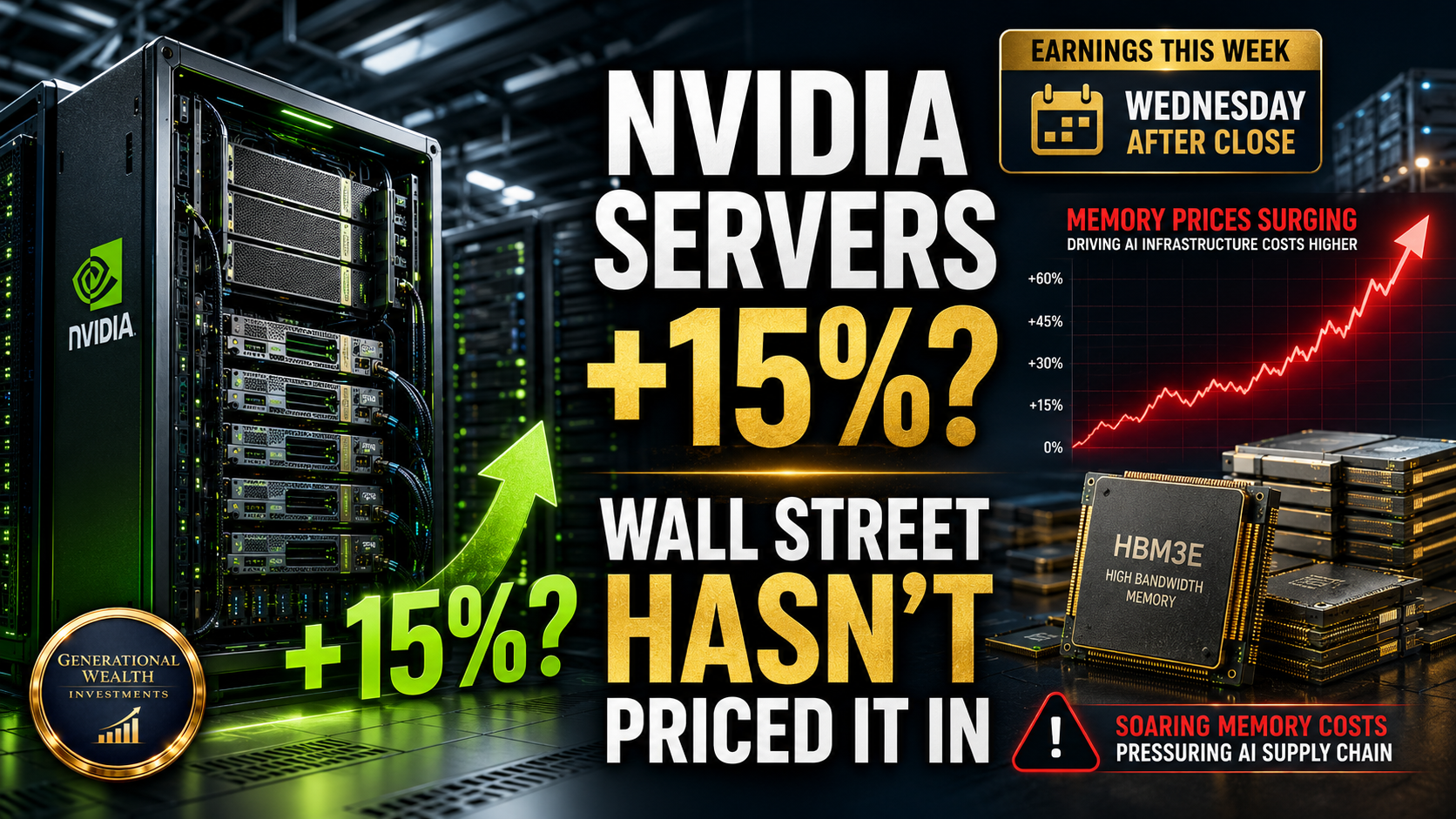
A weekend report says some Nvidia AI server prices could rise more than 15% as soaring memory costs move through the AI infrastructure supply chain. Nvidia shares get their first chance to react Monday, just two days before earnings put margins, pricing power, and data-center spending in focus.
August 23, 2026
Nvidia Server Prices May Jump 15% — Before the Stock Can React
Some Nvidia AI servers may soon cost more than 15% more as memory-chip prices climb, according to a Saturday report that Nvidia had not yet confirmed. Because the news arrived while markets were closed, Nvidia shares have not reacted. Monday brings the first test — followed by an even bigger one when Nvidia reports earnings Wednesday after the closing bell.
Watch Today’s Market Breakdown
See why rising memory costs could affect Nvidia’s AI-server pricing, data-center spending, semiconductor margins, and the market setup heading into earnings.
Today’s Market Setup
The report puts a new variable into the AI trade just days before Nvidia earnings: the cost of building the infrastructure powering the boom may be rising.
Nvidia Server Prices Could Rise Sharply
Bloomberg reported Saturday that some major Nvidia customers were told server prices could rise more than 15% in many cases because memory-chip costs are soaring. Reuters could not independently verify the report, and Nvidia had not commented.
The Pressure Extends Beyond Nvidia
The affected systems reportedly include Vera Rubin and Grace Blackwell platforms shipping early next year. Server builders supplying Microsoft, Google and Oracle have also reportedly warned customers about increases, raising questions about the cost of already enormous AI data-center budgets.
Memory Makers Sit on the Other Side
Higher memory prices could strengthen Samsung, SK Hynix and Micron even as they increase costs elsewhere in the AI supply chain. Nvidia lists memory and component expenses within cost of revenue, putting margins and pricing power directly in focus.
What Matters From Here
The reported price increases are important. The bigger issue is how much of those costs Nvidia can pass through — and whether the market sees them as a margin problem, a pricing-power signal, or both.
- Does Nvidia confirm the reported server-price increases, and how much of the higher memory cost will customers absorb?
- How does Nvidia stock react Monday when investors get their first opportunity to trade on the weekend report?
- What does Wednesday’s fiscal second-quarter report reveal about margins, pricing power, and the cost of the next phase of the AI infrastructure buildout?
The Headlines Are Only the First Step
The free Market Preview explains why rising memory costs could matter for Nvidia and the broader AI trade. The members-only Daily Market Brief goes deeper into the catalysts, risks, confirmation signals, and developments worth monitoring as Nvidia moves from Monday’s market reaction into Wednesday’s earnings report.
See What Members GetInside Today’s Members-Only Daily Market Brief
- What to monitor when Nvidia shares get their first chance to react to the weekend server-pricing report on Monday.
- The signals that could help determine whether higher memory costs are becoming a broader AI-infrastructure issue.
- Why Nvidia’s pricing power and margin commentary will matter when the company reports Wednesday after the closing bell.
- How Micron, Samsung and SK Hynix fit into the other side of the same memory-cost story.
Go Beyond the Headlines
The public Market Preview tells you what happened and why investors are paying attention. The Generational Wealth Community is designed for investors who want to understand what deserves attention next, what could confirm the current market narrative, what risks could change the setup, and which developments deserve continued monitoring. We don’t chase hype, we decode the market.
Unlock the Daily Market BriefEducational market research designed to help investors understand the setup — not chase headlines.
Your pathway from knowledge to legacy. We don’t chase hype, we decode the market.
Stay Ahead of What Matters Next
Follow the catalysts, risks, and confirmation signals that deserve attention as Nvidia, memory-chip costs, AI spending, and Wednesday’s earnings report test the next phase of the AI trade.
Join the Generational Wealth Community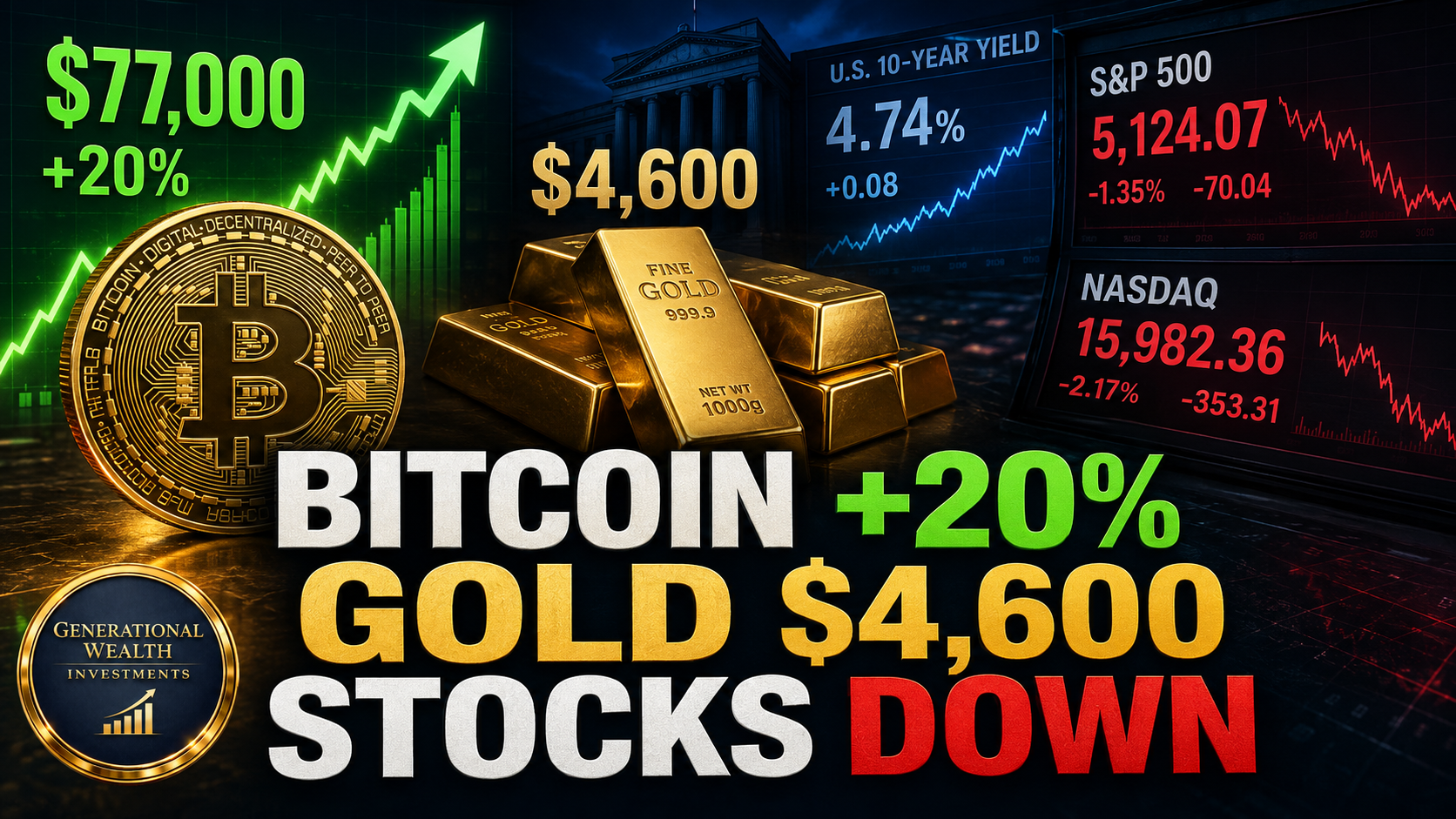
Bitcoin +20%, Gold $4,600 as Stocks Break the Pattern
Bitcoin gained more than 20% and gold pushed above $4,600 after the Treasury announced larger long-term debt buybacks — but stocks finished the week lower and Treasury yields climbed back up. Wednesday’s inflation report and Nvidia earnings now provide the next major test of a market pattern that suddenly stopped behaving normally.
August 22, 2026
Bitcoin +20%, Gold $4,600 — But Stocks Broke the Pattern
Bitcoin ended the week near $77,000 after gaining more than 20%, while gold futures settled above $4,600. Both strengthened after the Treasury announced plans to at least double its long-term debt buybacks. But stocks did not follow — and the 10-year Treasury yield is already back near 4.74%. Now the question is whether this unusual split can hold through Wednesday’s inflation report and Nvidia earnings.
Watch Today’s Market Breakdown
See why Treasury buybacks helped ignite Bitcoin and gold, why stocks moved the other way, and what could challenge the trade next.
Today’s Market Setup
Treasury policy triggered a powerful move in Bitcoin and gold, but weakness in stocks and another rise in long-term yields created a market setup that is anything but straightforward.
Treasury Buybacks Ignited Bitcoin
The Treasury said it would at least double how much long-term government debt it buys back. Traders read the added cash as easier financial conditions. Bitcoin reached nearly $80,000 before ending the week near $77,000, up more than 20% for its biggest weekly gain in over two years.
Gold Joined the Move
Gold futures settled Friday above $4,600 an ounce, reaching a three-month high and completing a fifth consecutive weekly gain. Its strength alongside Bitcoin shows that the Treasury announcement affected more than crypto, even as equities moved differently.
Stocks and Yields Broke the Pattern
The S&P 500 still finished the week down about 1.5%, while the Nasdaq lost roughly 2%. More importantly, the 10-year Treasury yield closed Friday near 4.74% — higher than before the buyback announcement and a potential challenge to the liquidity-driven move.
What Matters From Here
Bitcoin and gold delivered the headline move. The next step is determining whether the forces behind that strength are being confirmed or beginning to reverse.
- Can Bitcoin and gold maintain their strength if the 10-year Treasury yield remains near 4.74% or continues rising?
- Does Wednesday’s July inflation report reinforce the market’s easier-money interpretation — or challenge it?
- Can Nvidia earnings help stocks reconnect with the strength in Bitcoin and gold, or does the market divergence continue?
The Headlines Are Only the First Step
The free Market Preview explains why Bitcoin and gold surged while stocks lagged. The members-only Daily Market Brief goes deeper into the levels, catalysts, risks, confirmation signals, and market developments worth monitoring as Treasury yields, inflation data, and Nvidia earnings test the current setup.
See What Members GetInside Today’s Members-Only Daily Market Brief
- What to monitor in the 10-year Treasury yield after it returned to roughly 4.74% despite the Treasury buyback announcement.
- The signals that could help confirm whether Bitcoin’s more than 20% weekly advance is holding or beginning to unwind.
- How Wednesday’s July inflation report could strengthen or challenge the current market setup.
- Why Nvidia earnings on the same day could matter for the disconnect between stronger Bitcoin and gold and weaker equities.
Go Beyond the Headlines
The public Market Preview tells you what happened and why investors are paying attention. The Generational Wealth Community is designed for investors who want to understand what deserves attention next, what could confirm the current move, what risks could change the setup, and which developments deserve continued monitoring. We don’t chase hype, we decode the market.
Unlock the Daily Market BriefEducational market research designed to help investors understand the setup — not chase headlines.
Your pathway from knowledge to legacy. We don’t chase hype, we decode the market.
Stay Ahead of What Matters Next
Follow the catalysts, risks, and confirmation signals that deserve attention as Treasury yields, inflation, Nvidia, Bitcoin, gold, and stocks test this unusual market split.
Join the Generational Wealth Community
Walmart Falls 9% as High Gas Prices Squeeze Shoppers
Walmart beat earnings and raised guidance, but its 9% plunge exposed a bigger concern: shoppers are pulling back as high gas prices pressure household budgets. With Brent near $94, Treasury yields rising, and a major Iran policy announcement coming Monday, the consumer is becoming one of the market’s most important signals.
August 21, 2026
Walmart Beat Earnings and Fell 9% — The Consumer Just Broke
Walmart beat earnings and raised its guidance, yet the stock fell 9% in its worst day in years. The problem was not profit — it was the shopper. U.S. store sales grew just 2.6% versus the 3.7% Wall Street expected, and Walmart said high gas prices are forcing customers to make trade-offs. Now oil and Monday’s Iran announcement could determine whether that pressure gets worse.
Watch Today’s Market Breakdown
See why Walmart’s earnings beat was not enough, how oil and rising yields are tightening the consumer squeeze, and why Monday’s Iran plan matters next.
Today’s Market Setup
Walmart turned a strong-looking earnings headline into a warning about household budgets, while oil and interest rates added pressure across the broader market.
Walmart Exposed the Consumer Pressure
Walmart beat earnings and raised guidance, but the stock dropped 9%. U.S. store sales grew 2.6% versus the 3.7% Wall Street expected, the slowest pace since 2020. The company said shoppers are making trade-offs because gas prices are high.
Oil and Yields Tightened the Squeeze
Brent crude settled near $94 a barrel Thursday, up more than 2%, after the Treasury Secretary vowed the toughest sanctions ever on Iran. Treasury yields also climbed. The Dow fell more than 700 points, while the S&P 500 and Nasdaq each lost about 1%.
Bitcoin and Gold Moved Their Own Way
Not everything followed stocks lower. Bitcoin is near $77,000, its highest level since May, and is heading for its best week in more than two years. Gold held above $4,500 an ounce as investors head into Monday’s next major catalyst.
What Matters From Here
Walmart showed where consumer pressure is appearing. The bigger question now is whether Monday’s policy announcement strengthens or eases the forces behind it.
- What does Monday’s full Iran plan mean for crude oil and the gas-price pressure Walmart says is affecting shoppers?
- Do higher fuel costs and rising Treasury yields create additional pressure on consumers and the broader stock market?
- Can Bitcoin near $77,000 and gold above $4,500 maintain their strength if yields continue climbing?
The Headlines Are Only the First Step
The free Market Preview explains why Walmart’s earnings beat turned into a 9% selloff and how oil, rates, and consumer pressure connect. The members-only Daily Market Brief goes deeper into the catalysts, risks, confirmation signals, and developments worth monitoring as Monday’s Iran plan approaches.
See What Members GetInside Today’s Members-Only Daily Market Brief
- What to monitor in Monday’s Iran announcement and how the next developments could affect the oil and fuel-price story.
- The consumer signals behind Walmart’s 2.6% U.S. sales growth and why the gap versus expectations matters beyond one retailer.
- How rising Treasury yields and higher fuel costs interact with the inflation pressure already affecting household budgets.
- The developments that could help confirm or challenge the strength in Bitcoin near $77,000 and gold above $4,500.
Go Beyond the Headlines
The public Market Preview tells you what happened and why investors are paying attention. The Generational Wealth Community is designed for investors who want to understand what deserves attention next, what could confirm the current market move, what risks could change the setup, and which developments deserve continued monitoring. We don’t chase hype, we decode the market.
Unlock the Daily Market BriefEducational market research designed to help investors understand the setup — not chase headlines.
Your pathway from knowledge to legacy. We don’t chase hype, we decode the market.
Stay Ahead of What Matters Next
Follow the catalysts, risks, and market signals that deserve continued attention as oil, Treasury yields, consumer spending, Bitcoin, and gold reshape the market setup.
Join the Generational Wealth Community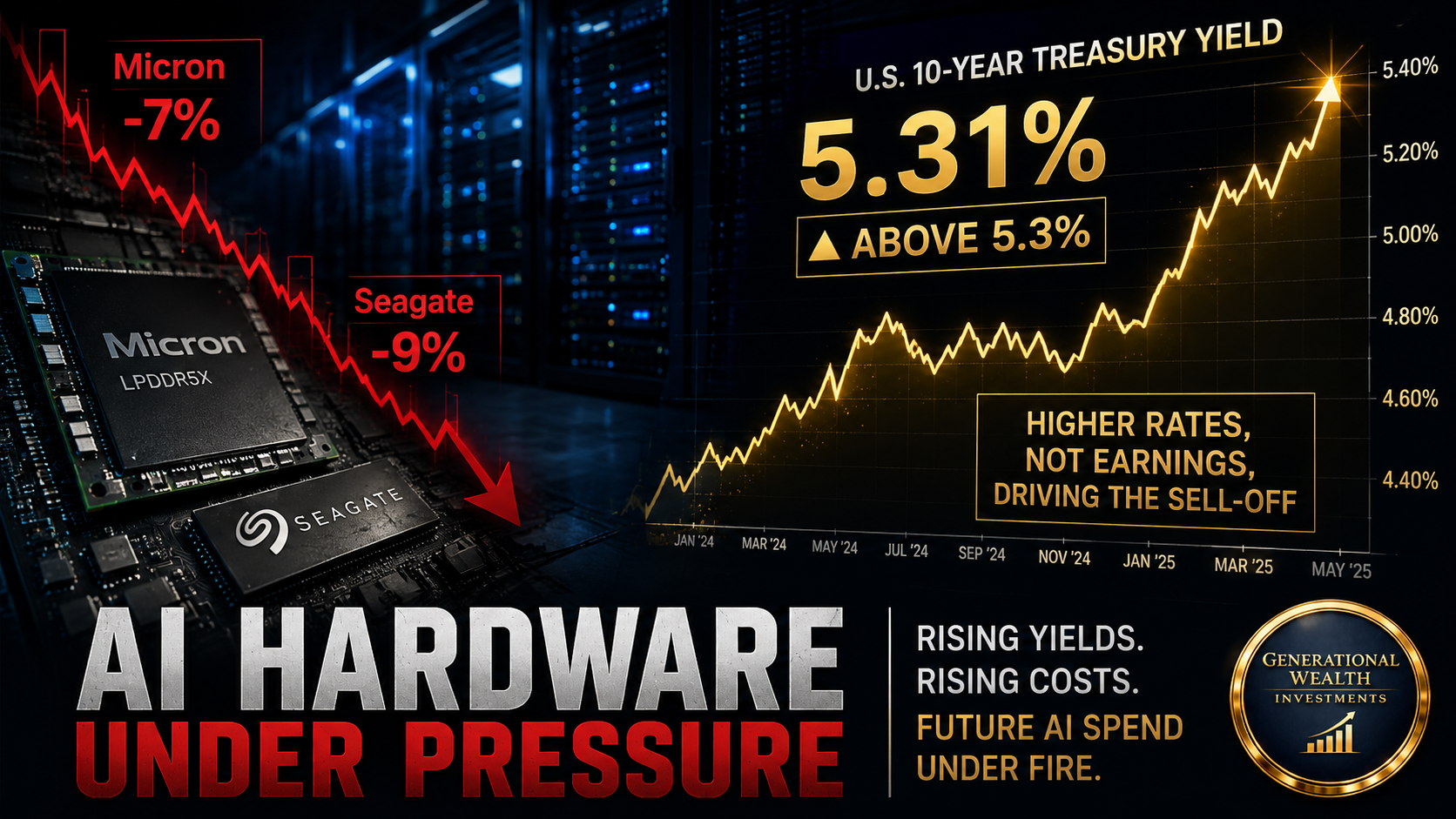
Micron Fell 7% as Treasury Yields Pressure AI Hardware
Micron, Seagate, and SanDisk were hit hard even without bad earnings or company-specific news. The real pressure came from rising long-term Treasury yields, just as investors begin questioning the enormous future cost of the AI buildout.
August 19, 2026
Micron Fell 7%, Seagate 9% — The Real Reason Isn't Earnings
Micron fell 7% yesterday while SanDisk and Seagate each dropped about 9% — without bad earnings or company-specific news driving the move. The pressure came as the 30-year Treasury yield climbed above 5.3%, a 19-year high, hitting stocks valued on profits far into the future. Now investors are watching whether higher yields, enormous future AI commitments, and today’s Fed minutes extend the pressure.
Watch Today’s Market Breakdown
See why rising long-term rates hit memory stocks so hard, how future AI spending commitments add to the pressure, and why today’s Fed minutes matter next.
Today’s Market Setup
The selloff was not simply another bad day for technology. Rising borrowing costs hit the market’s most rate-sensitive AI names while much of the broader market held up better.
Higher Yields Hit AI Hardware
The 30-year Treasury yield climbed above 5.3%, its highest level in 19 years. Micron fell 7%, while SanDisk and Seagate dropped about 9%. With AI hardware valued heavily on profits expected years into the future, rising long-term rates put immediate pressure on those valuations.
The AI Bill Is Getting Scrutiny
A Wall Street Journal review of filings found nine major technology firms carrying roughly $3 trillion of future AI commitments in their footnotes — about five times what they spent last year. As yields rise, the cost behind the massive AI buildout becomes increasingly important to investors.
The Pressure Spread Overseas
South Korea’s Kospi fell nearly 6% overnight and Japan’s Nikkei dropped about 3%, with Japan’s 10-year yield near a 30-year high. Yet the Dow slipped only about 0.2% and the Nasdaq lost 1.3%, pointing to concentrated pressure rather than a uniform market decline.
What Matters From Here
Yesterday explains what triggered the selloff. The more important question now is whether the forces behind it keep building.
- Can Micron and other AI hardware names stabilize if the 30-year Treasury yield remains above 5.3% or moves even higher?
- Will today’s July Federal Reserve minutes reinforce the rate pressure after three officials voted to raise rates at the meeting?
- Does Brent crude near $92 add another layer of pressure as Washington and Tehran clash over whether the Strait of Hormuz is open?
The Headlines Are Only the First Step
The free Market Preview explains why the AI hardware trade suddenly came under pressure. The members-only Daily Market Brief goes deeper into the catalysts, risks, confirmation signals, and developments that can help determine whether this remains a targeted rate-driven reset or begins changing the broader market setup.
See What Members GetInside Today’s Members-Only Daily Market Brief
- The Treasury-yield developments that could confirm whether pressure on rate-sensitive AI stocks is continuing or beginning to ease.
- What today’s Fed minutes could change after three officials voted in favor of raising rates at the July meeting.
- The signals that can help distinguish weakness concentrated in expensive AI hardware from deterioration spreading across the broader market.
- How the roughly $3 trillion of future AI commitments fits into the financing-cost story investors are now reassessing.
- The oil and Strait of Hormuz developments worth monitoring if Brent near $92 continues adding pressure to the market backdrop.
Go Beyond the Headlines
The public Market Preview tells you what happened and why investors are paying attention. The Generational Wealth Community is designed for investors who want to understand what deserves attention next, what could confirm the current setup, what risks could change it, and which developments deserve continued monitoring. We don’t chase hype, we decode the market.
Unlock the Daily Market BriefEducational market research designed to help investors understand the setup — not chase headlines.
Your pathway from knowledge to legacy. We don’t chase hype, we decode the market.
Stay Ahead of What Matters Next
Understand the catalysts, risks, and market signals that deserve continued attention as yields, AI spending, oil, and Federal Reserve policy reshape the setup.
Join the Generational Wealth Community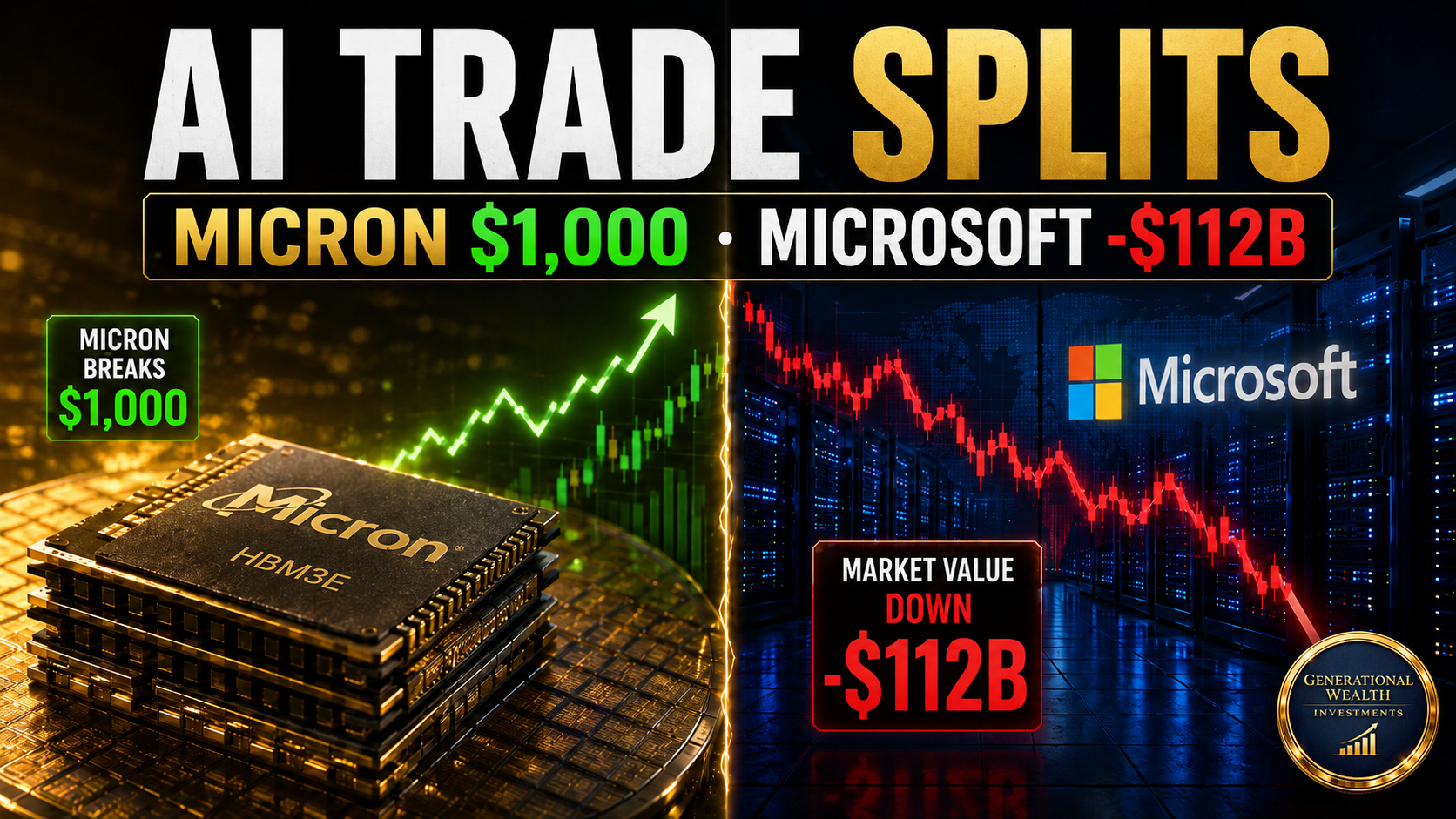
Micron Hits $1,000 as Microsoft Loses $112 Billion
Micron surged above $1,000 while Microsoft lost roughly $112 billion in market value as investors separated the companies selling the AI buildout from those paying for it. Rising memory costs, higher Treasury yields, and Wednesday’s Fed minutes could determine whether that divide grows wider.
August 18, 2026
Micron Hits $1,000 While Microsoft Loses $112 Billion — The AI Trade Just Split
Micron closed above $1,000 a share for the first time since early July while Microsoft lost roughly $112 billion in market value. The split reveals an important change inside the AI trade: investors rewarded companies selling the infrastructure while punishing some of the companies paying for it. Now rising memory costs, higher Treasury yields, and Wednesday’s Fed minutes are testing whether that divide gets wider.
Watch Today’s Market Breakdown
See why Micron surged while Microsoft fell, how semiconductor suppliers separated from major AI spenders, and why Wednesday’s Fed minutes matter next.
Today’s Market Setup
Monday’s action was less about technology broadly falling and more about investors separating the companies supplying the AI buildout from some of the companies absorbing its rising costs.
Memory Becomes the Winning Side
Micron gained about 4% as memory prices climbed and the administration opposed Apple buying Chinese memory chips. With supply already tight, the development kept attention on Micron and the companies positioned to sell increasingly expensive components into the AI buildout.
AI Spending Becomes the Pressure Point
Microsoft fell about 3% and Oracle dropped more than 2.5%, while Applied Materials gained more than 5% and Lam Research and Taiwan Semiconductor also advanced. Investors were not abandoning technology altogether; they were distinguishing between companies selling AI infrastructure and companies paying for it.
Financing Costs Add Another Test
The 30-year Treasury yield closed at 5.31%, its highest level of 2026. Nasdaq 100 futures were down about 1.1% this morning as yields and oil climbed, adding another layer of pressure as AI components themselves become more expensive.
What Matters From Here
Understanding Monday’s rotation is only the first part of the story. The next question is whether the forces behind it continue to reinforce one another.
- Can semiconductor suppliers keep outperforming if elevated memory costs continue pressuring the companies funding massive AI data-center buildouts?
- Does a 30-year Treasury yield at 5.31% deepen the divide between companies selling AI infrastructure and those financing it?
- What will Wednesday’s July Fed minutes reveal about how much support existed for a rate hike after three officials dissented?
The Headlines Are Only the First Step
The free Market Preview explains why the AI trade split. The members-only Daily Market Brief goes deeper into the levels, catalysts, risks, confirmation signals, and developments that can help determine whether today’s rotation is strengthening, weakening, or changing character.
See What Members GetInside Today’s Members-Only Daily Market Brief
- The signals that could confirm whether strength is continuing across Micron and other semiconductor suppliers.
- The Treasury-yield developments that could intensify or ease financing pressure across the AI buildout.
- What to monitor in Wednesday’s Fed minutes after three officials dissented in favor of a rate hike.
- The signs that help distinguish a targeted AI rotation from a broader deterioration in technology.
- The developments worth tracking if memory prices and infrastructure costs remain elevated.
Go Beyond the Headlines
The public Market Preview tells you what happened. The Generational Wealth Community is designed for investors who want to understand what deserves attention next, what could confirm the current setup, what risks could change it, and which developments deserve continued monitoring. We don’t chase hype, we decode the market.
Unlock the Daily Market BriefEducational market research designed to help investors understand the setup — not chase headlines.
Your pathway from knowledge to legacy. We don’t chase hype, we decode the market.
Stay Ahead of What Matters Next
Follow the market beyond the initial headline and understand the catalysts, risks, and signals that deserve continued attention.
Join the Generational Wealth Community
Market Preview: Jobs Miss, Records, Gold 7-Week High
The economy lost 23,000 jobs in July and stocks closed at record highs anyway, as September rate hike odds fell to roughly 44%. Gold ripped 2.5% to a seven-week high, Space Exploration Technologies surged 16%, and Bitcoin ETFs pulled in over $750 million for the week.
Market Preview: Stocks Close at Records on a Negative Jobs Report as Gold Rips to a Seven-Week High
The economy unexpectedly shed jobs in July, and equities finished Friday's session at record highs anyway. The reason sits with a Fed that has been debating a rate increase rather than a cut — and a weak payroll print pulled September hike odds down sharply. Today's video breaks down why capital rotated into growth and hard assets, why Space Exploration Technologies jumped roughly 16%, and the one data point Wednesday that could reverse the whole setup.

Today's Market Snapshot
Jobs and Rates: Bad News Read as Good News
July payrolls fell by 23,000 against expectations for an 80,000 gain, with May and June revised down a combined 103,000. Unemployment slipped to 4.1% and participation to 61.4%. With this Fed debating a hike rather than a cut, September hike odds tracked by LSEG fell to roughly 44% from about 57%.
Equities: Records, With Chips and Space Leading
At Friday's completed close the S&P 500 rose about 0.6% to a record near 7,758, the Nasdaq gained 1.3% to its own record, and the Dow added roughly 152 points — the strongest week since April. Semiconductors led. Space Exploration Technologies closed up about 16% after an Argus upgrade to buy.
Metals and Crypto: Hard Assets and Steady Flows
Spot gold rose roughly 2.5% to near $4,340 an ounce, a seven-week high and its best week since January, with silver around $64. Crypto lagged on price — Bitcoin near $65,000, ether near $1,920 — but U.S. spot Bitcoin ETFs logged a fifth straight inflow day and over $750 million for the week.
What Investors Should Be Watching
- Wednesday's July consumer price index, where economists expect headline inflation near 3.4%. A hot reading puts a September hike back on the table and challenges the rate math behind Friday's rally.
- Whether the rotation toward rate-sensitive growth and hard assets broadens, or stays concentrated in the chip and precious-metals names that did most of the work last week.
- Whether the move in Space Exploration Technologies can hold. Newly unlocked insider shares are the stated risk to further gains after a 16% single-session move.
Inside Today's Members-Only Daily Market Brief
- The specific levels and catalysts members are tracking across gold, the chip complex and the September rate path as hike odds reset toward 44%.
- Both sides of Wednesday's CPI print, and what to monitor into the next session depending on which way the number lands.
- Where capital is rotating as money moves out of energy and into rate-sensitive growth and hard assets — the strongest and weakest areas of the tape.
- The risks that could reverse a record week, including what a downwardly revised labor picture may actually be signaling about the economy.
- How members are reading the space and gold-miner moves, and why chasing a sharp run carries added risk.
Go Beyond the Headlines
The public video explains what happened. The Generational Wealth Community helps members understand what matters next, where the risks are, and which developments deserve continued attention.
Unlock the Daily Market Brief
Oil Spikes on Hormuz Plan as Gold Nears Best Week Since Jan
A single Iranian document on Strait of Hormuz shipping sent Brent up 3.8%, pushed the 10-year yield above 4.67%, and ended the Dow's record streak — while gold ran to its best week since January. Today's preview covers the memory chip selloff, where capital is rotating, and what the July jobs report could change.
Two things worth flagging: the snapshot figures are session-specific and will read stale within a day or two, so if you want this page to have a longer shelf life on the blog, say the word and I'll swap in an evergreen variant. And if you want the header banner and social thumbnail assets to match, I can build those next.
Market Preview: Oil Spikes on a Hormuz Document as Gold Heads for Its Best Week Since January
Iranian state media published a draft plan restricting ship traffic through the Strait of Hormuz, and Brent settled up about 3.8% — reversing a week of steep declines. Higher energy costs pushed the 10-year yield above 4.67% and lifted September Fed rate hike odds to roughly 58%, ending the Dow's record streak. Today's video breaks down why memory chip stocks sold off despite strong results, and why gold is having its best week since January.

Today's Market Snapshot
Energy and Rates: One Document Moves Everything
Iranian state media published a draft plan restricting Strait of Hormuz ship traffic. Brent settled up roughly 3.8% near $82.49 and WTI near $77.29, reversing a week of steep declines. Higher energy costs fed inflation expectations: the 10-year Treasury yield climbed more than five basis points to about 4.67%, and September rate hike odds sit near 58%.
Equities: Memory Chips Break the Record Streak
The Dow fell 464 points, or 0.85%, to 53,885, ending its record run. The S&P 500 slipped just under 7,710 and the Nasdaq was nearly flat. Western Digital dropped about 13% and SanDisk near 7% despite both beating results — guidance disappointed. Selling spread to Asia, where SK Hynix fell sharply. AppLovin tumbled roughly 19%.
Metals and Crypto: Rotation Into Hard Assets
Gold traded near $4,254 an ounce, up roughly 5% on the week and on pace for its best week since January, with silver around $62. Crypto stayed quiet: Bitcoin near $64,700 and still capped below $65,000, Ether near $1,910, XRP around $1.03. Cardano was the standout, up about 6.5%.
What Investors Should Be Watching
- The July jobs report at 8:30 a.m. Eastern. Economists expect roughly 80,000 jobs after 57,000 in June, with unemployment near 4.2%. A hot print strengthens the September hike case; a weak one does the opposite.
- Whether the memory chip selling stays contained. Western Digital grew revenue about 44% and still fell 13%, which suggests investors are repricing how much AI growth is already built into these names.
- Whether the Hormuz restrictions hold. The move in oil came from a published draft plan, and crude, yields and gold all reprice quickly if that story changes direction again.
Inside Today's Members-Only Daily Market Brief
- The specific levels and catalysts members are tracking across crude, gold and the 10-year as rate hike odds climb toward 58%.
- How members are reading the memory chip selloff, including the confirmation signal that would tell us whether this is sector-specific or the start of a broader AI valuation reset.
- Where capital is rotating as money moves out of crowded AI trades and into rate-sensitive and hard assets — the strongest and weakest areas of the tape.
- The risks that could reverse a 5% weekly move in gold, and why chasing a sharp run carries added risk.
- Both sides of the July jobs report, and what to monitor into the next session depending on which way the number lands.
Go Beyond the Headlines
The public video explains what happened. The Generational Wealth Community helps members understand what matters next, where the risks are, and which developments deserve continued attention.
Unlock the Daily Market Brief