

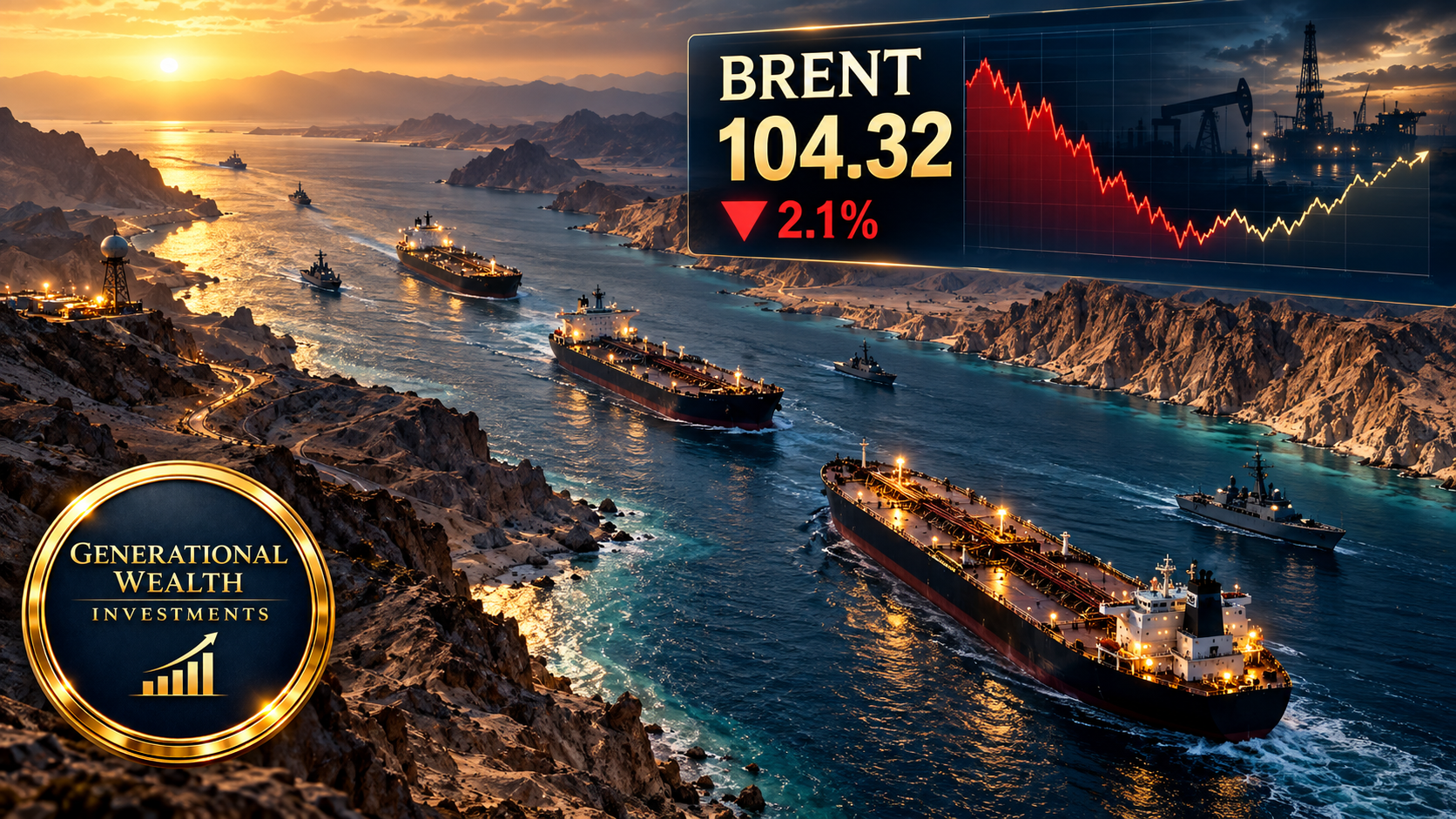
Trump Rejects Iran's Hormuz Offer: Will Brent Crude Spike?
President Trump rejected Iran’s proposal to reopen the Strait of Hormuz just as traders were pricing in renewed diplomacy. Now Iran’s latest warning puts the focus on Brent crude’s first trade after the weekend—and whether geopolitical risk returns to the price.
September 27, 2026
Trump Rejects Iran’s Hormuz Offer: Will Brent Crude Spike When Trading Reopens?
President Trump publicly rejected Iran’s proposal to reopen the Strait of Hormuz on Saturday. On Sunday, Iran’s army said it was prepared for renewed U.S. attacks and warned that Tehran would not accept being unable to trade while others use the region’s strategic waterways. Brent settled Friday near $104 after falling more than 2%, so the next crude trade will test whether diplomacy hopes still outweigh renewed geopolitical risk.
Watch Today’s Market Breakdown
See why Trump’s rejection and Iran’s new warning changed the weekend setup, and why Brent crude’s first trade when markets reopen could become the next important signal.
Today’s Market Setup
Friday’s oil decline reflected optimism that diplomacy could reopen the Strait of Hormuz. Trump’s rejection of Iran’s proposal and Tehran’s Sunday warning now create a tougher test: whether traders keep pricing in a path to negotiations or quickly add back geopolitical risk.
Trump Rejected the Hormuz Offer
President Trump said Saturday that he rejected Iran’s proposal to reopen the Strait of Hormuz and end the fighting. That removes, for now, the clearest weekend catalyst behind expectations for a faster reopening.
Iran Issued a New Warning
On Sunday, Iran’s army said it was prepared for renewed U.S. attacks and warned that Tehran would not accept being unable to trade while others use the region’s strategic waterways. That keeps escalation risk in focus.
Brent Closed Near $104
Brent crude fell more than 2% Friday to around $104 as traders focused on diplomacy. With roughly one-fifth of global oil supply moving through Hormuz before the war, the next crude trade carries unusual signaling value.
What Matters From Here
Friday’s market was still leaning toward diplomacy. The question now is whether the weekend’s developments change that calculation when crude trading resumes.
- Does Brent reverse sharply higher when trading resumes after Trump’s rejection of Iran’s reopening proposal?
- Do traders continue betting that negotiations survive despite Iran’s warning and the tougher public positions from both sides?
- Does Tehran’s condition that its demands be met keep a credible path to reopening Hormuz alive, or does the market begin pricing a longer disruption?
The Headlines Are Only the First Step
The free Market Preview explains why the weekend developments matter and why crude’s reopening trade is now the immediate market test. The members-only Daily Market Brief goes deeper into the catalysts, risks, confirmation signals and developments worth monitoring as traders decide whether diplomacy is still credible or geopolitical risk is rebuilding.
See What Members GetInside Today’s Members-Only Daily Market Brief
- The crude-market signals that could show whether Friday’s diplomacy-driven decline is reversing or still holding.
- What to monitor around Hormuz as traders reassess the probability and timing of a reopening.
- The next U.S.-Iran diplomatic or military developments that could strengthen or weaken the current oil-market setup.
- Why Brent’s first move after the weekend could help distinguish a temporary headline reaction from a broader repricing of supply risk.
Go Beyond the Headlines
The public Market Preview tells you what happened. The Generational Wealth Community is designed for investors who want to understand what deserves attention next, what could confirm the current market setup, what risks could change it and which developments deserve continued monitoring. We don’t chase hype, we decode the market.
Unlock the Daily Market BriefEducational market research designed to help investors understand the setup — not chase headlines.
Your pathway from knowledge to legacy. We don’t chase hype, we decode the market.
Stay Ahead of What Matters Next
Friday’s oil market reflected confidence that diplomacy could improve the Hormuz outlook. The next crude trade and the next U.S.-Iran signals will help show whether that confidence survives the weekend.
Join the Generational Wealth Community
Saudi Arabia Attacked—Why Oil Prices Fell Below $100
Weekend attacks on Saudi Arabia would normally add pressure to oil prices, yet WTI fell below $100 as traders focused on recovering Saudi exports and possible U.S.-Iran diplomacy. The next question is whether improving supply and diplomacy can keep oil below that threshold—or whether geopolitical risk takes control again.
September 21, 2026
Saudi Arabia Was Attacked — So Why Did Oil Prices Fall?
Weekend attacks on Saudi Arabia added fresh supply risk, yet West Texas Intermediate crude fell below $100. Traders instead focused on Saudi exports rebounding to just over 4 million barrels a day this month from about 2.4 million in August, along with possible U.S.-Iran diplomacy. The question now is whether those forces can keep pressure on oil prices.
Watch Today’s Market Breakdown
See why oil moved lower despite new attacks, what recovering Saudi exports are changing and why this week’s diplomacy now matters.
Today’s Market Setup
Oil is sending a counterintuitive signal: geopolitical risk remains elevated, but traders are also seeing signs that supply conditions and diplomacy could be improving.
WTI Falls Below $100
West Texas Intermediate crude moved below $100 even after weekend attacks on Saudi Arabia. Instead of reacting only to the attacks, traders are weighing whether improving Saudi exports and possible diplomatic progress could reduce some of the pressure on supply.
Saudi Exports Are Recovering
Saudi crude exports have rebounded to just over 4 million barrels a day this month, compared with roughly 2.4 million in August. That recovery is important because additional supply can change how the market evaluates geopolitical disruptions.
Inflation Pressure Is Back in Focus
Oil above $100 had been feeding inflation fears and expectations for higher interest rates. With crude moving lower and U.S. stock futures higher, investors are now watching whether the change in oil prices can persist.
What Matters From Here
The drop below $100 is important. What happens next depends on whether the forces pushing oil lower continue to outweigh the geopolitical risk.
- Can West Texas Intermediate remain below $100 if attacks and regional supply risks continue?
- Does the recovery in Saudi crude exports continue strongly enough to keep easing supply concerns?
- Does this week’s United Nations diplomacy produce meaningful de-escalation between the United States and Iran?
The Headlines Are Only the First Step
The free Market Preview explains why oil fell despite new attacks. The members-only Daily Market Brief goes deeper into the catalysts, risks, confirmation signals and developments worth monitoring as traders decide whether this oil move can continue.
See What Members GetInside Today’s Members-Only Daily Market Brief
- The signals worth monitoring to determine whether WTI can remain below $100 or begins reversing higher.
- How the recovery in Saudi crude exports changes the supply-risk picture after the weekend attacks.
- The diplomatic developments that could strengthen or weaken the current oil-market setup.
- How changes in oil prices could affect the inflation and interest-rate concerns investors have been watching.
Go Beyond the Headlines
The public Market Preview tells you what happened. The Generational Wealth Community is designed for investors who want to understand what deserves attention next, what could confirm the current setup, what risks could change it and which developments deserve continued monitoring. We don’t chase hype, we decode the market.
Unlock the Daily Market BriefEducational market research designed to help investors understand the setup — not chase headlines.
Your pathway from knowledge to legacy. We don’t chase hype, we decode the market.
Stay Ahead of What Matters Next
The next test is whether this week’s diplomacy produces real de-escalation — and whether WTI can remain below $100.
Join the Generational Wealth Community
Market Preview: Gold at $4,400 as Fed Weighs Rate Hike
Gold is back above $4,400 an ounce while the Federal Reserve debates a rate hike — a combination that normally works against a metal paying no yield. Today's preview covers the softer dollar, the closed Strait of Hormuz, and why Wednesday's Fed minutes are the event that matters.
August 17, 2026
Market Preview: Gold Climbs Past $4,400 as the Fed Debates a Rate Hike
Gold is pushing back above four thousand four hundred dollars an ounce at the same time the Federal Reserve is debating whether to raise interest rates. Those two things are not supposed to happen together, because higher rates normally punish an asset that pays no yield. Today’s video explains the two developments behind the move and why the hedge trade is going into metal rather than crypto.
Watch Today’s Market Breakdown
Gold Hits $4,400 While The Fed Debates A RATE HIKE — This Shouldn’t Happen

Today’s Market Snapshot
Gold Rises Into Rate-Hike Talk
Gold is back above $4,400 an ounce even as the Fed debates raising rates, a combination that usually works against a metal paying no yield. One driver showed up overnight: the dollar has slipped for a third straight session, near its weakest since May, making gold cheaper for buyers outside the U.S.
Energy Keeps Inflation Risk Alive
The Strait of Hormuz, which normally carries about a fifth of the world’s oil, has been effectively closed since late February, and talks to reopen it are stalled. Brent crude is trading near $89 a barrel. Investors appear to be buying gold as an inflation hedge rather than a bet on rate cuts.
Stocks Steady, Bitcoin Left Out
Equities are shrugging off the debate. The S&P 500 closed Friday within a quarter percent of Thursday’s record and futures are higher this morning. Bitcoin is not getting the hedge bid, sitting near $63,000, roughly flat over twenty-four hours and lower on the week.
What Investors Should Be Watching
- Whether gold continues trading as an inflation hedge, or whether a steadier dollar changes the character of the move.
- Whether stalled talks around the Strait of Hormuz keep energy prices elevated and inflation risk in the conversation.
- Whether Wednesday afternoon’s July Fed minutes shift September hike odds, currently near one in three, after three officials voted to raise rates.
Inside Today’s Members-Only Daily Market Brief
- The market levels and catalysts that matter next as gold extends its move.
- The strongest and weakest areas of the market beneath the major indexes.
- The risks that could reverse the current inflation-hedge interpretation.
- Important developments to monitor ahead of Wednesday’s Fed minutes.
- A clearer explanation of what rising gold and a rate-hike debate may mean together for investors.
Go Beyond the Headlines
The public video explains what happened. The Generational Wealth Community helps members understand what matters next, where the risks are, and which developments deserve continued attention.
Unlock the Daily Market BriefYour pathway from knowledge to legacy. We don’t chase hype, we decode the market.

Retail Sales Drop 0.6% as Small Caps Hit Record High
Retail sales fell 0.6% in July and consumer sentiment sank to 51, yet the Russell 2000 closed at an all-time high as rate-hike fears faded. The bond market disagreed — the ten-year yield rose to 4.68% while oil spiked near $82 on Strait of Hormuz tensions.
Market Preview: Retail Sales Fall 0.6% as Small Caps Close at a Record and Oil Spikes to $82
The American consumer just posted the biggest spending drop in more than a year — and small-cap stocks closed at an all-time high the same session. The bond market didn't go along with it: the ten-year yield rose instead of falling, while oil settled near $82 after drone strikes in the Strait of Hormuz. Today's video explains the tension underneath a record close: cheaper money versus more expensive energy.

Today's Market Snapshot
The Consumer Pulled Back
Retail sales fell six tenths of a percent in July, the biggest drop in more than a year, when economists had expected a small increase. Consumer sentiment sank about 8% to 51, and households now expect 4.3% inflation over the next year.
Small Caps Hit a Record Anyway
After softer inflation reports Wednesday and Thursday, a weaker consumer eased fears the Fed must raise rates again in September. Small caps are the most rate-sensitive corner of the market, and the Russell 2000 closed at an all-time high.
Bonds and Oil Disagreed
The ten-year Treasury yield rose to 4.68% instead of falling on weak data — a signal inflation risk hasn't gone away. Oil settled near $82, up more than 5% on the week after Strait of Hormuz tanker strikes. Energy led all sectors, up roughly 7%.
What Investors Should Be Watching
- The retailers deliver their own verdict this week — Home Depot Tuesday, Target and Lowe's Wednesday, Walmart Thursday. If they confirm shoppers are pulling back, that small-cap record gets much harder to defend.
- Whether the ten-year yield keeps climbing on soft data, which would say the bond market is more worried about inflation than about growth.
- Whether the Strait of Hormuz situation escalates or cools, with gasoline still around $4 a gallon and the naval blockade open-ended.
Inside Today's Members-Only Daily Market Brief
- The levels members are tracking on small caps now that the Russell 2000 is at a record with a weakening consumer underneath it.
- How to read a bond market that rises on bad news — and what that pattern has historically meant for rate expectations.
- What each retailer print this week would do to the September rate debate, and which one carries the most weight.
- Where the energy trade sits after a 7% sector week, and the risks that could reverse it quickly.
- The strongest and weakest areas of the market heading into the next session.
Go Beyond the Headlines
The public video explains what happened. The Generational Wealth Community helps members understand what matters next, where the risks are, and which developments deserve continued attention.
Unlock the Daily Market Brief