


Trump Rejects Iran's Hormuz Offer: Will Brent Crude Spike?
President Trump rejected Iran’s proposal to reopen the Strait of Hormuz just as traders were pricing in renewed diplomacy. Now Iran’s latest warning puts the focus on Brent crude’s first trade after the weekend—and whether geopolitical risk returns to the price.
September 27, 2026
Trump Rejects Iran’s Hormuz Offer: Will Brent Crude Spike When Trading Reopens?
President Trump publicly rejected Iran’s proposal to reopen the Strait of Hormuz on Saturday. On Sunday, Iran’s army said it was prepared for renewed U.S. attacks and warned that Tehran would not accept being unable to trade while others use the region’s strategic waterways. Brent settled Friday near $104 after falling more than 2%, so the next crude trade will test whether diplomacy hopes still outweigh renewed geopolitical risk.
Watch Today’s Market Breakdown
See why Trump’s rejection and Iran’s new warning changed the weekend setup, and why Brent crude’s first trade when markets reopen could become the next important signal.
Today’s Market Setup
Friday’s oil decline reflected optimism that diplomacy could reopen the Strait of Hormuz. Trump’s rejection of Iran’s proposal and Tehran’s Sunday warning now create a tougher test: whether traders keep pricing in a path to negotiations or quickly add back geopolitical risk.
Trump Rejected the Hormuz Offer
President Trump said Saturday that he rejected Iran’s proposal to reopen the Strait of Hormuz and end the fighting. That removes, for now, the clearest weekend catalyst behind expectations for a faster reopening.
Iran Issued a New Warning
On Sunday, Iran’s army said it was prepared for renewed U.S. attacks and warned that Tehran would not accept being unable to trade while others use the region’s strategic waterways. That keeps escalation risk in focus.
Brent Closed Near $104
Brent crude fell more than 2% Friday to around $104 as traders focused on diplomacy. With roughly one-fifth of global oil supply moving through Hormuz before the war, the next crude trade carries unusual signaling value.
What Matters From Here
Friday’s market was still leaning toward diplomacy. The question now is whether the weekend’s developments change that calculation when crude trading resumes.
- Does Brent reverse sharply higher when trading resumes after Trump’s rejection of Iran’s reopening proposal?
- Do traders continue betting that negotiations survive despite Iran’s warning and the tougher public positions from both sides?
- Does Tehran’s condition that its demands be met keep a credible path to reopening Hormuz alive, or does the market begin pricing a longer disruption?
The Headlines Are Only the First Step
The free Market Preview explains why the weekend developments matter and why crude’s reopening trade is now the immediate market test. The members-only Daily Market Brief goes deeper into the catalysts, risks, confirmation signals and developments worth monitoring as traders decide whether diplomacy is still credible or geopolitical risk is rebuilding.
See What Members GetInside Today’s Members-Only Daily Market Brief
- The crude-market signals that could show whether Friday’s diplomacy-driven decline is reversing or still holding.
- What to monitor around Hormuz as traders reassess the probability and timing of a reopening.
- The next U.S.-Iran diplomatic or military developments that could strengthen or weaken the current oil-market setup.
- Why Brent’s first move after the weekend could help distinguish a temporary headline reaction from a broader repricing of supply risk.
Go Beyond the Headlines
The public Market Preview tells you what happened. The Generational Wealth Community is designed for investors who want to understand what deserves attention next, what could confirm the current market setup, what risks could change it and which developments deserve continued monitoring. We don’t chase hype, we decode the market.
Unlock the Daily Market BriefEducational market research designed to help investors understand the setup — not chase headlines.
Your pathway from knowledge to legacy. We don’t chase hype, we decode the market.
Stay Ahead of What Matters Next
Friday’s oil market reflected confidence that diplomacy could improve the Hormuz outlook. The next crude trade and the next U.S.-Iran signals will help show whether that confidence survives the weekend.
Join the Generational Wealth Community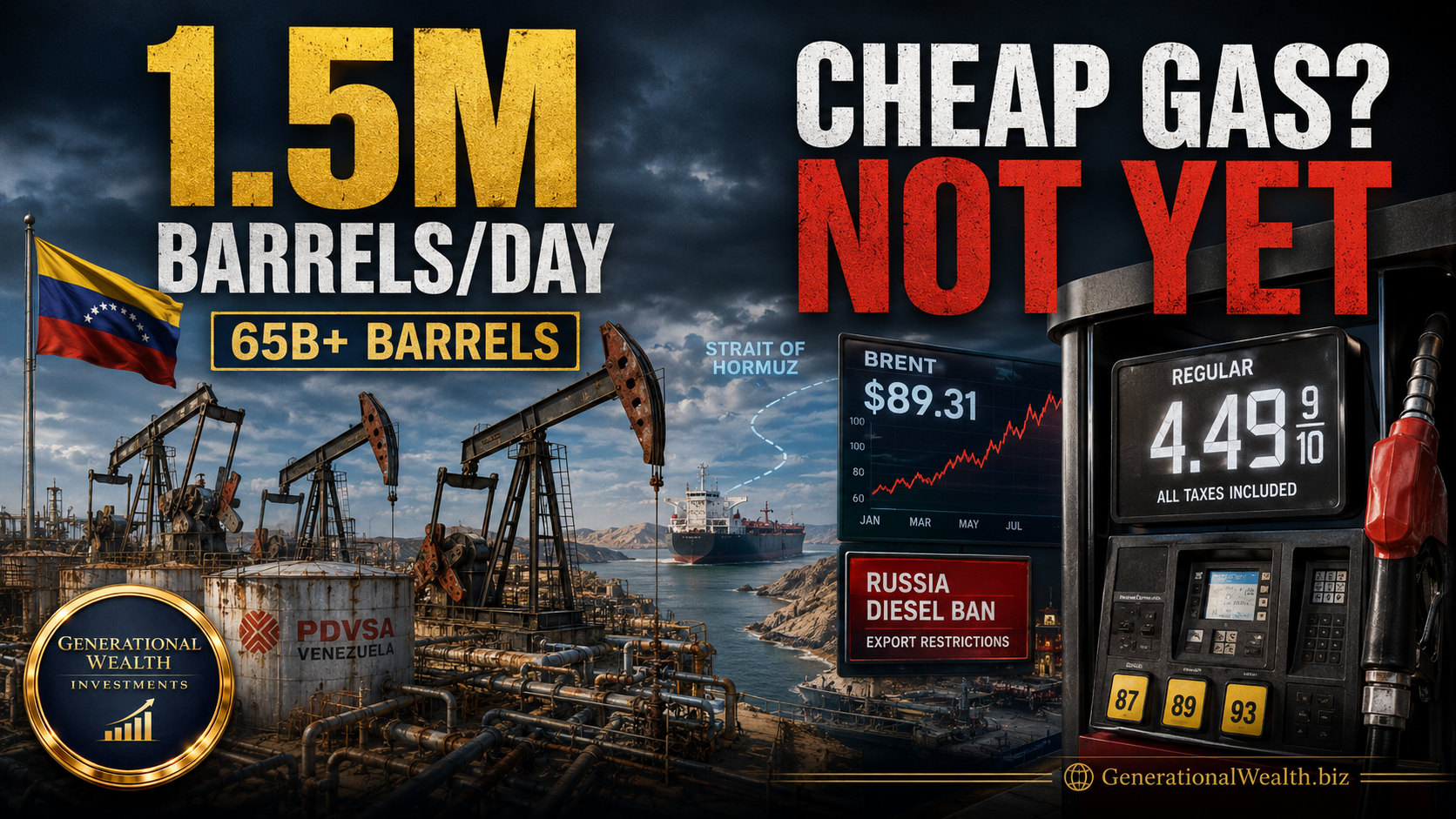
Venezuela’s 1.5M-Barrel Oil Deal: Why Gas Won’t Drop Yet
Venezuela’s new U.S. oil project targets more than 1.5 million barrels a day, but years of underinvestment mean those barrels may not reach the market quickly. At the same time, Russia’s diesel export ban and shifting Strait of Hormuz flows are creating a much more complicated near-term oil setup.
August 30, 2026
Venezuela Targets 1.5M Barrels a Day — Why Cheap Gas Isn’t Here Yet
Venezuela’s new U.S. oil project is targeting more than 1.5 million barrels a day and covers over 65 billion barrels of proven reserves. But years of underinvestment mean substantial new production could still take years, while Russia’s diesel export ban is tightening fuel availability now. The opportunity is enormous — but timing is what matters.
Watch Today’s Market Breakdown
See why Venezuela’s massive oil agreement does not automatically mean cheaper gasoline now, and how Russia, Hormuz and Brent crude complicate the near-term setup.
Today’s Market Setup
The oil market is balancing enormous potential future supply from Venezuela against infrastructure problems and fuel constraints that remain important right now.
Venezuela Targets 1.5M Barrels a Day
Venezuela says the 25-year bilateral project will develop 17 strategic oilfields and targets more than 1.5 million barrels of daily production. The original agreement covers more than 65 billion barrels of proven reserves, creating substantial long-term supply potential.
Infrastructure Is the Near-Term Constraint
Venezuela’s oil industry has suffered from years of underinvestment. Experts cited in the supplied research say major repairs could take years before production rises substantially, meaning headline production targets and actual new barrels may arrive on very different timelines.
Russia Keeps Pressure on Fuel Supply
Russia extended its diesel export ban through September 30 after drone attacks left several refineries offline. Meanwhile, Brent settled Friday at $89.31, down more than 5% for the week as traders weighed improving Hormuz flows and a more hawkish Federal Reserve.
What Matters From Here
The size of Venezuela’s agreement is clear. The bigger issue is how quickly the long-term supply story begins turning into actual production while current fuel constraints remain in place.
- How quickly can Venezuela repair infrastructure and translate the 1.5-million-barrel-a-day target into meaningful new production?
- Does Russia’s diesel export ban offset some of the near-term pressure lower from improving oil flows through the Strait of Hormuz?
- Do the new company agreements expected next week, including talks involving Chevron, begin moving the project from announcement toward execution?
The Headlines Are Only the First Step
The free Market Preview explains why Venezuela’s oil agreement matters and why it does not immediately solve today’s fuel constraints. The members-only Daily Market Brief goes deeper into the catalysts, risks, confirmation signals, and developments worth monitoring as this supply story moves from announcement toward execution.
See What Members GetInside Today’s Members-Only Daily Market Brief
- The developments that could show whether Venezuela’s 1.5-million- barrel-a-day target is beginning to move from headline to execution.
- Why the timing of infrastructure repairs matters to the long-term supply narrative and expectations around future production.
- How Russia’s diesel restrictions and improving Strait of Hormuz flows are pulling the near-term fuel market in opposite directions.
- What the company agreements expected next week could clarify about the pace and credibility of Venezuela’s oil expansion.
Go Beyond the Headlines
The public Market Preview tells you what happened and why investors are paying attention. The Generational Wealth Community is designed for investors who want to understand what deserves attention next, what could confirm the current setup, what risks could change it, and which developments deserve continued monitoring. We don’t chase hype, we decode the market.
Unlock the Daily Market BriefEducational market research designed to help investors understand the setup — not chase headlines.
Your pathway from knowledge to legacy. We don’t chase hype, we decode the market.
Stay Ahead of What Matters Next
Follow the catalysts and risks that matter as Venezuela moves toward new company agreements while Russia, Hormuz and infrastructure constraints continue shaping the oil-market setup.
Join the Generational Wealth Community
Oil's Biggest Build in 3.5 Years — And Prices Rose Anyway
U.S. crude inventories posted their biggest weekly build in three and a half years — 17.4 million barrels, against expectations for a drawdown — and oil closed higher anyway. Today's preview breaks down why the barrels piled up, what the Strait of Hormuz has to do with it, and why the Fed's next move may be a hike.
Market Preview: Oil Posts Its Biggest Build in 3.5 Years as Prices Climb Anyway
America's oil stockpile just posted its biggest weekly jump in three and a half years — 17.4 million barrels, when forecasters were looking for a drawdown — and crude still closed higher. That combination usually signals something other than weak demand. Today's video explains what the headline inventory number misses, and why it points toward the Federal Reserve.

Today's Market Snapshot
A Record Build, and a Higher Close
Government data showed U.S. crude inventories rose 17.4 million barrels in a single week, the largest build in three and a half years. Forecasters had expected a drawdown. Crude closed slightly higher anyway — the kind of divergence that says the inventory number is measuring something other than demand.
Hormuz Is the Bottleneck
American crude exports fell to their lowest level since the war with Iran began, while imports surged. Barrels piled up because they couldn't ship out. The Strait of Hormuz remains effectively closed, and the IEA now sees the world short roughly 1.8 million barrels a day this quarter.
Energy Reaches the Rate Path
July inflation cooled to 3.4%, but energy is still up nearly 15% from a year ago — which is why September odds now favor a hike near 42% rather than a cut. This morning crude finally cracked, with WTI near $81.60, down about 2%, snapping a five-day run on reopening-deal chatter.
What Investors Should Be Watching
- Wholesale inflation at 8:30 Eastern — the last read before September rate odds firm up, and the number most likely to move a hike-versus-cut debate that is already leaning one way.
- Whether talk of a deal to reopen the Strait of Hormuz can keep pressure on crude, or whether a shortfall the IEA puts near 1.8 million barrels a day reasserts itself.
- Whether the AI trade steadies after the S&P 500 closed at 7,748 on AI earnings, with Cerebras down roughly 17% before the bell — a sign the leadership may be narrowing.
Inside Today's Members-Only Daily Market Brief
- The specific crude levels members are tracking now that WTI has broken a five-day run, and what would confirm the move.
- Both sides of this morning's wholesale inflation print, and what each outcome does to a September decision priced near a coin flip.
- How to read an inventory build that reflects logistics rather than demand — and the tell that separates the two.
- What the shipping response signals about how long the Hormuz constraint is expected to last.
- Where capital is rotating as energy costs, not growth, become the pressure point on the rate path.
Go Beyond the Headlines
The public video explains what happened. The Generational Wealth Community helps members understand what matters next, where the risks are, and which developments deserve continued attention.
Unlock the Daily Market Brief
Super Micro Guides $72B as AI Stocks Sell Off Anyway
Super Micro guided to as much as $72 billion in AI server sales next year, roughly $19 billion above Wall Street's model, and the stock jumped about 9% after hours — hours after AI stocks had sold off all day. Today's preview decodes why the doubt has shifted from demand to financing, with yields near 4.7%, crude around $83, and the July inflation report landing at 8:30.
Market Preview: Super Micro Guides $72 Billion as AI Stocks Sell Off Anyway
Super Micro told Wall Street it expects to sell as much as $72 billion of AI servers next year — roughly $19 billion above what analysts were modeling — and the stock jumped about 9% after hours. The strange part is the timing: AI stocks had sold off all day in the regular session. Today's video explains why the doubt on Wall Street is no longer about demand, but about how the buildout gets paid for.

Today's Market Snapshot
Demand Beats, and Then Some
Super Micro guided to as much as $72 billion in AI server sales next year, against roughly $53 billion modeled on Wall Street. The stock rose about 9% after hours. CoreWeave said the same evening that its backlog grew roughly $25 billion in six weeks, and its stock jumped as well.
The Funding Question Takes Over
Hours earlier, AI names sold off all session. Alphabet fell nearly 4% on data center spending worries, Intel priced a $20 billion stock sale upsized from $15 billion, and Nvidia lined up more than $500 billion of outside financing this week. The Nasdaq closed down about 0.6%, a second straight loss.
Yields and Oil Set the Cost
When a buildout runs on borrowed money, the cost of borrowing becomes the story. The 10-year Treasury yield sits near 4.7%. Crude settled around $83, a fourth straight gain, after Iran said the Strait of Hormuz stays shut. Both feed directly into this morning's inflation math.
What Investors Should Be Watching
- The July inflation report at 8:30 this morning, where economists expect headline inflation around 3.4% — a cooler number takes pressure off yields, a hotter one makes every one of these deals pricier.
- Whether the after-hours enthusiasm around Super Micro and CoreWeave carries into the regular session, or whether the financing questions reassert themselves the way they did Tuesday.
- Whether crude can extend a fourth straight gain with the Strait of Hormuz still closed, and what that does to the rate path traders are already pricing near a coin flip for a hike.
Inside Today's Members-Only Daily Market Brief
- The specific levels members are tracking across the 10-year, crude, and the AI complex as the funding story develops.
- Both sides of this morning's inflation print, and what each outcome would mean for a rate decision now priced near even.
- Why the market can sell a demand beat, and what would actually resolve the question of who is holding the paper.
- How the Intel and Nvidia financing structures differ, and which one tells you more about the cycle.
- Where capital is rotating as borrowing costs, not demand, become the constraint on the buildout.
Go Beyond the Headlines
The public video explains what happened. The Generational Wealth Community helps members understand what matters next, where the risks are, and which developments deserve continued attention.
Unlock the Daily Market Brief