


AI Drives Wall Street Profits as Chip Earnings Jump 136%
AI is carrying an unusually large share of Wall Street’s expected profit growth, with semiconductor earnings projected to rise about 136%. That strength is supporting stocks near records, but it also makes the next AI earnings reports increasingly important.
October 10, 2026
AI Is Carrying Wall Street's Profits — Chip Earnings Seen Up 136%
AI is no longer just driving market enthusiasm — it is carrying a large share of expected profit growth. Analysts expect S&P 500 earnings to rise about 30% from a year ago this quarter, with roughly two-thirds of that increase coming from technology and AI heavyweights. The bigger question now is whether those profits can keep justifying the market's expectations.
Watch Today's Market Breakdown
See how concentrated Wall Street's expected earnings growth has become, why semiconductor profits matter and why TSMC's Thursday report is the next important test.
Today's Market Setup
The market's earnings story is increasingly tied to AI. Strong expected profit growth helps support stocks near records, but that concentration also means the next round of technology earnings carries more weight.
S&P 500 Profits Seen Up 30%
Analysts expect S&P 500 earnings to increase about 30% from a year ago this quarter. That headline growth helps explain continued market strength, but the gains are not expected to be spread evenly across corporate America.
AI Is Doing the Heavy Lifting
Roughly two-thirds of the expected increase is projected to come from technology and AI heavyweights including Alphabet, Amazon and Meta. That makes the market's profit growth unusually dependent on a relatively concentrated group of companies.
Chip Earnings Seen Surging 136%
Semiconductor earnings are projected to rise about 136%. That strength helps explain why stocks have remained near records even with the 10-year Treasury yield above 5% — but it also creates a high bar for upcoming results.
What Matters From Here
Strong AI earnings can support elevated market expectations. The risk is that the more investors depend on that growth, the more important each major earnings report becomes.
- Can AI-driven profit growth remain strong enough to support stocks while the 10-year Treasury yield remains above 5%?
- Will semiconductor results validate expectations for roughly 136% earnings growth, or show that investors have pushed expectations too far?
- Does Taiwan Semiconductor's Thursday report confirm continued AI-chip demand or begin to challenge one of the market's most important profit-growth assumptions?
The Headlines Are Only the First Step
The free Market Preview explains why AI is carrying such a large share of expected earnings growth. The members-only Daily Market Brief goes deeper into the catalysts, risks, confirmation signals and developments worth monitoring as the next round of AI earnings arrives.
See What Members GetInside Today's Members-Only Daily Market Brief
- How to evaluate whether AI earnings are continuing to justify the market's current expectations.
- Why the concentration of earnings growth in major technology companies matters if results begin diverging from forecasts.
- What Taiwan Semiconductor's upcoming earnings can reveal about the strength of underlying AI-chip demand.
- How the combination of strong AI profits and a 10-year Treasury yield above 5% shapes the market setup investors are now navigating.
Go Beyond the Headlines
Knowing that semiconductor earnings are expected to rise 136% is useful. Understanding whether the next results confirm that expectation — and what could change the broader market setup — requires following the story as it develops. The Generational Wealth Community is built for investors who want that deeper context without chasing every headline. We don't chase hype, we decode the market.
Unlock the Daily Market BriefEducational market research designed to help investors understand the setup — not chase headlines.
Your pathway from knowledge to legacy. We don't chase hype, we decode the market.
Stay Ahead of What Matters Next
AI is carrying an increasingly important share of Wall Street's expected profit growth. TSMC's earnings provide the next opportunity to test whether the underlying chip-demand story is keeping pace with expectations.
Join the Generational Wealth Community
SpaceX Buys $8B Spectrum; Wireless Stocks Fall 6%
SpaceX's reported $8 billion spectrum acquisition sent T-Mobile, Verizon and AT&T shares down about 6% after hours, raising questions about the future of America's wireless market. With Starlink Mobile preparing for broader competition, FCC approval is now a key development to watch.
October 9, 2026
SpaceX Buys $8B in Spectrum — T-Mobile, Verizon, AT&T Fall 6%
SpaceX agreed to buy nationwide low-band wireless spectrum for a reported $8 billion, and shares of T-Mobile, Verizon and AT&T fell about 6% in after-hours trading. The deal could help Starlink Mobile move closer to competing directly with America's established wireless carriers. The key question now is whether regulatory approval clears the way for that competition.
Watch Today's Market Breakdown
See why SpaceX's spectrum deal matters, how Starlink Mobile could challenge traditional wireless carriers and what the FCC must decide next.
Today's Market Setup
SpaceX's reported spectrum purchase is more than another satellite investment. It raises the possibility of a stronger competitor in the U.S. wireless market and shifts attention toward regulatory approval.
An $8 Billion Spectrum Deal
SpaceX agreed to acquire nationwide low-band spectrum for a reported $8 billion. These frequencies can travel farther and penetrate buildings, helping address a major technical challenge for satellite-based mobile service. The acquisition could expand Starlink Mobile's competitive capabilities.
Wireless Stocks Fall 6%
T-Mobile, Verizon and AT&T each fell about 6% in after-hours trading. Investors are weighing what a stronger Starlink Mobile service could mean for established wireless carriers and their competitive positions. The stock reaction reflects concern about potential industry disruption.
Existing Phones, Bigger Ambitions
Most existing phones already support the 800-megahertz band. Meanwhile, the FCC has authorized SpaceX to launch 15,000 Starlink Mobile satellites. Together, those developments strengthen the potential opportunity, although the spectrum transaction still requires regulatory approval.
What Matters From Here
The initial stock reaction shows how seriously investors are taking SpaceX's wireless ambitions. The more important questions concern approval, execution and the competitive impact.
- Will the FCC approve the spectrum transaction, and what conditions could affect its implementation?
- How much would the acquired spectrum improve Starlink Mobile's ability to deliver reliable service to existing smartphones?
- Are the carriers' roughly 6% after-hours declines anticipating a lasting competitive threat, or reacting to uncertainty about SpaceX's ambitions?
The Headlines Are Only the First Step
The free Market Preview explains the spectrum purchase, the carrier-stock reaction and the next regulatory hurdle. The members-only Daily Market Brief takes the next step: examining the developments, competitive questions and risks worth following as the Starlink Mobile story unfolds.
See What Members GetInside Today's Members-Only Daily Market Brief
- The significance of SpaceX's reported $8 billion investment for the competitive outlook in U.S. wireless services.
- Why the 800-megahertz spectrum band matters to Starlink Mobile and the limitations investors should still consider.
- What the FCC approval process could mean for the timing and execution of SpaceX's plans.
- How to evaluate the reaction in T-Mobile, Verizon and AT&T as the market reassesses the potential competitive threat.
Go Beyond the Headlines
A major technology announcement can move stocks in minutes. Understanding what that announcement means for an industry takes a deeper examination of the underlying business and the developments still ahead. The Generational Wealth Community is designed to help everyday investors follow those questions, evaluate the risks and better understand the market's changing narrative. We don't chase hype, we decode the market.
Unlock the Daily Market BriefEducational market research designed to help investors understand the setup — not chase headlines.
Your pathway from knowledge to legacy. We don't chase hype, we decode the market.
Stay Ahead of What Matters Next
SpaceX's spectrum agreement raises a major question for America's wireless industry. The next chapter depends on regulatory approval and whether Starlink Mobile can turn its technical ambitions into meaningful competition.
Join the Generational Wealth Community
Samsung Forecasts $80B Profit—Why Did the Stock Fall?
Samsung’s AI-driven memory business is producing extraordinary profits, yet its shares fell about 2.4% anyway. The market’s attention is shifting from whether AI demand is real to whether today’s exceptional memory margins can last through Samsung’s October 29 earnings report.
October 8, 2026
Samsung Forecasts $80B Profit — So Why Did the Stock Fall?
Samsung forecast roughly $80 billion in quarterly operating profit and says third-quarter operating profit reached about 107 trillion won, nearly nine times last year. Revenue more than doubled as memory-chip shortages pushed prices higher, yet Samsung shares still finished down about 2.4%. The tension is clear: AI demand is producing enormous profits, but investors are already asking how long those margins can last.
Watch Today’s Market Breakdown
See why Samsung’s record profit forecast did not lift the stock, how AI-driven memory demand is affecting results and what investors will be watching when full earnings arrive October 29.
Today’s Market Setup
AI demand is no longer showing up only in investment plans and spending forecasts. Samsung’s results show that the boom is producing enormous operating profits — while the market is already looking ahead to whether those economics can persist.
AI Demand Is Showing Up in Profit
Samsung says third-quarter operating profit reached about 107 trillion won, nearly nine times last year and a record for a technology company. Revenue more than doubled as memory-chip shortages pushed prices higher, turning strong AI demand into substantial operating results.
The Stock Still Fell 2.4%
Samsung shares finished down about 2.4% despite the record quarter. Investors are already looking beyond the headline profit number and asking whether today’s elevated memory margins can continue. That forward-looking question is becoming more important than the record itself.
October 29 Is the Next Test
TSMC also reported record quarterly revenue driven by AI demand, reinforcing the strength of the broader AI chip cycle. Samsung’s full earnings arrive October 29, when memory margins and demand for high-bandwidth memory will move into sharper focus.
What Matters From Here
The record profit answers whether AI demand is producing real financial results. The harder questions now concern how durable those economics will be.
- Can Samsung sustain elevated memory margins if the shortages that pushed prices higher begin to change?
- What will the October 29 full earnings report reveal about high-bandwidth-memory demand and the durability of the current profit cycle?
- Does the stock’s 2.4% decline suggest investors now need evidence that record AI-driven profits can continue, rather than simply another record quarter?
The Headlines Are Only the First Step
The free Market Preview explains Samsung’s record profit forecast, the stock’s reaction and the next earnings catalyst. The members-only Daily Market Brief goes deeper into the margins, demand signals, risks and developments worth monitoring as investors evaluate how durable the AI profit cycle may be.
See What Members GetInside Today’s Members-Only Daily Market Brief
- The margin question behind Samsung’s 2.4% decline despite its extraordinary quarterly profit.
- What the October 29 full earnings report could reveal about the durability of Samsung’s memory-chip economics.
- Why high-bandwidth-memory demand is an important signal to monitor as investors evaluate the next phase of AI infrastructure spending.
- How Samsung’s results and TSMC’s record revenue fit into the broader question of whether AI demand is continuing to translate into sustainable corporate profits.
Go Beyond the Headlines
The public Market Preview tells you what happened. The Generational Wealth Community is designed for investors who want to understand what deserves attention next, what could confirm the current setup, what risks could change it and which developments deserve continued monitoring. We don’t chase hype, we decode the market.
Unlock the Daily Market BriefEducational market research designed to help investors understand the setup — not chase headlines.
Your pathway from knowledge to legacy. We don’t chase hype, we decode the market.
Stay Ahead of What Matters Next
AI demand is now showing up in enormous operating results. The next question is whether those margins and high-bandwidth-memory demand can support the story once investors look beyond the headline quarter.
Join the Generational Wealth Community
SpaceX Seeks $40B for Nvidia AI Chips — Who Pays?
SpaceX reportedly wants $40 billion in financing to fund Nvidia AI chips, showing how quickly the AI infrastructure race is becoming a capital-markets story. The next question is what lenders and investors will demand to finance the buildout.
October 7, 2026
SpaceX Wants $40 Billion for Nvidia AI Chips — Who’s Paying?
SpaceX reportedly wants $40 billion in outside financing to fund Nvidia AI chips — a deal that turns the AI spending boom into a borrowing story. The reported package would combine bank loans with investment-grade debt, putting investor demand and borrowing costs at the center of what happens next.
Watch Today’s Market Breakdown
See how SpaceX reportedly plans to finance $40 billion of Nvidia AI hardware, who may provide the capital and why financing costs are becoming part of the AI story.
Today’s Market Setup
AI infrastructure spending is increasingly becoming a capital-markets story as companies look for enormous amounts of financing to build out computing capacity.
A Reported $40 Billion Financing Package
SpaceX reportedly wants $10 billion in bank loans plus $30 billion in investment-grade debt. Apollo is expected to lead the financing, making the scale and structure of the borrowing an important part of the AI infrastructure story.
The Money Is Going Toward Nvidia Hardware
SpaceX plans to build its data centers exclusively with Nvidia hardware. Nvidia rose about 0.5% after the report, reinforcing how demand for AI infrastructure can connect chipmakers directly to major corporate financing decisions.
AI Spending Meets the Debt Market
The financing is expected to close in 2027. That puts borrowing terms and investor demand in focus as the cost of financing becomes part of the economics behind increasingly large AI infrastructure projects.
What Matters From Here
The size of the proposed financing is clear. The bigger question is what lenders and bond investors will demand to fund it.
- What borrowing terms will SpaceX ultimately receive on the reported loan and debt package?
- How strong will investor demand be for financing tied to such a large AI infrastructure buildout?
- If lenders require a bigger premium, how much more important does the cost of capital become to the broader AI spending story?
The Headlines Are Only the First Step
The free Market Preview explains the reported $40 billion financing plan and why it matters. The members-only Daily Market Brief goes deeper into the catalysts, risks, financing signals and developments worth monitoring as AI investment increasingly meets the debt market.
See What Members GetInside Today’s Members-Only Daily Market Brief
- The financing terms that could help show how aggressively lenders are pricing the reported SpaceX borrowing.
- What investor demand could reveal about appetite for debt tied to large-scale AI infrastructure spending.
- How Nvidia hardware demand connects the chip boom with the financing required to build new AI capacity.
- The risks worth monitoring as the expected 2027 closing approaches and the cost of capital becomes part of the AI investment equation.
Go Beyond the Headlines
The public Market Preview tells you what happened. The Generational Wealth Community is designed for investors who want to understand what deserves attention next, what could confirm the current setup, what risks could change it and which developments deserve continued monitoring. We don’t chase hype, we decode the market.
Unlock the Daily Market BriefEducational market research designed to help investors understand the setup — not chase headlines.
Your pathway from knowledge to legacy. We don’t chase hype, we decode the market.
Stay Ahead of What Matters Next
AI spending is becoming a financing story. The next phase depends not only on how much companies want to invest, but also on what lenders and investors demand to provide the capital.
Join the Generational Wealth Community
Gold Drops 3% as Oil Surges Ahead of PCE Inflation
Gold dropped 3% to its lowest level in more than seven weeks even as renewed Middle East tension pushed oil higher. The contradiction puts Wednesday’s PCE inflation report, Treasury yields and the dollar at the center of the next move.
September 28, 2026
Gold Drops 3% to a 7-Week Low as Oil Surges: Why the Safe Haven Failed
Gold fell about 3% to around $4,160, its lowest level in more than seven weeks, even as renewed Middle East tension pushed oil higher. The unusual move shows investors are focusing less on gold’s traditional safe-haven role and more on inflation, Treasury yields and interest rates. Wednesday’s PCE inflation report is now the next major test.
Watch Today’s Market Breakdown
See why gold fell despite renewed geopolitical tension, how oil and interest rates are reshaping the setup, and why Wednesday’s PCE report could determine what comes next.
Today’s Market Setup
Gold’s decline is notable because renewed geopolitical stress would normally be expected to support safe-haven demand. Instead, rising oil, Treasury yields and the dollar are keeping inflation and interest-rate risk at the center of the market conversation.
Gold Fell to a 7-Week Low
Spot gold dropped about 3% to around $4,160, its lowest level in more than seven weeks. The decline came despite renewed Middle East tension, showing that traditional safe-haven demand is being outweighed, at least for now, by other macro pressures.
Oil Put Inflation Back in Focus
Brent crude rebounded more than 2%, keeping energy-driven inflation pressure in focus. Higher oil prices matter beyond the energy market because persistent inflation could reinforce expectations that interest rates need to remain higher.
Rates and the Dollar Are Pressuring Gold
Treasury yields and the U.S. dollar are both higher, creating two important headwinds for gold. Markets now price about a 70% chance of another Federal Reserve rate hike in October, making Wednesday’s inflation data especially important.
What Matters From Here
The key question is whether the forces pressuring gold continue after Wednesday’s PCE inflation report — or whether the current setup begins to shift.
- Does Wednesday’s PCE report keep inflation concerns strong enough to reinforce expectations for another Fed rate hike?
- Do Treasury yields and the dollar remain elevated, extending the pressure on gold?
- If geopolitical tension remains high, does safe-haven demand begin to reassert itself, or do inflation and interest-rate concerns continue to dominate the gold market?
The Headlines Are Only the First Step
The free Market Preview explains why gold fell while oil rose and why Wednesday’s inflation report matters. The members-only Daily Market Brief goes deeper into the catalysts, risks, confirmation signals and market relationships worth monitoring as investors reassess inflation, interest rates and the gold setup.
See What Members GetInside Today’s Members-Only Daily Market Brief
- The signals that could show whether gold’s current weakness is continuing or beginning to stabilize.
- How oil-driven inflation pressure, Treasury yields and the dollar are interacting with the gold market.
- Why Wednesday’s PCE report could strengthen or weaken expectations for another Federal Reserve rate hike.
- What to monitor next as investors decide whether geopolitical risk or interest-rate pressure becomes the stronger force for gold.
Go Beyond the Headlines
The public Market Preview tells you what happened. The Generational Wealth Community is designed for investors who want to understand what deserves attention next, what could confirm the current market setup, what risks could change it and which developments deserve continued monitoring. We don’t chase hype, we decode the market.
Unlock the Daily Market BriefEducational market research designed to help investors understand the setup — not chase headlines.
Your pathway from knowledge to legacy. We don’t chase hype, we decode the market.
Stay Ahead of What Matters Next
Gold’s 3% decline shows that geopolitical tension is not the only force driving safe-haven markets. Wednesday’s PCE report will provide the next major test for inflation expectations, rates and the gold setup.
Join the Generational Wealth Community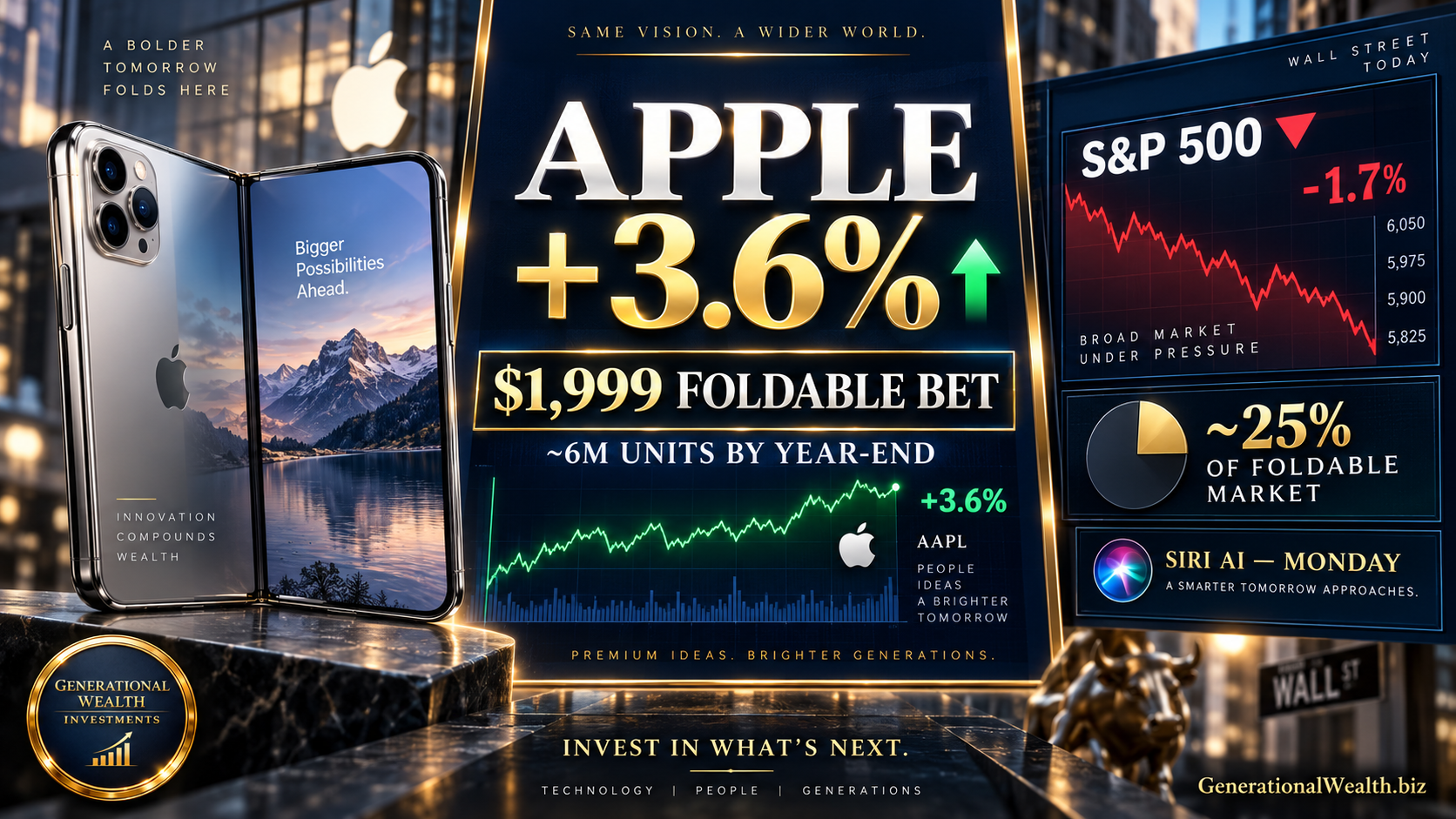
Apple Jumps 3.6% on $1,999 iPhone Duo Foldable Bet
Apple rallied 3.6% while the S&P 500 fell after unveiling its first foldable iPhone at a $1,999 starting price. The bigger test is whether Apple can transform a category representing less than 3% of global smartphone shipments into a meaningful new premium growth engine.
September 11, 2026
Apple Jumps 3.6% While the S&P Falls on Its $1,999 Foldable Bet
Apple jumped 3.6% Thursday even as the S&P 500 fell. The move came one day after Apple unveiled the $1,999 iPhone Duo, its first foldable iPhone. Investors are now weighing whether Apple can turn a category representing less than 3% of global smartphone shipments into a meaningful new premium growth engine — with another test arriving Monday.
Watch Today’s Market Breakdown
See why Apple rallied against a falling market, what the iPhone Duo could mean for the foldable market, and why Monday’s Siri AI beta is the next development to watch.
Today’s Market Setup
Apple’s strength stands out because it came while the broader market was under pressure from oil, inflation concerns and rising yields. The company-specific question is whether its new premium device can expand demand in a category that remains small globally.
Apple Breaks Away From the Market
Apple gained 3.6% Thursday while the S&P 500 fell. That divergence put attention on Apple’s product announcement even as broader markets remained under pressure from oil, inflation and higher yields.
The $1,999 Foldable Bet
Apple’s first foldable iPhone, the iPhone Duo, starts at $1,999. Counterpoint estimates Apple could sell nearly 6 million units by year-end, enough for roughly one quarter of the global foldable market.
A Big Share of a Small Market
Foldable devices still account for less than 3% of worldwide smartphone shipments. Apple is therefore betting that a premium launch can help turn a niche device category into a larger source of growth.
What Matters From Here
The launch created an immediate market reaction. The next questions are whether the early expectations translate into real adoption and whether Apple can build a broader premium-growth story around the Duo and Siri AI.
- Can Apple sell nearly 6 million iPhone Duo units by year-end and capture roughly one quarter of the foldable market?
- Can Apple expand interest in foldables when the category still represents less than 3% of worldwide smartphone shipments?
- Does Monday’s Siri AI beta rollout strengthen the growth narrative surrounding Apple’s newest hardware launch?
The Headlines Are Only the First Step
The free Market Preview explains why Apple rallied and why the iPhone Duo matters. The members-only Daily Market Brief goes deeper into the catalysts, risks, confirmation signals and developments worth monitoring as investors evaluate adoption, market share and Apple’s strength relative to the broader market.
See What Members GetInside Today’s Members-Only Daily Market Brief
- The adoption signals worth following as the iPhone Duo moves from launch announcement toward actual sales.
- What the nearly 6-million-unit estimate could reveal about Apple’s ability to capture a meaningful share of the foldable category.
- Why the small size of the global foldable market remains an important part of evaluating Apple’s premium-device strategy.
- How Monday’s Siri AI beta rollout could become the next test of the broader Apple growth narrative.
Go Beyond the Headlines
The public Market Preview tells you what happened. The Generational Wealth Community is designed for investors who want to understand what deserves attention next, what could confirm the current setup, what risks could change it and which developments deserve continued monitoring. We don’t chase hype, we decode the market.
Unlock the Daily Market BriefEducational market research designed to help investors understand the setup — not chase headlines.
Your pathway from knowledge to legacy. We don’t chase hype, we decode the market.
Stay Ahead of What Matters Next
Follow the adoption, market-share and AI developments that could determine whether Apple’s foldable launch becomes more than a strong first reaction from investors.
Join the Generational Wealth Community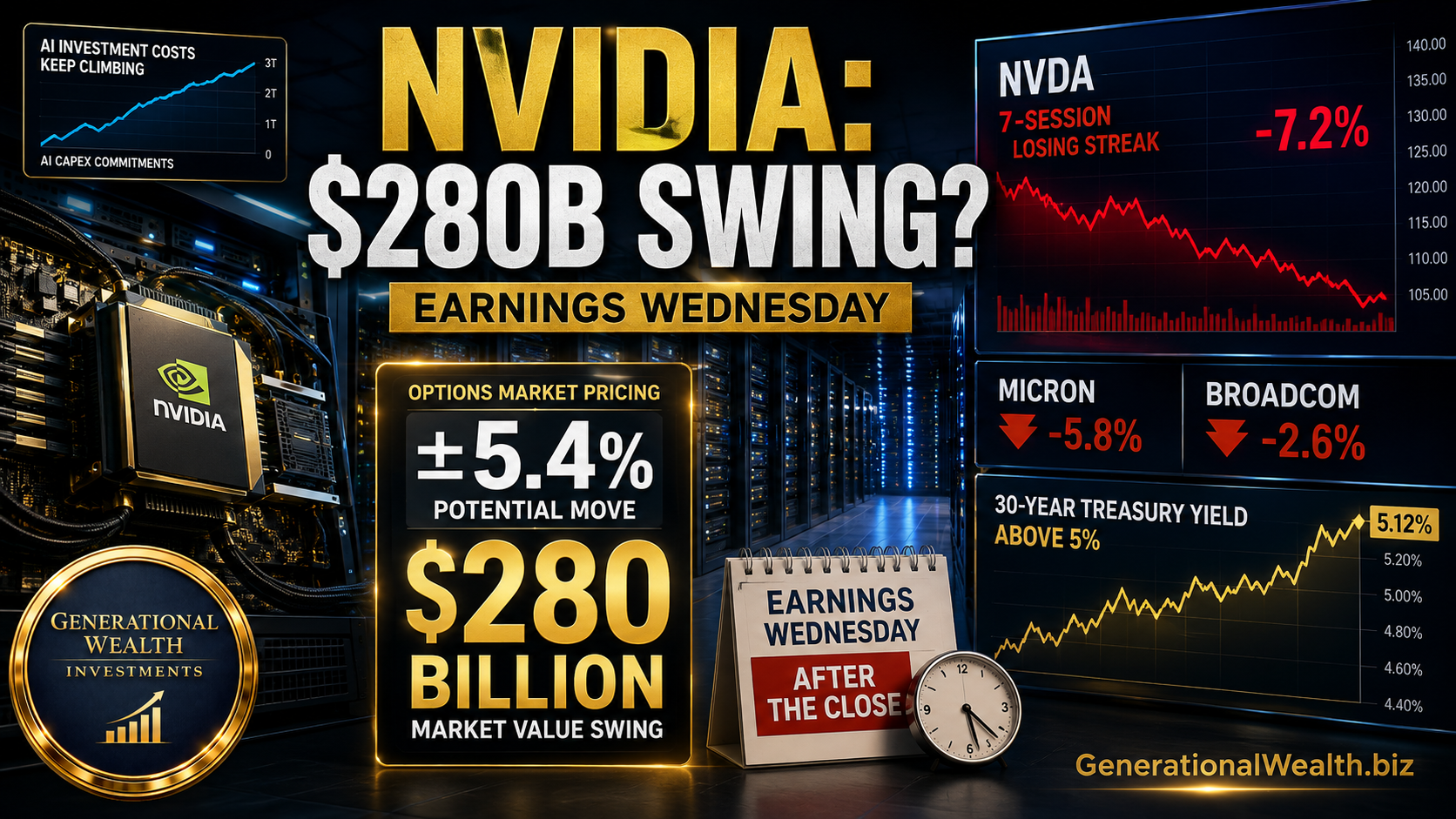
Nvidia Earnings Could Swing $280 Billion — Why It Matters
Nvidia’s Wednesday earnings report could produce a roughly $280 billion market-value swing, yet options traders are pricing a smaller move than Nvidia has averaged after its last twelve reports. With semiconductor stocks already under pressure and long-term Treasury yields above 5%, the report has become a major test of confidence in the AI spending boom.
August 25, 2026
Nvidia Earnings Could Swing $280 Billion — Yet Traders Expect Less Volatility Than Usual
Nvidia’s Wednesday earnings report carries an implied move of about 5.4%, equal to roughly $280 billion in market value. That sounds enormous, but it is still smaller than Nvidia’s average post-earnings swing over the last twelve quarters. With Nvidia entering the report after seven straight down sessions, the bigger question is whether its outlook can restore confidence in the broader AI trade.
Watch Today’s Market Breakdown
See why Nvidia’s earnings could move far more than one stock, what Wall Street is watching beyond revenue, and how high Treasury yields complicate the AI spending story.
Nvidia Earnings Could Swing $280 Billion — Why Traders Are Nervous Watch today’s free Generational Wealth market breakdownToday’s Market Setup
Nvidia has become a much broader test of the AI investment story. The setup going into Wednesday combines elevated earnings expectations, weakness across major semiconductor stocks, and borrowing costs that remain historically high.
Traders Are Pricing a $280 Billion Swing
Options imply about a 5.4% move after Nvidia reports Wednesday. That represents roughly $280 billion in market value and is larger than the individual market value of 90% of S&P 500 companies, yet it remains below Nvidia’s average post-earnings move over the last twelve quarters.
Chip Stocks Are Already Under Pressure
Nvidia fell 2.9% Monday for its seventh consecutive down session. Micron dropped nearly 6%, Broadcom fell more than 2.5%, and the Nasdaq lost about three-quarters of a percent. That puts Wednesday’s report in focus well beyond Nvidia itself.
AI Spending Faces a Rates Test
Wall Street is looking for quarterly revenue around $92 billion, nearly double a year earlier, but the 30-year Treasury yield remains above 5%. Higher borrowing costs can make capital-intensive data-center projects harder to finance even when demand for AI infrastructure remains strong.
What Matters From Here
The headline earnings number will matter, but investors are looking beyond one quarter to determine whether the broader AI spending cycle still has enough momentum to support expectations.
- Does Nvidia’s guidance, margin outlook and chip-demand commentary support the expectations already built into the AI trade?
- Are major cloud providers still increasing AI spending aggressively enough to support continued demand for data-center infrastructure?
- Can the AI investment cycle remain resilient if long-term Treasury yields stay above 5% and financing remains expensive?
The Headlines Are Only the First Step
The free Market Preview explains why Nvidia’s report matters and the forces shaping the setup going into Wednesday. The members-only Daily Market Brief goes deeper into the catalysts, risks, confirmation signals and developments worth monitoring as investors judge whether the AI trade is strengthening or losing momentum.
See What Members GetInside Today’s Members-Only Daily Market Brief
- The guidance, margin and chip-demand signals that could strengthen or weaken confidence in the AI spending cycle.
- What continued cloud-provider AI spending would mean for Nvidia and the broader semiconductor complex.
- How weakness in Micron, Broadcom and the Nasdaq fits into the market setup heading into Nvidia’s report.
- Why long-term Treasury yields above 5% remain an important pressure point for capital-intensive data-center investment.
Go Beyond the Headlines
The public Market Preview tells you what happened and why investors are paying attention. The Generational Wealth Community is designed for investors who want to understand what deserves attention next, what could confirm the current setup, what risks could change it, and which developments deserve continued monitoring. We don’t chase hype, we decode the market.
Unlock the Daily Market BriefEducational market research designed to help investors understand the setup — not chase headlines.
Your pathway from knowledge to legacy. We don’t chase hype, we decode the market.
Stay Ahead of What Matters Next
Follow the catalysts, risks and confirmation signals that deserve attention as Nvidia’s earnings test expectations for AI demand, cloud spending and the broader semiconductor trade.
Join the Generational Wealth Community
Gold Tops $4,600 as Treasury Yields Stay Near 19-Year Highs
Gold has climbed above $4,600 even as long-term Treasury yields remain near levels not seen in almost two decades. The next test is Wednesday’s July PCE inflation report—and whether rates, the dollar and oil begin confirming gold’s move or pushing against it.
August 24, 2026
Gold Pushes Above $4,600 While Treasury Yields Stay Near 19-Year Highs
Gold pushed above $4,600 Monday, with spot gold trading around $4,635 even as the 30-year Treasury yield remained near 5.25%. Elevated yields normally pressure an asset that pays no interest, making the combination unusually important. A weak dollar is helping the setup, but Wednesday’s July PCE inflation report could determine whether rate pressure returns or the rally gains stronger confirmation.
Watch Today’s Market Breakdown
See why gold is rising despite elevated Treasury yields, how Bitcoin and oil fit into the same macro picture, and why Wednesday’s inflation report is the next major test.
Today’s Market Setup
Gold is sending a strong signal, but the bond market has not fully relaxed. That tension makes rates, the dollar, oil and Wednesday’s inflation data more important than the headline gold price alone.
Gold Is Defying High Yields
Spot gold traded around $4,635 Monday, its highest since May 15, while the 30-year Treasury yield remained near 5.25% and close to its recent 5.34% peak. High yields normally increase the opportunity cost of holding gold, making the simultaneous strength notable.
The Dollar and Bitcoin Add Context
The dollar remains near multi-month lows after the Treasury said it would at least double long-dated bond buybacks to $4 billion per operation. Gold gained more than 5% last week, while Bitcoin is holding above $77,000 after gaining more than 21%.
Oil Keeps Inflation Risk Alive
Brent crude is down about 1.6% near $93 as traders await new U.S. sanctions on Iran. Lower oil helps ease immediate inflation pressure, but another spike could push inflation concerns and Treasury yields back into focus ahead of Wednesday’s July PCE report.
What Matters From Here
Gold clearing $4,600 explains what happened. The next question is whether the forces underneath the move begin confirming it or start working against it.
- Can gold hold its strength if the 30-year Treasury yield remains near 5.25% or moves back toward its recent peak?
- Does Wednesday’s July PCE inflation report ease rate pressure, or give the bond market another reason to keep yields elevated?
- Could another oil spike revive inflation concerns even if the dollar remains weak?
The Headlines Are Only the First Step
The free Market Preview explains why gold, Treasury yields, Bitcoin and oil are sending an unusual combination of signals. The members-only Daily Market Brief goes deeper into the catalysts, risks, confirmation signals and developments worth monitoring as markets approach Wednesday’s inflation report.
See What Members GetInside Today’s Members-Only Daily Market Brief
- The yield and dollar signals that could strengthen or weaken the case behind gold’s current move.
- How Bitcoin holding above $77,000 fits into the broader cross-asset market message.
- Why Brent crude and the next U.S. sanctions on Iran matter for the inflation and interest-rate setup.
- What to monitor around Wednesday’s July PCE report as markets test whether inflation pressure is becoming more or less important.
Go Beyond the Headlines
The public Market Preview tells you what moved and why investors are paying attention. The Generational Wealth Community is designed for investors who want to understand what deserves attention next, what could confirm the current setup, what risks could change it, and which developments deserve continued monitoring. We don’t chase hype, we decode the market.
Unlock the Daily Market BriefEducational market research designed to help investors understand the setup — not chase headlines.
Your pathway from knowledge to legacy. We don’t chase hype, we decode the market.
Stay Ahead of What Matters Next
Follow the catalysts, risks and confirmation signals that deserve attention as gold, Treasury yields, oil and Wednesday’s inflation report test the current market setup.
Join the Generational Wealth Community