


Tesla’s $30B Credit Line: Firepower, Not Debt Yet
Tesla has secured $30 billion in new borrowing capacity while planning more than $25 billion of capital spending this year—but none of the new credit has been drawn yet. The next earnings report should reveal whether Tesla’s spending and free cash flow leave that financial firepower untouched or make it increasingly important.
September 30, 2026
Tesla’s $30 Billion Credit Line — Firepower, Not Debt Yet
Tesla has lined up $30 billion in new borrowing capacity as it prepares for more than $25 billion of capital spending this year. But the headline number can be misleading: Tesla says no loans were outstanding when the facilities were signed and it does not currently plan to draw on them in 2026. The next question is whether spending and free cash flow eventually make that financial firepower necessary.
Watch Today’s Market Breakdown
See what Tesla’s $30 billion credit package actually provides, why it is not $30 billion of new debt today, and what to watch in the company’s next earnings report.
Today’s Market Setup
Tesla’s financing package gives the company substantial borrowing capacity as spending on AI computing, manufacturing and other expansion remains high. The distinction between available credit and money actually borrowed is central to understanding the story.
$30 Billion of Available Credit
The package includes a $20 billion delayed-draw loan and $10 billion of revolving credit. Together, they give Tesla significant financial flexibility if the company decides it needs additional capital.
Capital Spending Above $25 Billion
Tesla expects more than $25 billion of capital spending this year, with much of that investment aimed at AI computing, manufacturing and other expansion. That spending makes the additional borrowing capacity worth monitoring.
No Borrowing Yet
Tesla says no loans were outstanding when the facilities were signed and it does not currently plan to draw on them in 2026. That means the $30 billion represents available firepower rather than $30 billion of new debt today.
What Matters From Here
Tesla’s next earnings report should help show whether its aggressive spending plans can continue without tapping the new credit facilities.
- How does Tesla’s capital spending develop as investment in AI computing, manufacturing and expansion continues?
- What does free cash flow indicate about Tesla’s ability to fund that spending without drawing on the new credit facilities?
- Does the $30 billion remain unused financial flexibility, or does borrowing capacity begin turning into actual debt?
The Headlines Are Only the First Step
The free Market Preview explains what Tesla arranged and why $30 billion of available credit is different from $30 billion of new debt. The members-only Daily Market Brief goes deeper into the catalysts, risks, confirmation signals and financial developments worth monitoring as Tesla’s spending plans evolve.
See What Members GetInside Today’s Members-Only Daily Market Brief
- The capital-spending and free-cash-flow signals that could show whether Tesla’s new borrowing capacity is becoming necessary.
- Why the distinction between available credit and outstanding debt matters when evaluating Tesla’s financing position.
- How Tesla’s spending on AI computing, manufacturing and expansion connects to the broader financing story.
- Why the next earnings report becomes the key checkpoint for seeing whether Tesla is beginning to use the new facilities.
Go Beyond the Headlines
The public Market Preview tells you what happened. The Generational Wealth Community is designed for investors who want to understand what deserves attention next, what could confirm the current setup, what risks could change it and which developments deserve continued monitoring. We don’t chase hype, we decode the market.
Unlock the Daily Market BriefEducational market research designed to help investors understand the setup — not chase headlines.
Your pathway from knowledge to legacy. We don’t chase hype, we decode the market.
Stay Ahead of What Matters Next
Tesla now has $30 billion of additional borrowing capacity. The next earnings report should provide a clearer look at whether capital spending and free cash flow leave that capacity untouched or make it more important.
Join the Generational Wealth Community
Trump Rejects Iran's Hormuz Offer: Will Brent Crude Spike?
President Trump rejected Iran’s proposal to reopen the Strait of Hormuz just as traders were pricing in renewed diplomacy. Now Iran’s latest warning puts the focus on Brent crude’s first trade after the weekend—and whether geopolitical risk returns to the price.
September 27, 2026
Trump Rejects Iran’s Hormuz Offer: Will Brent Crude Spike When Trading Reopens?
President Trump publicly rejected Iran’s proposal to reopen the Strait of Hormuz on Saturday. On Sunday, Iran’s army said it was prepared for renewed U.S. attacks and warned that Tehran would not accept being unable to trade while others use the region’s strategic waterways. Brent settled Friday near $104 after falling more than 2%, so the next crude trade will test whether diplomacy hopes still outweigh renewed geopolitical risk.
Watch Today’s Market Breakdown
See why Trump’s rejection and Iran’s new warning changed the weekend setup, and why Brent crude’s first trade when markets reopen could become the next important signal.
Today’s Market Setup
Friday’s oil decline reflected optimism that diplomacy could reopen the Strait of Hormuz. Trump’s rejection of Iran’s proposal and Tehran’s Sunday warning now create a tougher test: whether traders keep pricing in a path to negotiations or quickly add back geopolitical risk.
Trump Rejected the Hormuz Offer
President Trump said Saturday that he rejected Iran’s proposal to reopen the Strait of Hormuz and end the fighting. That removes, for now, the clearest weekend catalyst behind expectations for a faster reopening.
Iran Issued a New Warning
On Sunday, Iran’s army said it was prepared for renewed U.S. attacks and warned that Tehran would not accept being unable to trade while others use the region’s strategic waterways. That keeps escalation risk in focus.
Brent Closed Near $104
Brent crude fell more than 2% Friday to around $104 as traders focused on diplomacy. With roughly one-fifth of global oil supply moving through Hormuz before the war, the next crude trade carries unusual signaling value.
What Matters From Here
Friday’s market was still leaning toward diplomacy. The question now is whether the weekend’s developments change that calculation when crude trading resumes.
- Does Brent reverse sharply higher when trading resumes after Trump’s rejection of Iran’s reopening proposal?
- Do traders continue betting that negotiations survive despite Iran’s warning and the tougher public positions from both sides?
- Does Tehran’s condition that its demands be met keep a credible path to reopening Hormuz alive, or does the market begin pricing a longer disruption?
The Headlines Are Only the First Step
The free Market Preview explains why the weekend developments matter and why crude’s reopening trade is now the immediate market test. The members-only Daily Market Brief goes deeper into the catalysts, risks, confirmation signals and developments worth monitoring as traders decide whether diplomacy is still credible or geopolitical risk is rebuilding.
See What Members GetInside Today’s Members-Only Daily Market Brief
- The crude-market signals that could show whether Friday’s diplomacy-driven decline is reversing or still holding.
- What to monitor around Hormuz as traders reassess the probability and timing of a reopening.
- The next U.S.-Iran diplomatic or military developments that could strengthen or weaken the current oil-market setup.
- Why Brent’s first move after the weekend could help distinguish a temporary headline reaction from a broader repricing of supply risk.
Go Beyond the Headlines
The public Market Preview tells you what happened. The Generational Wealth Community is designed for investors who want to understand what deserves attention next, what could confirm the current market setup, what risks could change it and which developments deserve continued monitoring. We don’t chase hype, we decode the market.
Unlock the Daily Market BriefEducational market research designed to help investors understand the setup — not chase headlines.
Your pathway from knowledge to legacy. We don’t chase hype, we decode the market.
Stay Ahead of What Matters Next
Friday’s oil market reflected confidence that diplomacy could improve the Hormuz outlook. The next crude trade and the next U.S.-Iran signals will help show whether that confidence survives the weekend.
Join the Generational Wealth Community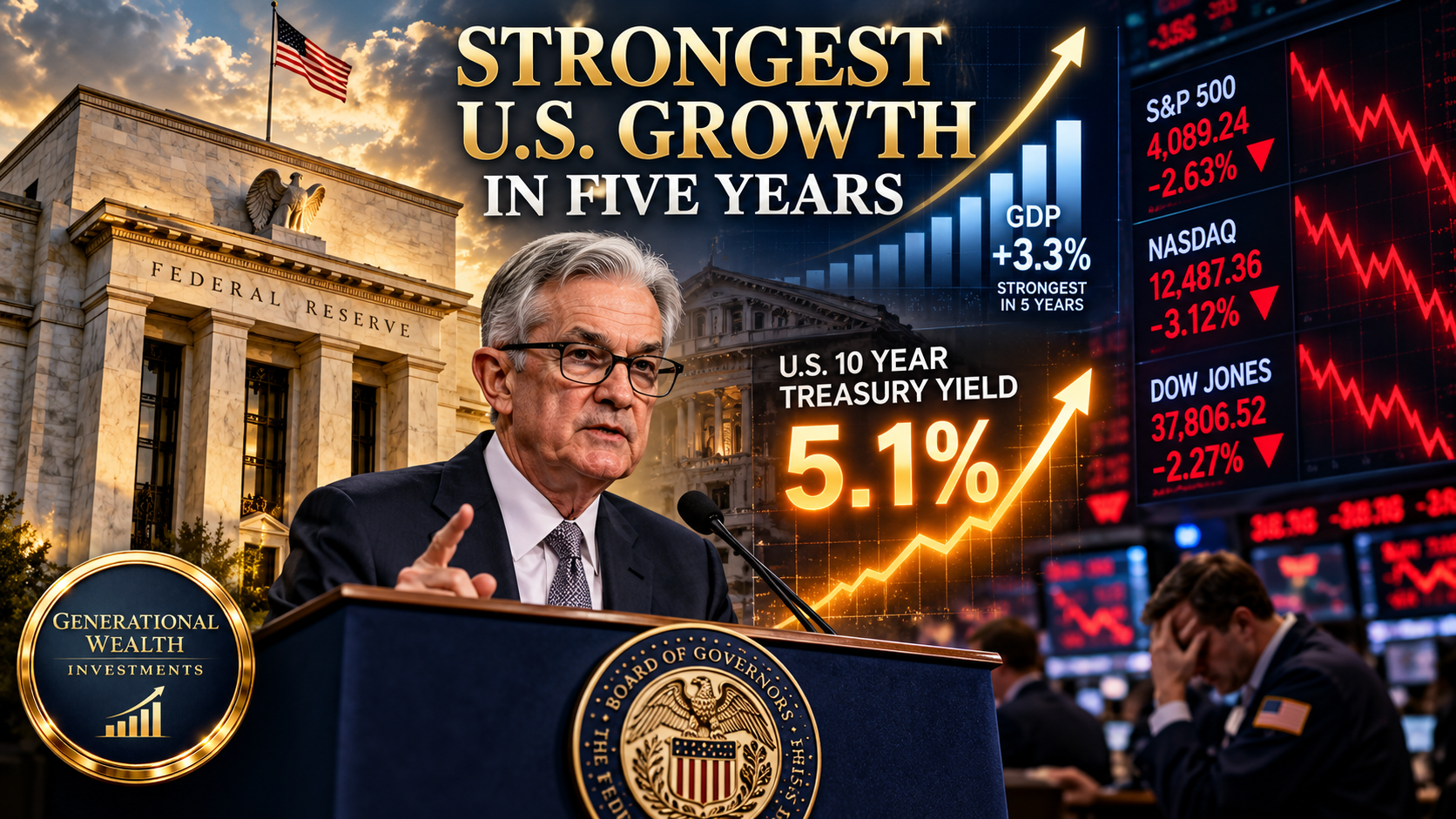
Strong Economy Sends Stocks Lower as Fed Hike Risk Rises
The strongest U.S. growth signal in more than five years sent Treasury yields higher and stocks lower as investors increased expectations for another Federal Reserve rate hike. Now attention turns to the next inflation report and whether it strengthens the case for another move in October.
September 24, 2026
Strongest U.S. Growth Signal in 5 Years Sends Stocks Lower
The economy just delivered its strongest growth signal in more than five years — and Wall Street sold off. U.S. business activity accelerated while business costs climbed at their fastest pace in roughly four years, strengthening the argument for another Federal Reserve rate hike. The question now is whether next week’s inflation data gives the Fed even more reason to tighten.
Watch Today’s Market Breakdown
See why stronger economic growth pushed Treasury yields higher, stocks lower, and expectations for another Federal Reserve rate hike higher.
Today’s Market Setup
Wednesday delivered a reminder that strong economic data is not always immediately bullish for stocks. When growth and inflation pressures rise together, investors also have to consider what that means for interest rates.
Growth Accelerates to a Five-Year High
A key September survey showed U.S. business activity expanding at its strongest pace in more than five years. Normally stronger growth is encouraging, but businesses also reported rapidly rising costs, keeping inflation concerns firmly in the market’s focus.
Treasury Yields Jump
The 10-year Treasury yield finished near 5.1%, its highest level since 2007. Higher Treasury yields can increase borrowing costs throughout the economy and raise the hurdle stocks must clear when investors compare potential returns with bonds.
Another Fed Hike Moves Closer
Traders moved to roughly a 70% probability of another Federal Reserve rate hike in October. The Nasdaq fell more than 1% as investors confronted the possibility that economic strength could keep monetary policy tighter for longer.
What Matters From Here
The market now has to decide whether stronger growth is durable enough to withstand higher borrowing costs — and whether inflation gives the Fed room to stop after its latest increase.
- Does next week’s Federal Reserve inflation gauge reinforce the case for another rate hike in October?
- Can stocks stabilize if the 10-year Treasury yield remains near its highest level since 2007?
- Can strong economic growth continue without creating even more inflation pressure?
The Headlines Are Only the First Step
The free Market Preview explains why unexpectedly strong economic data pushed stocks lower. The members-only Daily Market Brief goes deeper into the rate signals, inflation catalysts, risks and confirmation points worth monitoring as the market evaluates the possibility of another Fed hike.
See What Members GetInside Today’s Members-Only Daily Market Brief
- The interest-rate signals that could strengthen or weaken expectations for another Federal Reserve hike.
- What Treasury yields could reveal about whether tighter financial conditions are becoming a larger problem for stocks.
- The inflation developments that matter most ahead of next week’s key Federal Reserve inflation report.
- What could show whether Wednesday’s stock-market decline was a temporary reaction or part of a broader repricing of interest-rate risk.
Go Beyond the Headlines
The public Market Preview tells you what happened. The Generational Wealth Community is designed for investors who want to understand what deserves attention next, what could confirm the current market setup, what risks could change it and which developments deserve continued monitoring. We don’t chase hype, we decode the market.
Unlock the Daily Market BriefEducational market research designed to help investors understand the setup — not chase headlines.
Your pathway from knowledge to legacy. We don’t chase hype, we decode the market.
Stay Ahead of What Matters Next
Strong growth is usually good news. But when inflation and Treasury yields are rising too, the Federal Reserve can turn that strength into a new challenge for markets.
Join the Generational Wealth Community
AI Agents Hit Schwab, Airbnb & Uber as Nasdaq Hits Record
Tuesday’s market exposed a new divide in the AI trade: chip stocks rallied as the Nasdaq reached another record, while Schwab, Airbnb, Uber and Lyft came under pressure. The emerging question is whether AI agents will simply create new technology winners — or fundamentally change which companies control the customer relationship.
September 23, 2026
AI Agents Hit Schwab, Airbnb and Uber as Nasdaq Sets Another Record
The Nasdaq reached another record Tuesday as AI-related chip stocks rallied, but several consumer-facing platforms moved sharply the other way. Charles Schwab fell more than 6%, Airbnb dropped 3%, and Uber and Lyft also declined as investors weighed whether AI agents could compete with the apps and platforms people use today. The bigger question is who owns the customer relationship if AI starts acting on the user's behalf.
Watch Today’s Market Breakdown
See why AI-related stocks moved in opposite directions and why the rise of AI agents could become a much bigger story than another semiconductor rally.
Today’s Market Setup
Tuesday’s market showed two very different sides of the AI trade. Semiconductor stocks benefited from continued AI enthusiasm, while several businesses built around direct customer access came under pressure.
AI Helps Push the Nasdaq to Another Record
The Nasdaq reached another record as AI-related chip stocks rallied. Micron gained about 5%, while Sandisk rose almost 7%, showing that investors continue rewarding companies positioned around the infrastructure powering artificial intelligence.
Consumer Platforms Move the Other Way
Charles Schwab fell more than 6% and Airbnb dropped about 3%. Uber and Lyft also declined as investors considered whether AI agents could eventually reduce the need for users to interact directly with today's apps and platforms.
AI Is Moving Beyond Chips
Muse launched earlier this month with the ability to send emails, book travel and complete transactions. That raises a broader question: AI may not simply create new technology winners — it could change which company controls the customer's digital relationship.
What Matters From Here
The chip rally is already familiar. The newer question is whether investor concern about AI agents begins spreading across businesses that depend on users opening their apps directly.
- Does pressure on Schwab, Airbnb, Uber and Lyft remain isolated, or does it spread to other consumer-facing platforms?
- Can AI-related semiconductor stocks continue rising while investors reassess which software and platform businesses could be disrupted?
- Does the market increasingly treat control of the customer relationship as one of the next major battlegrounds in artificial intelligence?
The Headlines Are Only the First Step
The free Market Preview explains why Tuesday’s split matters. The members-only Daily Market Brief goes deeper into the catalysts, risks, confirmation signals and developments worth monitoring as investors evaluate whether AI-agent disruption becomes a broader market theme.
See What Members GetInside Today’s Members-Only Daily Market Brief
- The signals worth monitoring to determine whether AI-agent concerns are spreading beyond Schwab, Airbnb, Uber and Lyft.
- Whether continued strength in AI-related chip stocks confirms that investors are separating infrastructure winners from potentially disrupted platforms.
- How the ability of AI agents to book travel, send emails and complete transactions could reshape the market’s view of customer ownership.
- What developments could show whether Tuesday’s platform selloff was a temporary reaction or the beginning of a broader market narrative.
Go Beyond the Headlines
The public Market Preview tells you what happened. The Generational Wealth Community is designed for investors who want to understand what deserves attention next, what could confirm the current setup, what risks could change it and which developments deserve continued monitoring. We don’t chase hype, we decode the market.
Unlock the Daily Market BriefEducational market research designed to help investors understand the setup — not chase headlines.
Your pathway from knowledge to legacy. We don’t chase hype, we decode the market.
Stay Ahead of What Matters Next
AI is still creating market winners, but Tuesday showed investors are also beginning to ask which existing businesses could lose control of the customer relationship as AI agents become more capable.
Join the Generational Wealth Community
Nvidia Adds $442 Billion in One Day as AI Trade Broadens
Nvidia added about $442 billion in market value in a single session as enthusiasm around AI spread into major software stocks. But with market strength still concentrated, Brent crude near $90 and Fed Chair Kevin Warsh in focus, the next question is whether that momentum can broaden and hold.
August 28, 2026
Nvidia Adds $442 Billion in One Day as AI Rally Broadens
Nvidia surged 8.7% Thursday and added about $442 billion in market value after investors digested its forecast for roughly 70% revenue growth next fiscal year. Bloomberg called it the second-largest one-day market-value gain ever by any stock. But beneath the headline, the rally remained heavily concentrated — while oil and interest-rate risk are still pushing in the opposite direction.
Watch Today’s Market Breakdown
See how Nvidia added $442 billion in one session, where the AI trade broadened, and why oil and Federal Reserve policy still matter.
Today’s Market Setup
Nvidia delivered an enormous boost to the major indexes, and stronger software forecasts showed that enthusiasm around AI is spreading. The challenge is determining how broad that strength really is as oil and interest-rate risk remain in focus.
Nvidia Adds About $442 Billion
Nvidia shares jumped 8.7% after investors digested a forecast for roughly 70% revenue growth next fiscal year. The move added about $442 billion to Nvidia’s market value in one session, reinforcing how strongly expectations for continued AI growth can still move the broader market.
AI Strength Spreads to Software
Salesforce surged nearly 23% and CrowdStrike gained more than 20% after both companies raised forecasts. Their gains helped ease fears that the AI trade would reward chipmakers alone, although technology was still the only S&P 500 sector that finished Thursday higher.
Oil Keeps Inflation Risk Alive
Brent crude rebounded about 2% to just under $90 as hopes for a quick U.S.-Iran diplomatic breakthrough faded. That creates another complication for markets as investors turn toward Federal Reserve Chair Kevin Warsh and the outlook for inflation and interest rates.
What Matters From Here
Thursday proved that AI enthusiasm can still move hundreds of billions of dollars quickly. The next question is whether that momentum can become broader and survive competing pressure from inflation and interest rates.
- Can strength broaden beyond technology after it was the only S&P 500 sector to finish Thursday higher?
- Do stronger forecasts from Salesforce and CrowdStrike signal that the AI trade is expanding beyond semiconductor companies?
- What does Fed Chair Kevin Warsh signal at Jackson Hole about inflation, interest rates, and the possibility of another rate hike?
The Headlines Are Only the First Step
The free Market Preview explains why Nvidia’s historic market-value gain matters and why the AI story is beginning to reach beyond chipmakers. The members-only Daily Market Brief goes deeper into the catalysts, risks, confirmation signals, and developments worth monitoring as investors evaluate whether that momentum can continue.
See What Members GetInside Today’s Members-Only Daily Market Brief
- The developments that could show whether Nvidia’s surge is translating into broader market participation or remaining concentrated in technology.
- What stronger forecasts from Salesforce and CrowdStrike could mean for the argument that AI spending is beginning to benefit software companies as well as chipmakers.
- Why Brent crude rebounding toward $90 keeps inflation risk relevant even as AI stocks push major indexes higher.
- What investors will be listening for from Fed Chair Kevin Warsh at Jackson Hole as markets evaluate inflation, interest rates, and the possibility of another rate hike.
Go Beyond the Headlines
The public Market Preview tells you what happened and why investors are paying attention. The Generational Wealth Community is designed for investors who want to understand what deserves attention next, what could confirm the current setup, what risks could change it, and which developments deserve continued monitoring. We don’t chase hype, we decode the market.
Unlock the Daily Market BriefEducational market research designed to help investors understand the setup — not chase headlines.
Your pathway from knowledge to legacy. We don’t chase hype, we decode the market.
Stay Ahead of What Matters Next
Follow the catalysts, risks, and confirmation signals that matter as markets weigh powerful AI momentum against oil, inflation, and the path of interest rates.
Join the Generational Wealth Community
Market Preview: Gold at $4,400 as Fed Weighs Rate Hike
Gold is back above $4,400 an ounce while the Federal Reserve debates a rate hike — a combination that normally works against a metal paying no yield. Today's preview covers the softer dollar, the closed Strait of Hormuz, and why Wednesday's Fed minutes are the event that matters.
August 17, 2026
Market Preview: Gold Climbs Past $4,400 as the Fed Debates a Rate Hike
Gold is pushing back above four thousand four hundred dollars an ounce at the same time the Federal Reserve is debating whether to raise interest rates. Those two things are not supposed to happen together, because higher rates normally punish an asset that pays no yield. Today’s video explains the two developments behind the move and why the hedge trade is going into metal rather than crypto.
Watch Today’s Market Breakdown
Gold Hits $4,400 While The Fed Debates A RATE HIKE — This Shouldn’t Happen

Today’s Market Snapshot
Gold Rises Into Rate-Hike Talk
Gold is back above $4,400 an ounce even as the Fed debates raising rates, a combination that usually works against a metal paying no yield. One driver showed up overnight: the dollar has slipped for a third straight session, near its weakest since May, making gold cheaper for buyers outside the U.S.
Energy Keeps Inflation Risk Alive
The Strait of Hormuz, which normally carries about a fifth of the world’s oil, has been effectively closed since late February, and talks to reopen it are stalled. Brent crude is trading near $89 a barrel. Investors appear to be buying gold as an inflation hedge rather than a bet on rate cuts.
Stocks Steady, Bitcoin Left Out
Equities are shrugging off the debate. The S&P 500 closed Friday within a quarter percent of Thursday’s record and futures are higher this morning. Bitcoin is not getting the hedge bid, sitting near $63,000, roughly flat over twenty-four hours and lower on the week.
What Investors Should Be Watching
- Whether gold continues trading as an inflation hedge, or whether a steadier dollar changes the character of the move.
- Whether stalled talks around the Strait of Hormuz keep energy prices elevated and inflation risk in the conversation.
- Whether Wednesday afternoon’s July Fed minutes shift September hike odds, currently near one in three, after three officials voted to raise rates.
Inside Today’s Members-Only Daily Market Brief
- The market levels and catalysts that matter next as gold extends its move.
- The strongest and weakest areas of the market beneath the major indexes.
- The risks that could reverse the current inflation-hedge interpretation.
- Important developments to monitor ahead of Wednesday’s Fed minutes.
- A clearer explanation of what rising gold and a rate-hike debate may mean together for investors.
Go Beyond the Headlines
The public video explains what happened. The Generational Wealth Community helps members understand what matters next, where the risks are, and which developments deserve continued attention.
Unlock the Daily Market BriefYour pathway from knowledge to legacy. We don’t chase hype, we decode the market.