

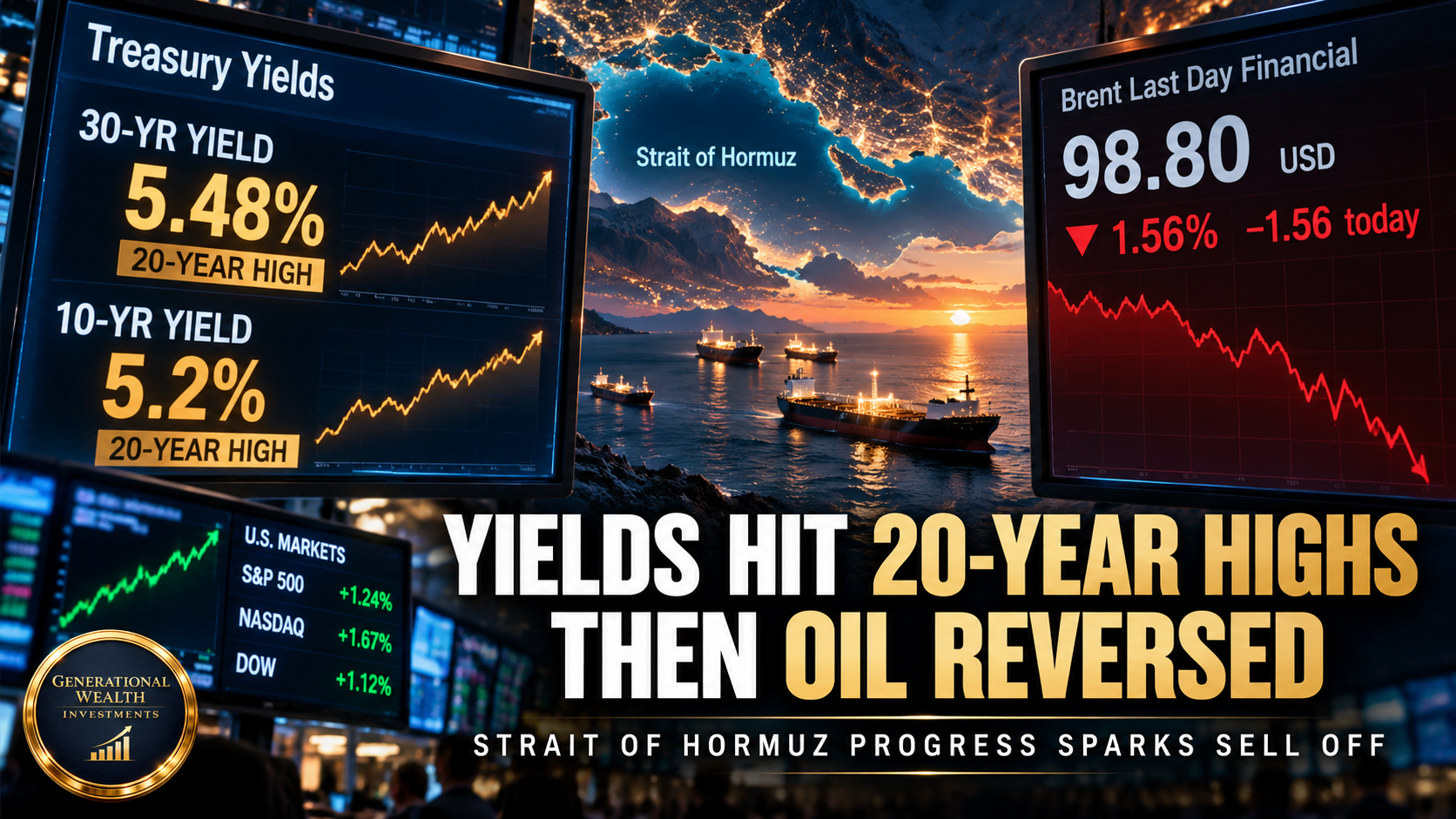
Oil Shock Sends Treasury Yields to 20-Year High
Oil-driven inflation fears pushed long-term Treasury yields to multi-decade highs before a Strait of Hormuz diplomacy headline suddenly reversed crude and helped stocks recover. Now the focus shifts to whether oil stays elevated — and what next week’s inflation and jobs data mean for the rate outlook.
September 25, 2026
Oil Shock Sends Treasury Yields to 20-Year High — Then Hormuz Changes the Setup
Oil-driven inflation fears pushed long-term Treasury yields to levels not seen in roughly two decades Thursday. Then the market changed direction: reports that U.S. and Iranian negotiators were exploring a path to reopen the Strait of Hormuz sent Brent crude sharply lower and helped stocks recover. Now investors have to determine whether that reversal can hold.
Watch Today’s Market Breakdown
See how the oil shock pushed Treasury yields higher, why a Hormuz headline suddenly reversed crude, and what markets are watching next.
Today’s Market Setup
Thursday showed how quickly oil, inflation expectations and interest rates can become one interconnected market story — and how quickly that setup can change when geopolitical expectations shift.
Treasury Yields Reach Multi-Decade Highs
The 30-year Treasury yield reached about 5.48%, its highest since 2004, while the 10-year climbed to around 5.2%, a level last seen in 2007. Rising long-term yields mean higher borrowing costs remain a major pressure point for markets.
Oil Revives Inflation Concerns
Renewed attacks on Saudi Arabia pushed oil higher as investors confronted fresh supply fears. With the U.S. economy remaining strong, another rise in energy prices added to concerns that inflation pressure could remain elevated.
Hormuz Headline Reverses the Move
Reports that U.S. and Iranian negotiators were exploring a path to reopen the Strait of Hormuz changed the market quickly. Brent crude fell roughly three dollars within minutes, while stocks recovered much of their earlier losses.
What Matters From Here
The key question is whether Thursday’s reversal marks a meaningful change in the oil-and-rates setup or only a temporary reaction to a diplomatic headline.
- Does oil remain elevated enough to keep inflation concerns and Treasury yields under pressure?
- Can the decline in crude continue if negotiations over reopening the Strait of Hormuz progress?
- How will next week’s inflation data and jobs report affect a market already confronting historically high long-term Treasury yields?
The Headlines Are Only the First Step
The free Market Preview explains how oil, Treasury yields and the Hormuz headline changed Thursday’s market. The members-only Daily Market Brief goes deeper into the catalysts, risks, confirmation signals and developments worth monitoring as investors evaluate what happens next.
See What Members GetInside Today’s Members-Only Daily Market Brief
- The oil-market developments that could reinforce or weaken the inflation pressure now affecting Treasury yields.
- What to monitor around the Strait of Hormuz as markets evaluate the possibility of reopening the critical shipping route.
- The interest-rate signals that could show whether Thursday’s surge in long-term Treasury yields is continuing or beginning to ease.
- Why next week’s inflation data and jobs report could become the next major tests for the current market setup.
Go Beyond the Headlines
The public Market Preview tells you what happened. The Generational Wealth Community is designed for investors who want to understand what deserves attention next, what could confirm the current market setup, what risks could change it and which developments deserve continued monitoring. We don’t chase hype, we decode the market.
Unlock the Daily Market BriefEducational market research designed to help investors understand the setup — not chase headlines.
Your pathway from knowledge to legacy. We don’t chase hype, we decode the market.
Stay Ahead of What Matters Next
Oil, inflation expectations and Treasury yields are moving together, while developments around the Strait of Hormuz can change that setup quickly. The next major tests arrive with inflation data and the jobs report.
Join the Generational Wealth Community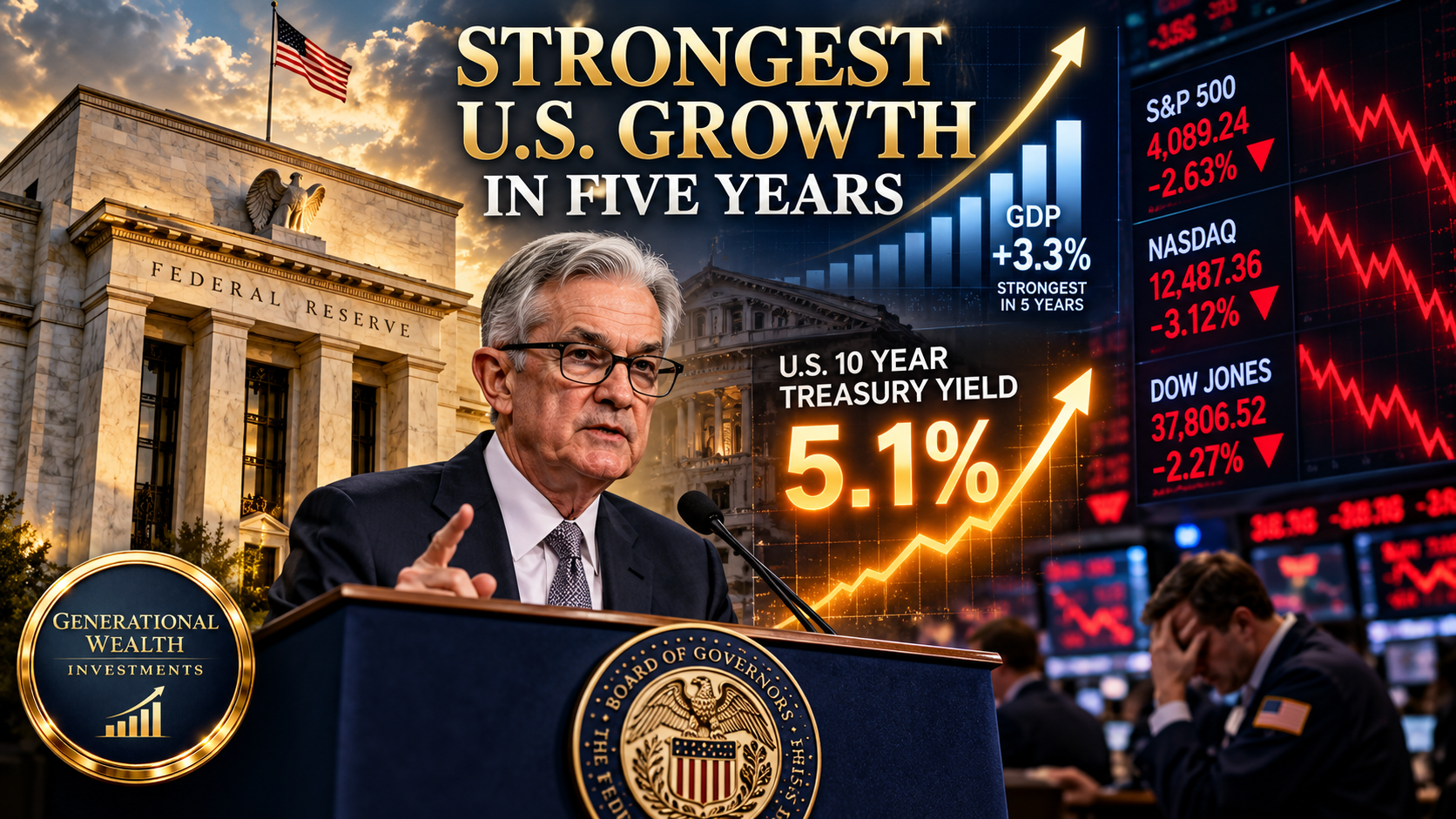
Strong Economy Sends Stocks Lower as Fed Hike Risk Rises
The strongest U.S. growth signal in more than five years sent Treasury yields higher and stocks lower as investors increased expectations for another Federal Reserve rate hike. Now attention turns to the next inflation report and whether it strengthens the case for another move in October.
September 24, 2026
Strongest U.S. Growth Signal in 5 Years Sends Stocks Lower
The economy just delivered its strongest growth signal in more than five years — and Wall Street sold off. U.S. business activity accelerated while business costs climbed at their fastest pace in roughly four years, strengthening the argument for another Federal Reserve rate hike. The question now is whether next week’s inflation data gives the Fed even more reason to tighten.
Watch Today’s Market Breakdown
See why stronger economic growth pushed Treasury yields higher, stocks lower, and expectations for another Federal Reserve rate hike higher.
Today’s Market Setup
Wednesday delivered a reminder that strong economic data is not always immediately bullish for stocks. When growth and inflation pressures rise together, investors also have to consider what that means for interest rates.
Growth Accelerates to a Five-Year High
A key September survey showed U.S. business activity expanding at its strongest pace in more than five years. Normally stronger growth is encouraging, but businesses also reported rapidly rising costs, keeping inflation concerns firmly in the market’s focus.
Treasury Yields Jump
The 10-year Treasury yield finished near 5.1%, its highest level since 2007. Higher Treasury yields can increase borrowing costs throughout the economy and raise the hurdle stocks must clear when investors compare potential returns with bonds.
Another Fed Hike Moves Closer
Traders moved to roughly a 70% probability of another Federal Reserve rate hike in October. The Nasdaq fell more than 1% as investors confronted the possibility that economic strength could keep monetary policy tighter for longer.
What Matters From Here
The market now has to decide whether stronger growth is durable enough to withstand higher borrowing costs — and whether inflation gives the Fed room to stop after its latest increase.
- Does next week’s Federal Reserve inflation gauge reinforce the case for another rate hike in October?
- Can stocks stabilize if the 10-year Treasury yield remains near its highest level since 2007?
- Can strong economic growth continue without creating even more inflation pressure?
The Headlines Are Only the First Step
The free Market Preview explains why unexpectedly strong economic data pushed stocks lower. The members-only Daily Market Brief goes deeper into the rate signals, inflation catalysts, risks and confirmation points worth monitoring as the market evaluates the possibility of another Fed hike.
See What Members GetInside Today’s Members-Only Daily Market Brief
- The interest-rate signals that could strengthen or weaken expectations for another Federal Reserve hike.
- What Treasury yields could reveal about whether tighter financial conditions are becoming a larger problem for stocks.
- The inflation developments that matter most ahead of next week’s key Federal Reserve inflation report.
- What could show whether Wednesday’s stock-market decline was a temporary reaction or part of a broader repricing of interest-rate risk.
Go Beyond the Headlines
The public Market Preview tells you what happened. The Generational Wealth Community is designed for investors who want to understand what deserves attention next, what could confirm the current market setup, what risks could change it and which developments deserve continued monitoring. We don’t chase hype, we decode the market.
Unlock the Daily Market BriefEducational market research designed to help investors understand the setup — not chase headlines.
Your pathway from knowledge to legacy. We don’t chase hype, we decode the market.
Stay Ahead of What Matters Next
Strong growth is usually good news. But when inflation and Treasury yields are rising too, the Federal Reserve can turn that strength into a new challenge for markets.
Join the Generational Wealth Community
Rate Hike Odds Jump to 57% as Nvidia Drops 4.6% After Warsh
Rate-hike odds jumped to roughly 57% after Kevin Warsh’s Jackson Hole speech, sending Treasury yields higher as Nvidia and gold fell. Now the August jobs report could determine whether that shift in Fed expectations gains momentum or becomes more complicated.
August 29, 2026
Rate Hike Odds Jump to 57% as Nvidia Drops 4.6%
Traders sharply increased the odds of a September rate hike after Fed Chair Kevin Warsh put inflation back at the center of the market during his Jackson Hole speech. The shift pushed Treasury yields higher, pressured gold, and sent Nvidia down 4.6% just one day after its powerful AI-driven rally. Now attention turns to Friday’s August jobs report.
Watch Today’s Market Breakdown
See why rate-hike expectations jumped, how the move reached Nvidia, bonds and gold, and why the August jobs report matters next.
Today’s Market Setup
Warsh’s inflation message changed the market’s interest-rate expectations quickly, with the impact showing up across bonds, technology stocks and gold.
September Hike Odds Reach 57%
Traders raised the implied probability of a September rate hike from about 35% before the Jackson Hole speech to roughly 57% by Friday’s close after Warsh emphasized that the Fed’s 2% inflation target remains firm.
Treasury Yields Pressure Nvidia
The two-year Treasury yield jumped about 13 basis points to 4.36%, a one-month high. The Nasdaq fell about half a percent while Nvidia dropped 4.6%, reversing part of the previous session’s 8.7% surge.
Gold Falls as Rates Reprice
Gold dropped about 3% as traders priced in greater odds of higher interest rates. The next major test is the August jobs report on Friday, September 4, with a Reuters poll expecting about 58,000 jobs.
What Matters From Here
The market has repriced September policy risk. The next question is whether incoming labor data reinforces that shift or complicates it.
- Does the August jobs report strengthen the case for a September rate hike or make the Fed’s decision more difficult?
- Can Nvidia regain momentum if Treasury yields remain under upward pressure?
- Does gold stabilize if rate-hike expectations stop increasing, or does tighter-policy risk remain the dominant pressure?
The Headlines Are Only the First Step
The free Market Preview explains why markets repriced September rate-hike risk. The members-only Daily Market Brief goes deeper into the catalysts, risks, confirmation signals, and developments worth monitoring as investors evaluate what comes next.
See What Members GetInside Today’s Members-Only Daily Market Brief
- The developments that could show whether markets continue pricing a greater probability of a September rate hike.
- What the August jobs report could mean for the tension between persistent inflation concerns and the Fed’s next decision.
- The signals worth monitoring across Treasury yields and technology stocks after Nvidia’s sharp post-rally reversal.
- How gold’s decline fits into the broader repricing of interest-rate expectations following Jackson Hole.
Go Beyond the Headlines
The public Market Preview tells you what happened and why investors are paying attention. The Generational Wealth Community is designed for investors who want to understand what deserves attention next, what could confirm the current setup, what risks could change it, and which developments deserve continued monitoring. We don’t chase hype, we decode the market.
Unlock the Daily Market BriefEducational market research designed to help investors understand the setup — not chase headlines.
Your pathway from knowledge to legacy. We don’t chase hype, we decode the market.
Stay Ahead of What Matters Next
Follow the catalysts, risks, and confirmation signals that matter as markets weigh inflation, Treasury yields, the August jobs report, and the possibility of another rate hike.
Join the Generational Wealth Community
Retail Sales Drop 0.6% as Small Caps Hit Record High
Retail sales fell 0.6% in July and consumer sentiment sank to 51, yet the Russell 2000 closed at an all-time high as rate-hike fears faded. The bond market disagreed — the ten-year yield rose to 4.68% while oil spiked near $82 on Strait of Hormuz tensions.
Market Preview: Retail Sales Fall 0.6% as Small Caps Close at a Record and Oil Spikes to $82
The American consumer just posted the biggest spending drop in more than a year — and small-cap stocks closed at an all-time high the same session. The bond market didn't go along with it: the ten-year yield rose instead of falling, while oil settled near $82 after drone strikes in the Strait of Hormuz. Today's video explains the tension underneath a record close: cheaper money versus more expensive energy.

Today's Market Snapshot
The Consumer Pulled Back
Retail sales fell six tenths of a percent in July, the biggest drop in more than a year, when economists had expected a small increase. Consumer sentiment sank about 8% to 51, and households now expect 4.3% inflation over the next year.
Small Caps Hit a Record Anyway
After softer inflation reports Wednesday and Thursday, a weaker consumer eased fears the Fed must raise rates again in September. Small caps are the most rate-sensitive corner of the market, and the Russell 2000 closed at an all-time high.
Bonds and Oil Disagreed
The ten-year Treasury yield rose to 4.68% instead of falling on weak data — a signal inflation risk hasn't gone away. Oil settled near $82, up more than 5% on the week after Strait of Hormuz tanker strikes. Energy led all sectors, up roughly 7%.
What Investors Should Be Watching
- The retailers deliver their own verdict this week — Home Depot Tuesday, Target and Lowe's Wednesday, Walmart Thursday. If they confirm shoppers are pulling back, that small-cap record gets much harder to defend.
- Whether the ten-year yield keeps climbing on soft data, which would say the bond market is more worried about inflation than about growth.
- Whether the Strait of Hormuz situation escalates or cools, with gasoline still around $4 a gallon and the naval blockade open-ended.
Inside Today's Members-Only Daily Market Brief
- The levels members are tracking on small caps now that the Russell 2000 is at a record with a weakening consumer underneath it.
- How to read a bond market that rises on bad news — and what that pattern has historically meant for rate expectations.
- What each retailer print this week would do to the September rate debate, and which one carries the most weight.
- Where the energy trade sits after a 7% sector week, and the risks that could reverse it quickly.
- The strongest and weakest areas of the market heading into the next session.
Go Beyond the Headlines
The public video explains what happened. The Generational Wealth Community helps members understand what matters next, where the risks are, and which developments deserve continued attention.
Unlock the Daily Market Brief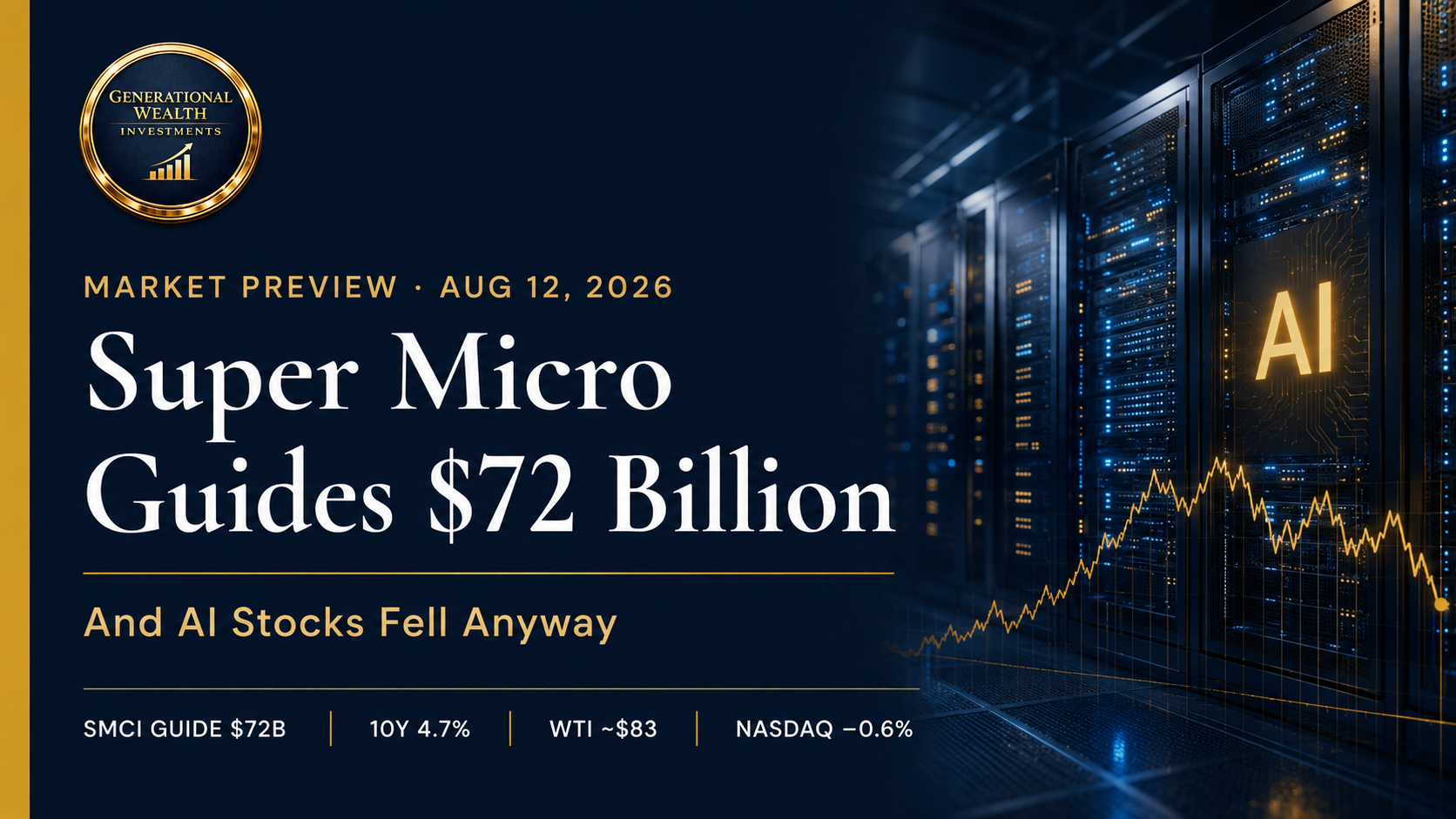
Super Micro Guides $72B as AI Stocks Sell Off Anyway
Super Micro guided to as much as $72 billion in AI server sales next year, roughly $19 billion above Wall Street's model, and the stock jumped about 9% after hours — hours after AI stocks had sold off all day. Today's preview decodes why the doubt has shifted from demand to financing, with yields near 4.7%, crude around $83, and the July inflation report landing at 8:30.
Market Preview: Super Micro Guides $72 Billion as AI Stocks Sell Off Anyway
Super Micro told Wall Street it expects to sell as much as $72 billion of AI servers next year — roughly $19 billion above what analysts were modeling — and the stock jumped about 9% after hours. The strange part is the timing: AI stocks had sold off all day in the regular session. Today's video explains why the doubt on Wall Street is no longer about demand, but about how the buildout gets paid for.

Today's Market Snapshot
Demand Beats, and Then Some
Super Micro guided to as much as $72 billion in AI server sales next year, against roughly $53 billion modeled on Wall Street. The stock rose about 9% after hours. CoreWeave said the same evening that its backlog grew roughly $25 billion in six weeks, and its stock jumped as well.
The Funding Question Takes Over
Hours earlier, AI names sold off all session. Alphabet fell nearly 4% on data center spending worries, Intel priced a $20 billion stock sale upsized from $15 billion, and Nvidia lined up more than $500 billion of outside financing this week. The Nasdaq closed down about 0.6%, a second straight loss.
Yields and Oil Set the Cost
When a buildout runs on borrowed money, the cost of borrowing becomes the story. The 10-year Treasury yield sits near 4.7%. Crude settled around $83, a fourth straight gain, after Iran said the Strait of Hormuz stays shut. Both feed directly into this morning's inflation math.
What Investors Should Be Watching
- The July inflation report at 8:30 this morning, where economists expect headline inflation around 3.4% — a cooler number takes pressure off yields, a hotter one makes every one of these deals pricier.
- Whether the after-hours enthusiasm around Super Micro and CoreWeave carries into the regular session, or whether the financing questions reassert themselves the way they did Tuesday.
- Whether crude can extend a fourth straight gain with the Strait of Hormuz still closed, and what that does to the rate path traders are already pricing near a coin flip for a hike.
Inside Today's Members-Only Daily Market Brief
- The specific levels members are tracking across the 10-year, crude, and the AI complex as the funding story develops.
- Both sides of this morning's inflation print, and what each outcome would mean for a rate decision now priced near even.
- Why the market can sell a demand beat, and what would actually resolve the question of who is holding the paper.
- How the Intel and Nvidia financing structures differ, and which one tells you more about the cycle.
- Where capital is rotating as borrowing costs, not demand, become the constraint on the buildout.
Go Beyond the Headlines
The public video explains what happened. The Generational Wealth Community helps members understand what matters next, where the risks are, and which developments deserve continued attention.
Unlock the Daily Market Brief
Nvidia's $500B AI War Chest as Oil Surges | Aug 11, 2026
Nvidia lined up more than $500 billion from six Wall Street giants for AI data centers, and the stock fell anyway on circular financing concerns. Crude surged roughly 5% as Hormuz talks stalled, the 10-year yield topped 4.7%, and September rate hike odds moved to roughly even ahead of Wednesday's CPI.
Market Preview: Nvidia Lines Up $500 Billion for AI as Oil Surges and Rate Hike Odds Climb
Nvidia announced partnerships with six of the largest firms on Wall Street to mobilize more than $500 billion for AI data centers — and the stock fell anyway. Meanwhile crude jumped roughly 5%, the 10-year Treasury yield pushed above 4.7%, and traders now put roughly even odds on a Federal Reserve rate hike in September. Today's video connects the energy move, the AI financing question, and the rate math heading into Wednesday's inflation print.

Today's Market Snapshot
Crude Jumps as Hormuz Talks Stall
West Texas Intermediate settled up about 5% Monday near $82 a barrel, with Brent near $88, after President Trump demanded Iran pay compensation and talks to reopen the Strait of Hormuz stalled. Both moved higher again this morning, Brent near its highest since late July. Producers and refiners benefit if it holds.
Nvidia's $500 Billion Question
Nvidia announced partnerships with Apollo, BlackRock, Blackstone, Brookfield, Goldman Sachs and KKR to mobilize over $500 billion for AI data centers. Shares still fell roughly 2–3% as investors questioned circular financing, recovering slightly overnight. Intel dropped nearly 4% on a $15 billion dilutive stock offering.
Yields Rise, Stocks Slip
Higher oil lifted inflation expectations and the 10-year Treasury yield climbed above 4.7%, near its highest since January. September hike odds moved to roughly even from about 44% Monday, and Cleveland Fed President Hammack said several increases may be needed. The S&P 500 closed down 0.1% at 7,752.
What Investors Should Be Watching
- Wednesday's consumer price index, now the week's real catalyst after oil and yields reset expectations for the September meeting.
- Whether AI spending confirmation arrives, with CoreWeave reporting today and Applied Materials Thursday — or whether the financing questions around Nvidia's announcement keep pressure on leadership.
- Whether the crude rally holds, and what a sudden deal reopening the Strait of Hormuz would do to the energy trade.
Inside Today's Members-Only Daily Market Brief
- The specific levels and catalysts members are tracking across crude, gold, and rates as the Hormuz standoff drags on.
- Both sides of Wednesday's inflation print, and what each outcome would mean for a September hike now priced near a coin flip.
- Why circular financing is drawing scrutiny, and what would actually confirm or break the AI spending story this week.
- The bitcoin level analysts say shifts sentiment, plus what recent fund flows suggest beneath a heavy tape.
- Where capital is rotating as money moves toward energy and hard assets while AI leadership wobbles.
Go Beyond the Headlines
The public video explains what happened. The Generational Wealth Community helps members understand what matters next, where the risks are, and which developments deserve continued attention.
Unlock the Daily Market Brief