

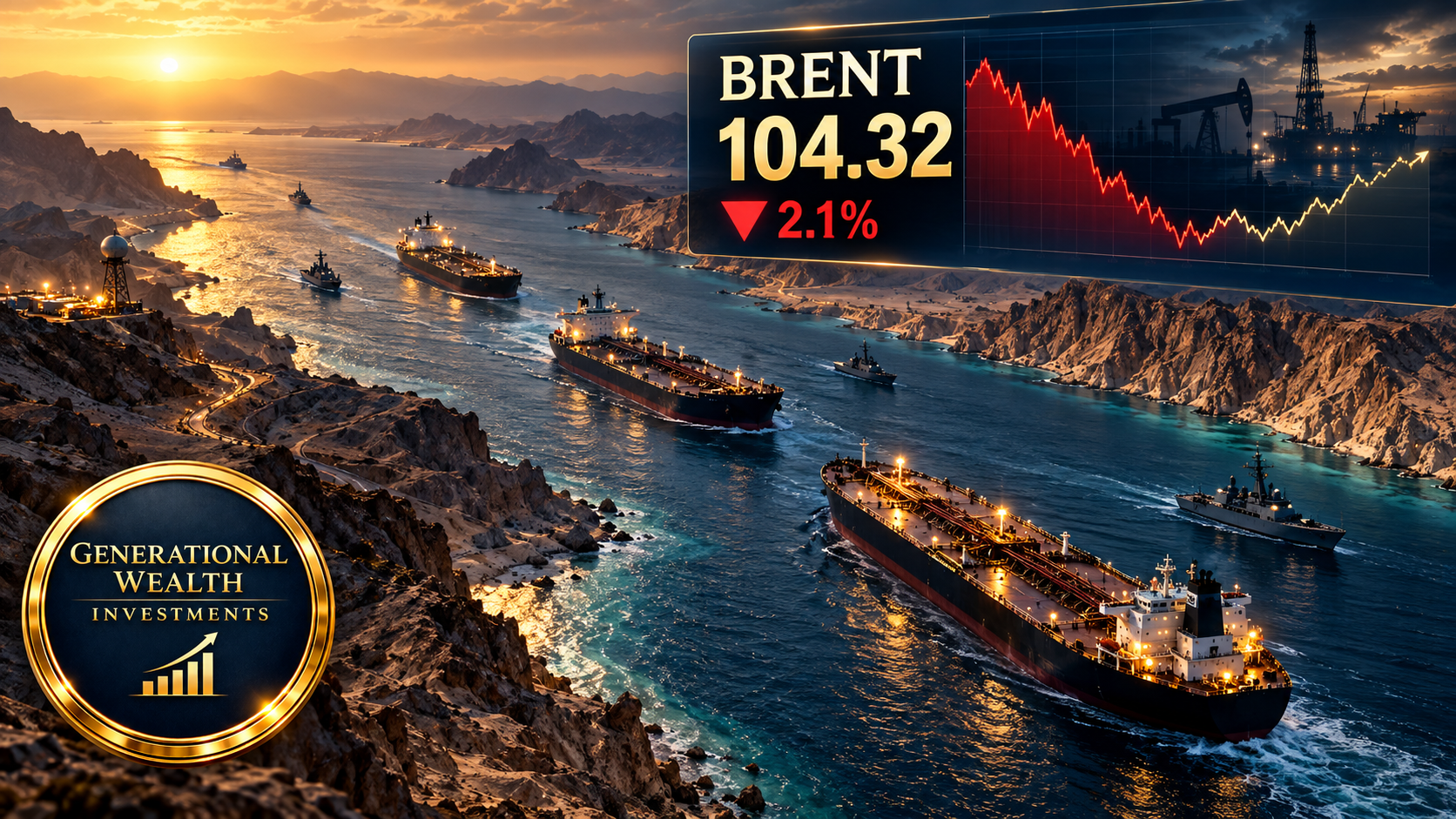
Trump Rejects Iran's Hormuz Offer: Will Brent Crude Spike?
President Trump rejected Iran’s proposal to reopen the Strait of Hormuz just as traders were pricing in renewed diplomacy. Now Iran’s latest warning puts the focus on Brent crude’s first trade after the weekend—and whether geopolitical risk returns to the price.
September 27, 2026
Trump Rejects Iran’s Hormuz Offer: Will Brent Crude Spike When Trading Reopens?
President Trump publicly rejected Iran’s proposal to reopen the Strait of Hormuz on Saturday. On Sunday, Iran’s army said it was prepared for renewed U.S. attacks and warned that Tehran would not accept being unable to trade while others use the region’s strategic waterways. Brent settled Friday near $104 after falling more than 2%, so the next crude trade will test whether diplomacy hopes still outweigh renewed geopolitical risk.
Watch Today’s Market Breakdown
See why Trump’s rejection and Iran’s new warning changed the weekend setup, and why Brent crude’s first trade when markets reopen could become the next important signal.
Today’s Market Setup
Friday’s oil decline reflected optimism that diplomacy could reopen the Strait of Hormuz. Trump’s rejection of Iran’s proposal and Tehran’s Sunday warning now create a tougher test: whether traders keep pricing in a path to negotiations or quickly add back geopolitical risk.
Trump Rejected the Hormuz Offer
President Trump said Saturday that he rejected Iran’s proposal to reopen the Strait of Hormuz and end the fighting. That removes, for now, the clearest weekend catalyst behind expectations for a faster reopening.
Iran Issued a New Warning
On Sunday, Iran’s army said it was prepared for renewed U.S. attacks and warned that Tehran would not accept being unable to trade while others use the region’s strategic waterways. That keeps escalation risk in focus.
Brent Closed Near $104
Brent crude fell more than 2% Friday to around $104 as traders focused on diplomacy. With roughly one-fifth of global oil supply moving through Hormuz before the war, the next crude trade carries unusual signaling value.
What Matters From Here
Friday’s market was still leaning toward diplomacy. The question now is whether the weekend’s developments change that calculation when crude trading resumes.
- Does Brent reverse sharply higher when trading resumes after Trump’s rejection of Iran’s reopening proposal?
- Do traders continue betting that negotiations survive despite Iran’s warning and the tougher public positions from both sides?
- Does Tehran’s condition that its demands be met keep a credible path to reopening Hormuz alive, or does the market begin pricing a longer disruption?
The Headlines Are Only the First Step
The free Market Preview explains why the weekend developments matter and why crude’s reopening trade is now the immediate market test. The members-only Daily Market Brief goes deeper into the catalysts, risks, confirmation signals and developments worth monitoring as traders decide whether diplomacy is still credible or geopolitical risk is rebuilding.
See What Members GetInside Today’s Members-Only Daily Market Brief
- The crude-market signals that could show whether Friday’s diplomacy-driven decline is reversing or still holding.
- What to monitor around Hormuz as traders reassess the probability and timing of a reopening.
- The next U.S.-Iran diplomatic or military developments that could strengthen or weaken the current oil-market setup.
- Why Brent’s first move after the weekend could help distinguish a temporary headline reaction from a broader repricing of supply risk.
Go Beyond the Headlines
The public Market Preview tells you what happened. The Generational Wealth Community is designed for investors who want to understand what deserves attention next, what could confirm the current market setup, what risks could change it and which developments deserve continued monitoring. We don’t chase hype, we decode the market.
Unlock the Daily Market BriefEducational market research designed to help investors understand the setup — not chase headlines.
Your pathway from knowledge to legacy. We don’t chase hype, we decode the market.
Stay Ahead of What Matters Next
Friday’s oil market reflected confidence that diplomacy could improve the Hormuz outlook. The next crude trade and the next U.S.-Iran signals will help show whether that confidence survives the weekend.
Join the Generational Wealth Community
Hormuz Tanker Hit as Both Major Oil Routes Face Pressure
A tanker attack in the Strait of Hormuz comes as Saudi Arabia’s East-West oil pipeline is already shut, putting two major regional oil routes under pressure. With oil recently above $100, attention now turns to whether supply disruptions worsen and what Monday’s regional meeting means for Hormuz.
September 13, 2026
Hormuz Tanker Struck as Both Major Oil Routes Face Pressure
A ship was struck by a projectile in the Strait of Hormuz overnight, forcing its crew to evacuate after a fire broke out. The attack comes while Saudi Arabia’s East-West oil pipeline is already shut following drone strikes, putting pressure on two critical routes for moving Middle Eastern oil. The bigger question now is whether these disruptions remain contained or create another supply shock.
Watch Today’s Market Breakdown
See why the tanker attack matters beyond one vessel, how the East-West pipeline changes the oil-supply picture, and why Monday’s regional meeting is the next major catalyst.
Today’s Market Setup
The immediate story is a tanker attack in Hormuz. The broader market concern is that the incident comes while another major regional oil route is already unavailable, increasing the importance of what happens next across the region.
Tanker Struck in Hormuz
A projectile hit a ship in the Strait of Hormuz overnight and a fire forced the crew to evacuate. The concern extends beyond the vessel itself because Hormuz has already been largely disrupted by war.
East-West Pipeline Is Shut
Saudi Arabia’s East-West oil pipeline is also shut after drone strikes. The pipeline had been moving roughly four to five million barrels per day — approximately four to five percent of global supply.
Supply Risk Meets $100 Oil
Oil was already above $100 last week. With pressure now affecting both major regional routes, another supply shock could feed into fuel costs and inflation, keeping energy markets at the center of the broader economic picture.
What Matters From Here
The tanker attack explains what happened overnight. The next questions are about whether transportation pressure worsens and what Monday’s regional discussions mean for the future of Hormuz.
- Does pressure on both Hormuz and the East-West pipeline create a broader disruption to regional oil flows?
- Could another supply shock add renewed pressure to fuel costs and inflation after oil moved above $100 last week?
- What comes out of Monday’s meeting between regional countries over the future of the Strait of Hormuz?
The Headlines Are Only the First Step
The free Market Preview explains why the tanker attack matters and why having both major oil routes under pressure changes the market setup. The members-only Daily Market Brief goes deeper into the catalysts, risks, confirmation signals and developments worth monitoring as the region approaches Monday’s meeting.
See What Members GetInside Today’s Members-Only Daily Market Brief
- The developments that could show whether pressure on the region’s two major oil routes is stabilizing or becoming a larger supply problem.
- The signals worth monitoring around oil after prices moved above $100 last week.
- Why additional disruption could matter for fuel costs and the broader inflation picture.
- What Monday’s regional meeting could change about the market’s focus on the future of Hormuz.
Go Beyond the Headlines
The public Market Preview tells you what happened. The Generational Wealth Community is designed for investors who want to understand what deserves attention next, what could confirm the current market setup, what risks could change it and which developments deserve continued monitoring. We don’t chase hype, we decode the market.
Unlock the Daily Market BriefEducational market research designed to help investors understand the setup — not chase headlines.
Your pathway from knowledge to legacy. We don’t chase hype, we decode the market.
Stay Ahead of What Matters Next
Follow the oil-supply, inflation and regional developments that could determine whether today’s disruption remains contained or becomes a broader market issue.
Join the Generational Wealth Community
Oil Jumps 5% as 10-Year Yield Hits 4.81% and Gold Falls
Oil surged as renewed fighting near the Strait of Hormuz pushed energy prices higher while the 10-year Treasury yield reached about 4.81%. Gold’s decline reveals the bigger market tension as investors weigh geopolitical risk against higher yields, a stronger dollar and the next test from U.S. labor data.
September 2, 2026
Oil Jumps 5% as Treasury Yields Hit 4.81% — So Why Is Gold Falling?
Oil surged after renewed U.S.-Iran fighting near the Strait of Hormuz, pushing Brent to $94.65 Tuesday and briefly near $97 overnight. At the same time, the 10-year Treasury yield reached about 4.81%, its highest since 2023. Yet gold moved the opposite direction, falling to a more than three-week low as higher yields and a stronger dollar outweighed safe-haven demand. Now labor data could test the entire setup.
Watch Today’s Market Breakdown
See how the Hormuz oil shock is feeding into inflation expectations, Treasury yields, stock valuations and gold ahead of the ADP employment report.
Today’s Market Setup
The market is dealing with one connected chain of pressure: geopolitical risk is lifting oil, higher oil is keeping inflation concerns alive, and rising rate expectations are pushing Treasury yields higher.
Oil Surges on Hormuz Risk
Brent settled Tuesday at $94.65, up 4.6%, while WTI gained 5.2%. Brent then briefly touched $97 overnight before easing near $95. Renewed U.S.-Iran fighting near Hormuz is keeping supply risk at the center of the inflation outlook.
Treasury Yields Reach New Highs
The 10-year Treasury yield reached about 4.81%, its highest since 2023, while the 2-year climbed near 4.41%. Higher energy costs can keep inflation elevated, strengthening the market’s focus on whether the Federal Reserve may need to raise rates again.
Gold Breaks the Safe-Haven Pattern
Spot gold fell near $4,324, a more than three-week low, despite the geopolitical tension. Higher Treasury yields and a stronger dollar outweighed safe-haven demand, showing why geopolitical risk alone has not been enough to push gold higher.
What Matters From Here
Oil, rates, stocks and gold are now reacting to the same inflation question. The next test is whether incoming labor data reinforces the higher-rate narrative or begins to challenge it.
- Does the ADP private-payrolls report strengthen the case for another Federal Reserve rate hike, or complicate the market’s current expectations?
- Can oil remain near current levels if fighting around the Strait of Hormuz continues to threaten supply?
- Will higher Treasury yields and a stronger dollar continue to outweigh safe-haven demand for gold?
The Headlines Are Only the First Step
The free Market Preview explains why oil, Treasury yields, stocks and gold are moving the way they are. The members-only Daily Market Brief goes deeper into the catalysts, risks, confirmation signals and developments worth monitoring as the market determines whether this inflation-and-rates pressure continues.
See What Members GetInside Today’s Members-Only Daily Market Brief
- The developments that could confirm whether the current oil-driven inflation pressure is continuing or beginning to ease.
- How the ADP employment report fits into the market’s changing expectations for Federal Reserve policy.
- The Treasury-yield signals worth following as the 10-year trades around its highest level since 2023.
- What gold’s weakness may reveal about the competition between safe-haven demand, higher yields and a stronger dollar.
- The next developments that could change the relationship between energy prices, interest rates and stock valuations.
Go Beyond the Headlines
The public Market Preview tells you what happened and why investors are paying attention. The Generational Wealth Community is designed for investors who want to understand what deserves attention next, what could confirm the current market setup, what risks could change it and which developments deserve continued monitoring. We don’t chase hype, we decode the market.
Unlock the Daily Market BriefEducational market research designed to help investors understand the setup — not chase headlines.
Your pathway from knowledge to legacy. We don’t chase hype, we decode the market.
Stay Ahead of What Matters Next
Follow the catalysts that matter as markets weigh oil near $95, Treasury yields around 4.81%, gold weakness and the next test from U.S. labor data.
Join the Generational Wealth Community