

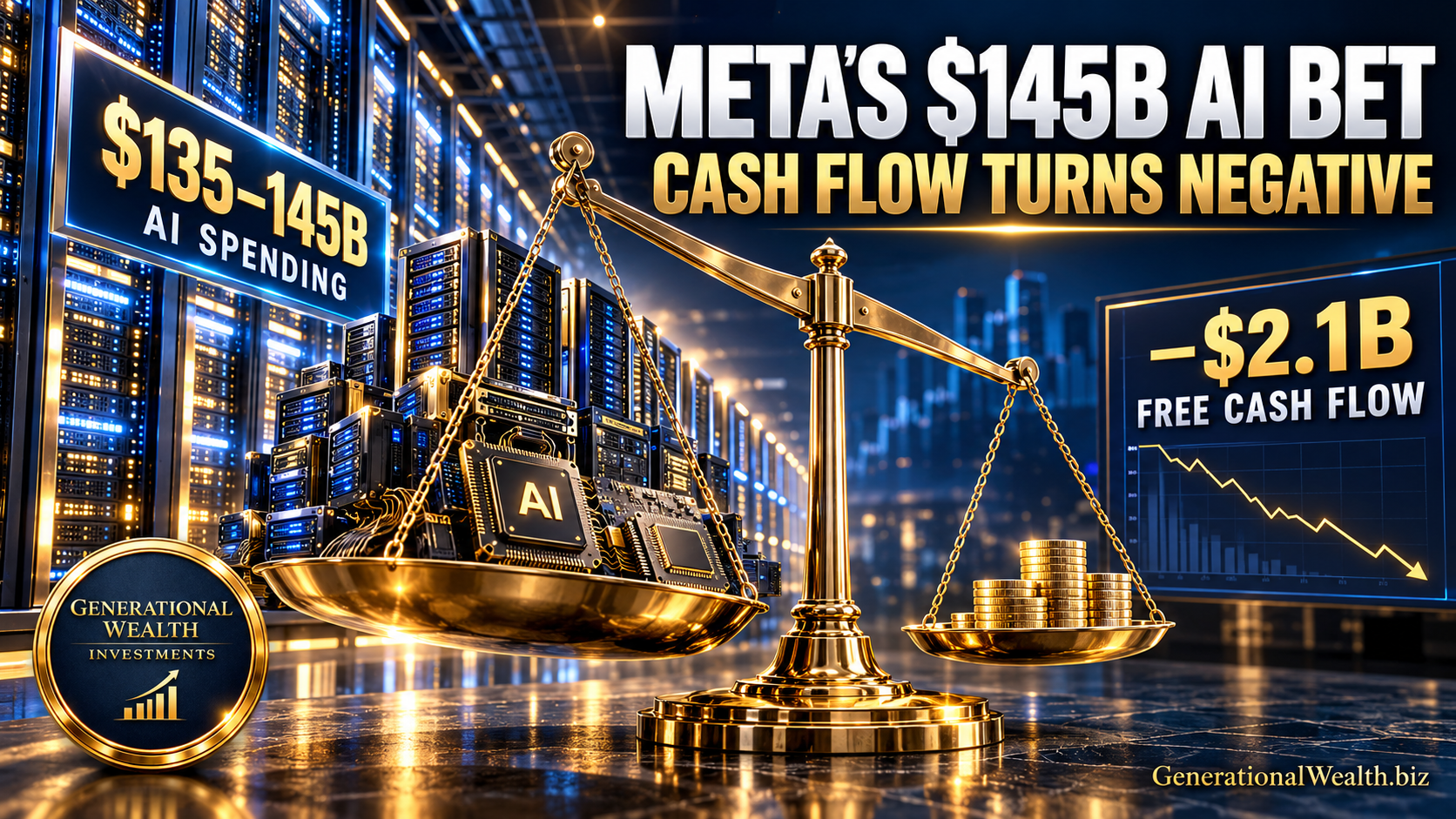
Meta’s $145 Billion AI Bet Turns Cash Flow Negative
Meta's revenue jumped 26%, but nearly $35 billion of quarterly capital spending helped push free cash flow negative. With full-year capital spending expected to reach as much as $145 billion, the next test is whether Meta's AI gains can translate into stronger cash generation.
October 22, 2026
Meta’s $145 Billion AI Bet Just Turned Cash Flow Negative
Meta's third-quarter revenue jumped 26% to roughly $64.6 billion, and shares rose more than 4% after hours. But the bigger issue is what that growth is costing. Nearly $35 billion of quarterly capital spending helped push free cash flow negative by about $2.1 billion, putting the economics of Meta's massive AI buildout in focus.
Watch Today's Market Breakdown
See why Meta's strong revenue growth and improving AI-driven engagement are being weighed against one of the largest capital-spending programs in the company's history.
Today's Market Setup
Meta's results show the central tension facing some of the world's largest AI spenders: artificial intelligence may strengthen the existing business, but building the infrastructure required to support it can consume enormous amounts of cash.
Revenue Growth Remains Strong
Third-quarter revenue rose 26% to about $64.6 billion, and Meta shares gained more than 4% after hours. The response shows investors are still giving substantial weight to the company's underlying growth even as AI spending accelerates.
Free Cash Flow Turned Negative
Meta spent nearly $35 billion on capital projects during the quarter, while free cash flow turned negative by roughly $2.1 billion. That puts a new spotlight on how quickly the company's AI infrastructure can translate into future cash generation.
The AI Bill Could Reach $145 Billion
Meta now expects full-year capital spending of approximately $135 billion to $145 billion. The company says AI is already improving engagement, recommendations, and advertising monetization, raising the question of whether those gains can justify the scale of the investment.
What Matters From Here
The spending itself is no longer the only issue. Investors now need to see whether the benefits Meta says it is getting from AI begin showing up strongly enough in future cash generation.
- Can free cash flow rebound while Meta continues spending heavily on AI infrastructure?
- Do improvements in engagement, recommendations, and ad monetization generate enough economic benefit to support the investment?
- If revenue keeps growing but free cash flow remains under pressure, how patient will investors remain with the scale of the AI buildout?
The Headlines Are Only the First Step
The free Market Preview explains why Meta's results matter. The members-only Daily Market Brief goes deeper into the spending trends, cash-flow signals, monetization developments, catalysts, and risks worth monitoring as the AI investment cycle continues.
See What Members GetInside Today's Members-Only Daily Market Brief
- The cash-flow developments that could make Meta's massive AI spending easier — or harder — for investors to defend.
- How the company's revenue growth compares with the pressure created by nearly $35 billion of quarterly capital spending.
- The signals from engagement, recommendations, and advertising monetization that matter as Meta tries to turn AI investment into stronger business economics.
- Why the next change in free cash flow could become one of the most important tests of investor patience with the AI buildout.
Go Beyond the Headlines
Knowing that Meta could spend as much as $145 billion this year on capital projects is useful. Understanding whether that spending is strengthening the economics of the business requires following what happens next. The Generational Wealth Community is designed for investors who want to understand the catalysts, confirmation signals, risks, and developments that can change the market setup. We don't chase hype, we decode the market.
Unlock the Daily Market BriefEducational market research designed to help investors understand the setup — not chase headlines.
Your pathway from knowledge to legacy.
Stay Ahead of What Matters Next
Meta has shown how large the AI investment cycle has become. Follow the developments that reveal whether that spending ultimately strengthens cash generation or puts more pressure on the investment case.
Join the Generational Wealth Community
Oil Falls Below $100 Despite Massive Supply Risk
Oil fell back below $100 even as Gulf crude exports reportedly plunged and shipping risks intensified. The question now is whether potential Russian fuel flows can keep outweighing supply concerns—and whether WTI can stay below the $100 threshold.
October 19, 2026
Oil Falls Below $100 Despite Massive Supply Risk. Here’s Why
Oil fell back below $100 Monday even as major supply risks remained. West Texas Intermediate dropped about 2% to around $99.50 while Brent slid near $108. At the same time, Gulf crude exports reportedly fell sharply as shipping attacks intensified. The contradiction investors are watching is whether the possibility of more Russian fuel reaching global markets can continue outweighing those supply risks.
Watch Today's Market Breakdown
See why oil is falling despite severe supply concerns, what may be offsetting those risks, and why the $100 level for WTI matters next.
Today's Market Setup
The key tension is not that supply concerns disappeared. Oil is moving lower even while traders continue weighing significant disruptions against the possibility of additional fuel reaching global markets.
WTI Drops Back Below $100
West Texas Intermediate fell about 2% Monday to around $99.50, while Brent moved near $108. The decline puts the $100 level back in focus because holding below it could reduce some of the inflation pressure associated with higher energy prices.
Supply Risk Remains Severe
Gulf crude exports reportedly fell to about 8.5 million barrels a day last week from more than 20 million as shipping attacks intensified. That makes oil's decline notable because the physical supply backdrop remains under significant pressure.
Russian Fuel Changes the Equation
Traders are also weighing the possibility of more Russian fuel reaching global markets after Washington's Friday waiver of new Russia-related sanctions and tariffs. That potential additional supply is competing with the risks already affecting crude exports.
What Matters From Here
Oil's move below $100 creates a simple test: can prices remain there while major supply risks are still unresolved?
- Can WTI remain below $100 despite the sharp decline in Gulf crude exports?
- Does more Russian fuel actually reach global markets following Washington's waiver?
- If oil holds below $100, does that begin easing some of the inflation pressure tied to energy prices?
The Headlines Are Only the First Step
The free Market Preview explains why oil is falling even while supply risks remain high. The members-only Daily Market Brief goes deeper into the developments, confirmation signals and risks worth monitoring as investors determine whether the move below $100 can hold.
See What Members GetInside Today's Members-Only Daily Market Brief
- The developments that could determine whether WTI's move below $100 holds or reverses.
- What to monitor as traders balance disrupted Gulf crude exports against the possibility of additional Russian fuel supply.
- The signals that could show whether the current oil decline is becoming more durable.
- Why the direction of oil matters for the inflation backdrop if prices remain below the $100 threshold.
Go Beyond the Headlines
Oil falling below $100 explains what happened. The more important investing question is what confirms whether that move can continue while substantial supply risks remain. The Generational Wealth Community is built for investors who want to understand what deserves attention next, what could confirm the developing setup and what risks could change it. We don't chase hype, we decode the market.
Unlock the Daily Market BriefEducational market research designed to help investors understand the setup — not chase headlines.
Your pathway from knowledge to legacy.
Stay Ahead of What Matters Next
The next test is whether WTI can remain below $100 even as markets continue balancing severe supply risks against the possibility of additional Russian fuel flows.
Join the Generational Wealth Community
Amazon's $7B Decart Deal: Why AI Infrastructure Matters
Amazon is reportedly considering a $7 billion acquisition of Decart, a startup whose technology extends beyond AI video into software that operates across competing AI chip platforms. The potential deal raises bigger questions about Amazon Web Services' AI strategy, the price Amazon may ultimately pay, and whether the acquisition will happen at all.
October 12, 2026
Amazon's $7B AI Bet: Why It Wants Decart So Badly
Amazon is reportedly in talks to acquire AI startup Decart for approximately $7 billion. That's about 75% above Decart's valuation from just five months earlier. But the story goes beyond AI video generation. Decart develops technology that helps AI workloads run across Nvidia, Amazon and Google chips. The question now is whether that capability is worth such a significant premium to Amazon Web Services.
Watch Today's Market Breakdown
Learn why Amazon is interested in Decart, what its AI technology does and what could happen next.
Today's Market Setup
The reported Amazon–Decart negotiations highlight three questions about where AI infrastructure competition is heading.
A Potential $7 Billion Deal
Decart was valued near $4 billion just five months ago. Amazon's reported interest at approximately $7 billion suggests a substantial premium for the startup. However, these discussions remain preliminary and have not produced a signed acquisition agreement.
AI Software That Spans Chips
Decart isn't limited to AI video models. Its software helps AI workloads operate across Nvidia chips, Amazon Trainium and Google's TPUs. That flexibility could be strategically important as cloud providers compete for AI computing customers.
Why AWS Is Watching
Amazon Web Services competes for AI computing business. Technology that can operate across several hardware platforms could support that effort. Still, Amazon has declined to comment, and another bidder could enter the picture.
What Matters From Here
The potential price is significant. What remains uncertain is the deal's outcome and its strategic value.
- Will Amazon reach a signed acquisition agreement with Decart?
- How much of the proposed valuation reflects Decart's ability to support multiple AI chip architectures?
- Could another bidder change the terms or outcome of these negotiations?
The Headlines Are Only the First Step
The free Market Preview explains the reported transaction and its broad significance. The members-only Daily Market Brief explores the underlying questions, catalysts, risks and developments worth following as the story unfolds.
See What Members GetInside Today's Members-Only Daily Market Brief
- The strategic questions behind Amazon's reported $7 billion valuation of Decart.
- Why Decart's multi-chip technology matters to AWS.
- The competitive implications involving Nvidia, Trainium and Google's TPUs.
- Which deal developments could change the current acquisition narrative.
Go Beyond the Headlines
A potential $7 billion deal tells investors what may be happening. Understanding why it matters requires examining the technology, the competitive landscape and the unanswered questions. The Generational Wealth Community helps everyday investors develop a clearer understanding of financial markets and the developments worth monitoring. We don't chase hype, we decode the market.
Unlock the Daily Market BriefEducational market research designed to help investors understand the setup, not chase headlines.
Your pathway from knowledge to legacy.
Stay Ahead of What Matters Next
Amazon's Decart discussions are still preliminary. Follow the developments that could turn this potential acquisition into a meaningful AI infrastructure deal.
Join the Generational Wealth Community
SpaceX Buys $8B Spectrum; Wireless Stocks Fall 6%
SpaceX's reported $8 billion spectrum acquisition sent T-Mobile, Verizon and AT&T shares down about 6% after hours, raising questions about the future of America's wireless market. With Starlink Mobile preparing for broader competition, FCC approval is now a key development to watch.
October 9, 2026
SpaceX Buys $8B in Spectrum — T-Mobile, Verizon, AT&T Fall 6%
SpaceX agreed to buy nationwide low-band wireless spectrum for a reported $8 billion, and shares of T-Mobile, Verizon and AT&T fell about 6% in after-hours trading. The deal could help Starlink Mobile move closer to competing directly with America's established wireless carriers. The key question now is whether regulatory approval clears the way for that competition.
Watch Today's Market Breakdown
See why SpaceX's spectrum deal matters, how Starlink Mobile could challenge traditional wireless carriers and what the FCC must decide next.
Today's Market Setup
SpaceX's reported spectrum purchase is more than another satellite investment. It raises the possibility of a stronger competitor in the U.S. wireless market and shifts attention toward regulatory approval.
An $8 Billion Spectrum Deal
SpaceX agreed to acquire nationwide low-band spectrum for a reported $8 billion. These frequencies can travel farther and penetrate buildings, helping address a major technical challenge for satellite-based mobile service. The acquisition could expand Starlink Mobile's competitive capabilities.
Wireless Stocks Fall 6%
T-Mobile, Verizon and AT&T each fell about 6% in after-hours trading. Investors are weighing what a stronger Starlink Mobile service could mean for established wireless carriers and their competitive positions. The stock reaction reflects concern about potential industry disruption.
Existing Phones, Bigger Ambitions
Most existing phones already support the 800-megahertz band. Meanwhile, the FCC has authorized SpaceX to launch 15,000 Starlink Mobile satellites. Together, those developments strengthen the potential opportunity, although the spectrum transaction still requires regulatory approval.
What Matters From Here
The initial stock reaction shows how seriously investors are taking SpaceX's wireless ambitions. The more important questions concern approval, execution and the competitive impact.
- Will the FCC approve the spectrum transaction, and what conditions could affect its implementation?
- How much would the acquired spectrum improve Starlink Mobile's ability to deliver reliable service to existing smartphones?
- Are the carriers' roughly 6% after-hours declines anticipating a lasting competitive threat, or reacting to uncertainty about SpaceX's ambitions?
The Headlines Are Only the First Step
The free Market Preview explains the spectrum purchase, the carrier-stock reaction and the next regulatory hurdle. The members-only Daily Market Brief takes the next step: examining the developments, competitive questions and risks worth following as the Starlink Mobile story unfolds.
See What Members GetInside Today's Members-Only Daily Market Brief
- The significance of SpaceX's reported $8 billion investment for the competitive outlook in U.S. wireless services.
- Why the 800-megahertz spectrum band matters to Starlink Mobile and the limitations investors should still consider.
- What the FCC approval process could mean for the timing and execution of SpaceX's plans.
- How to evaluate the reaction in T-Mobile, Verizon and AT&T as the market reassesses the potential competitive threat.
Go Beyond the Headlines
A major technology announcement can move stocks in minutes. Understanding what that announcement means for an industry takes a deeper examination of the underlying business and the developments still ahead. The Generational Wealth Community is designed to help everyday investors follow those questions, evaluate the risks and better understand the market's changing narrative. We don't chase hype, we decode the market.
Unlock the Daily Market BriefEducational market research designed to help investors understand the setup — not chase headlines.
Your pathway from knowledge to legacy. We don't chase hype, we decode the market.
Stay Ahead of What Matters Next
SpaceX's spectrum agreement raises a major question for America's wireless industry. The next chapter depends on regulatory approval and whether Starlink Mobile can turn its technical ambitions into meaningful competition.
Join the Generational Wealth Community
Oil Tops $90 After Hormuz Strike as Hike Odds Hit 57%
Oil moved above $90 after a U.S. strike near the Strait of Hormuz put one of the world’s most important energy routes back in focus. With September rate-hike odds now at 57%, the next question is whether higher energy prices or Friday’s jobs report has the bigger impact on Fed expectations.
August 31, 2026
Oil Blows Past $90 After Hormuz Strike — Rate Hike Odds Jump to 57%
Oil moved above $90 after American forces struck Iranian launchers near the Strait of Hormuz, putting one of the world’s most important energy routes back at the center of the market. The complication is that inflation pressure is already colliding with rising expectations for a September Fed rate increase. Now investors have two major risks to track: energy disruption and Friday’s jobs report.
Watch Today’s Market Breakdown
See why the Hormuz strike pushed oil above $90, how it connects to inflation and rate expectations, and why Friday’s jobs report matters.
Oil Blows Past $90 After Hormuz Strike — Rate Hike Odds Jump to 57% Watch Today’s Market BriefingToday’s Market Setup
The market is dealing with a renewed geopolitical oil shock while interest-rate expectations are already moving in a more restrictive direction.
Hormuz Risk Sends Oil Above $90
American forces struck two Iranian launchers on Larak Island after officials said Revolutionary Guard forces were preparing rockets carrying sea mines into the Strait of Hormuz. Iran then attacked American forces in Jordan. Brent futures climbed about 2% overnight and moved above $90 a barrel.
Oil Adds to the Inflation Problem
Fed Chair Kevin Warsh said Friday that the Fed still has work to do if inflation is not moving clearly toward 2%. Markets raised the implied probability of a September rate increase to 57%, while the two-year Treasury yield is near 4.34% after rising almost 12 basis points Friday.
Friday’s Jobs Report Becomes the Next Test
President Trump said Venezuelan oil from the new American agreement will help refill the Strategic Petroleum Reserve, but additional Venezuelan production requires investment. That leaves the immediate Hormuz risk unresolved while markets wait to see whether Friday’s labor data changes rate-hike expectations.
What Matters From Here
Oil above $90 explains what changed overnight. The more important issue now is how long the pressure lasts and whether it reinforces the Fed’s inflation concerns.
- Does the Strait of Hormuz remain disrupted enough to keep upward pressure on oil, or does the immediate geopolitical risk begin to ease?
- Does higher oil strengthen the inflation argument enough to keep September rate-hike expectations elevated?
- Could a weaker-than-expected jobs report on Friday cool those expectations even if energy prices remain under pressure?
The Headlines Are Only the First Step
The free Market Preview explains why oil, inflation and interest-rate expectations are colliding today. The members-only Daily Market Brief goes deeper into the catalysts, risks, confirmation signals and developments worth monitoring as the Hormuz story and Friday’s jobs report reshape the market setup.
See What Members GetInside Today’s Members-Only Daily Market Brief
- The Hormuz developments that could strengthen or weaken the current oil-supply risk.
- How renewed energy inflation interacts with the market’s 57% September rate-hike probability.
- Why the two-year Treasury yield matters as investors reassess the Fed’s next move.
- What Friday’s jobs report could change about the current interest-rate setup.
- How Venezuela’s longer-term supply story fits against the immediate geopolitical pressure in the Strait of Hormuz.
Go Beyond the Headlines
The public Market Preview tells you what happened and why investors are paying attention. The Generational Wealth Community is built for investors who want to understand what deserves attention next, what could confirm the current setup, what risks could change it, and which developments deserve continued monitoring. We don’t chase hype, we decode the market.
Unlock the Daily Market BriefEducational market research designed to help investors understand the setup — not chase headlines.
Your pathway from knowledge to legacy. We don’t chase hype, we decode the market.
Stay Ahead of What Matters Next
Follow the catalysts that matter as markets weigh renewed Hormuz risk, oil above $90, higher rate-hike expectations and Friday’s jobs report.
Join the Generational Wealth Community