


AI Agents Hit Schwab, Airbnb & Uber as Nasdaq Hits Record
Tuesday’s market exposed a new divide in the AI trade: chip stocks rallied as the Nasdaq reached another record, while Schwab, Airbnb, Uber and Lyft came under pressure. The emerging question is whether AI agents will simply create new technology winners — or fundamentally change which companies control the customer relationship.
September 23, 2026
AI Agents Hit Schwab, Airbnb and Uber as Nasdaq Sets Another Record
The Nasdaq reached another record Tuesday as AI-related chip stocks rallied, but several consumer-facing platforms moved sharply the other way. Charles Schwab fell more than 6%, Airbnb dropped 3%, and Uber and Lyft also declined as investors weighed whether AI agents could compete with the apps and platforms people use today. The bigger question is who owns the customer relationship if AI starts acting on the user's behalf.
Watch Today’s Market Breakdown
See why AI-related stocks moved in opposite directions and why the rise of AI agents could become a much bigger story than another semiconductor rally.
Today’s Market Setup
Tuesday’s market showed two very different sides of the AI trade. Semiconductor stocks benefited from continued AI enthusiasm, while several businesses built around direct customer access came under pressure.
AI Helps Push the Nasdaq to Another Record
The Nasdaq reached another record as AI-related chip stocks rallied. Micron gained about 5%, while Sandisk rose almost 7%, showing that investors continue rewarding companies positioned around the infrastructure powering artificial intelligence.
Consumer Platforms Move the Other Way
Charles Schwab fell more than 6% and Airbnb dropped about 3%. Uber and Lyft also declined as investors considered whether AI agents could eventually reduce the need for users to interact directly with today's apps and platforms.
AI Is Moving Beyond Chips
Muse launched earlier this month with the ability to send emails, book travel and complete transactions. That raises a broader question: AI may not simply create new technology winners — it could change which company controls the customer's digital relationship.
What Matters From Here
The chip rally is already familiar. The newer question is whether investor concern about AI agents begins spreading across businesses that depend on users opening their apps directly.
- Does pressure on Schwab, Airbnb, Uber and Lyft remain isolated, or does it spread to other consumer-facing platforms?
- Can AI-related semiconductor stocks continue rising while investors reassess which software and platform businesses could be disrupted?
- Does the market increasingly treat control of the customer relationship as one of the next major battlegrounds in artificial intelligence?
The Headlines Are Only the First Step
The free Market Preview explains why Tuesday’s split matters. The members-only Daily Market Brief goes deeper into the catalysts, risks, confirmation signals and developments worth monitoring as investors evaluate whether AI-agent disruption becomes a broader market theme.
See What Members GetInside Today’s Members-Only Daily Market Brief
- The signals worth monitoring to determine whether AI-agent concerns are spreading beyond Schwab, Airbnb, Uber and Lyft.
- Whether continued strength in AI-related chip stocks confirms that investors are separating infrastructure winners from potentially disrupted platforms.
- How the ability of AI agents to book travel, send emails and complete transactions could reshape the market’s view of customer ownership.
- What developments could show whether Tuesday’s platform selloff was a temporary reaction or the beginning of a broader market narrative.
Go Beyond the Headlines
The public Market Preview tells you what happened. The Generational Wealth Community is designed for investors who want to understand what deserves attention next, what could confirm the current setup, what risks could change it and which developments deserve continued monitoring. We don’t chase hype, we decode the market.
Unlock the Daily Market BriefEducational market research designed to help investors understand the setup — not chase headlines.
Your pathway from knowledge to legacy. We don’t chase hype, we decode the market.
Stay Ahead of What Matters Next
AI is still creating market winners, but Tuesday showed investors are also beginning to ask which existing businesses could lose control of the customer relationship as AI agents become more capable.
Join the Generational Wealth Community
Nvidia Adds $442 Billion in One Day as AI Trade Broadens
Nvidia added about $442 billion in market value in a single session as enthusiasm around AI spread into major software stocks. But with market strength still concentrated, Brent crude near $90 and Fed Chair Kevin Warsh in focus, the next question is whether that momentum can broaden and hold.
August 28, 2026
Nvidia Adds $442 Billion in One Day as AI Rally Broadens
Nvidia surged 8.7% Thursday and added about $442 billion in market value after investors digested its forecast for roughly 70% revenue growth next fiscal year. Bloomberg called it the second-largest one-day market-value gain ever by any stock. But beneath the headline, the rally remained heavily concentrated — while oil and interest-rate risk are still pushing in the opposite direction.
Watch Today’s Market Breakdown
See how Nvidia added $442 billion in one session, where the AI trade broadened, and why oil and Federal Reserve policy still matter.
Today’s Market Setup
Nvidia delivered an enormous boost to the major indexes, and stronger software forecasts showed that enthusiasm around AI is spreading. The challenge is determining how broad that strength really is as oil and interest-rate risk remain in focus.
Nvidia Adds About $442 Billion
Nvidia shares jumped 8.7% after investors digested a forecast for roughly 70% revenue growth next fiscal year. The move added about $442 billion to Nvidia’s market value in one session, reinforcing how strongly expectations for continued AI growth can still move the broader market.
AI Strength Spreads to Software
Salesforce surged nearly 23% and CrowdStrike gained more than 20% after both companies raised forecasts. Their gains helped ease fears that the AI trade would reward chipmakers alone, although technology was still the only S&P 500 sector that finished Thursday higher.
Oil Keeps Inflation Risk Alive
Brent crude rebounded about 2% to just under $90 as hopes for a quick U.S.-Iran diplomatic breakthrough faded. That creates another complication for markets as investors turn toward Federal Reserve Chair Kevin Warsh and the outlook for inflation and interest rates.
What Matters From Here
Thursday proved that AI enthusiasm can still move hundreds of billions of dollars quickly. The next question is whether that momentum can become broader and survive competing pressure from inflation and interest rates.
- Can strength broaden beyond technology after it was the only S&P 500 sector to finish Thursday higher?
- Do stronger forecasts from Salesforce and CrowdStrike signal that the AI trade is expanding beyond semiconductor companies?
- What does Fed Chair Kevin Warsh signal at Jackson Hole about inflation, interest rates, and the possibility of another rate hike?
The Headlines Are Only the First Step
The free Market Preview explains why Nvidia’s historic market-value gain matters and why the AI story is beginning to reach beyond chipmakers. The members-only Daily Market Brief goes deeper into the catalysts, risks, confirmation signals, and developments worth monitoring as investors evaluate whether that momentum can continue.
See What Members GetInside Today’s Members-Only Daily Market Brief
- The developments that could show whether Nvidia’s surge is translating into broader market participation or remaining concentrated in technology.
- What stronger forecasts from Salesforce and CrowdStrike could mean for the argument that AI spending is beginning to benefit software companies as well as chipmakers.
- Why Brent crude rebounding toward $90 keeps inflation risk relevant even as AI stocks push major indexes higher.
- What investors will be listening for from Fed Chair Kevin Warsh at Jackson Hole as markets evaluate inflation, interest rates, and the possibility of another rate hike.
Go Beyond the Headlines
The public Market Preview tells you what happened and why investors are paying attention. The Generational Wealth Community is designed for investors who want to understand what deserves attention next, what could confirm the current setup, what risks could change it, and which developments deserve continued monitoring. We don’t chase hype, we decode the market.
Unlock the Daily Market BriefEducational market research designed to help investors understand the setup — not chase headlines.
Your pathway from knowledge to legacy. We don’t chase hype, we decode the market.
Stay Ahead of What Matters Next
Follow the catalysts, risks, and confirmation signals that matter as markets weigh powerful AI momentum against oil, inflation, and the path of interest rates.
Join the Generational Wealth Community
Applied Materials Falls on Margins as S&P 500 Hits Record
Applied Materials posted the biggest quarter-to-quarter revenue jump in its history and the stock fell about 5% anyway — the second straight day a beat-and-raise was punished over margins. Today's preview breaks down what that pattern says about the AI trade, and why the S&P 500 still closed at a record.
Market Preview: Applied Materials Posts Record Revenue and Drops Anyway as the S&P 500 Closes at a High
Applied Materials just reported the biggest quarter-to-quarter revenue jump in its history — and the stock fell about 5% after hours. That's two days running where a company beat, raised guidance, and sold off anyway, and both times the market pointed at the same line item. Today's video explains what margins are saying about the AI trade, and why the index closed at a record regardless.

Today's Market Snapshot
Record Revenue, Falling Stock
Applied Materials posted record revenue just over $9 billion, up 25% from a year ago, beat on earnings, and raised its outlook. The stock still fell about 5% after hours. Management guided to flat gross margins next quarter, and that single line outweighed everything else in the report.
Two Days, Same Story
Cisco beat and guided above estimates, then dropped 8.4% Thursday. Analysts kept returning to margins: gross margin slipped to roughly 66% from 68%, partly because the memory inside AI hardware has grown more expensive. Investors aren't questioning AI demand — they're questioning what it costs to meet it.
The Index Barely Blinked
Micron, which sells that memory, rose more than 4% the same day — the cost is moving through the AI trade, not ending it. Meanwhile the S&P 500 closed at a record just under 7,800 after wholesale inflation came in flat for July and traders trimmed September rate-hike odds.
What Investors Should Be Watching
- July retail sales at 8:30 Eastern — the read on the consumer landing right after a flat wholesale inflation print already pulled September rate-hike odds lower.
- The SEC votes at 10 on its first formal crypto rulemaking, with Bitcoin near $63,000.
- Whether the Applied Materials drop holds at the open, or whether buyers treat a margin warning inside record revenue differently in daylight.
Inside Today's Members-Only Daily Market Brief
- The levels members are tracking on Applied Materials as an after-hours drop meets the cash open.
- How to read a margin squeeze that travels through the AI supply chain — and which side of it is absorbing the cost.
- What each retail sales outcome would do to September rate expectations now that a hike has been trimmed back.
- Why the SEC's first formal crypto rulemaking deserves attention beyond today's headline.
- Where the strongest and weakest parts of the market sit with the index at a record.
Go Beyond the Headlines
The public video explains what happened. The Generational Wealth Community helps members understand what matters next, where the risks are, and which developments deserve continued attention.
Unlock the Daily Market Brief
Oil's Biggest Build in 3.5 Years — And Prices Rose Anyway
U.S. crude inventories posted their biggest weekly build in three and a half years — 17.4 million barrels, against expectations for a drawdown — and oil closed higher anyway. Today's preview breaks down why the barrels piled up, what the Strait of Hormuz has to do with it, and why the Fed's next move may be a hike.
Market Preview: Oil Posts Its Biggest Build in 3.5 Years as Prices Climb Anyway
America's oil stockpile just posted its biggest weekly jump in three and a half years — 17.4 million barrels, when forecasters were looking for a drawdown — and crude still closed higher. That combination usually signals something other than weak demand. Today's video explains what the headline inventory number misses, and why it points toward the Federal Reserve.

Today's Market Snapshot
A Record Build, and a Higher Close
Government data showed U.S. crude inventories rose 17.4 million barrels in a single week, the largest build in three and a half years. Forecasters had expected a drawdown. Crude closed slightly higher anyway — the kind of divergence that says the inventory number is measuring something other than demand.
Hormuz Is the Bottleneck
American crude exports fell to their lowest level since the war with Iran began, while imports surged. Barrels piled up because they couldn't ship out. The Strait of Hormuz remains effectively closed, and the IEA now sees the world short roughly 1.8 million barrels a day this quarter.
Energy Reaches the Rate Path
July inflation cooled to 3.4%, but energy is still up nearly 15% from a year ago — which is why September odds now favor a hike near 42% rather than a cut. This morning crude finally cracked, with WTI near $81.60, down about 2%, snapping a five-day run on reopening-deal chatter.
What Investors Should Be Watching
- Wholesale inflation at 8:30 Eastern — the last read before September rate odds firm up, and the number most likely to move a hike-versus-cut debate that is already leaning one way.
- Whether talk of a deal to reopen the Strait of Hormuz can keep pressure on crude, or whether a shortfall the IEA puts near 1.8 million barrels a day reasserts itself.
- Whether the AI trade steadies after the S&P 500 closed at 7,748 on AI earnings, with Cerebras down roughly 17% before the bell — a sign the leadership may be narrowing.
Inside Today's Members-Only Daily Market Brief
- The specific crude levels members are tracking now that WTI has broken a five-day run, and what would confirm the move.
- Both sides of this morning's wholesale inflation print, and what each outcome does to a September decision priced near a coin flip.
- How to read an inventory build that reflects logistics rather than demand — and the tell that separates the two.
- What the shipping response signals about how long the Hormuz constraint is expected to last.
- Where capital is rotating as energy costs, not growth, become the pressure point on the rate path.
Go Beyond the Headlines
The public video explains what happened. The Generational Wealth Community helps members understand what matters next, where the risks are, and which developments deserve continued attention.
Unlock the Daily Market Brief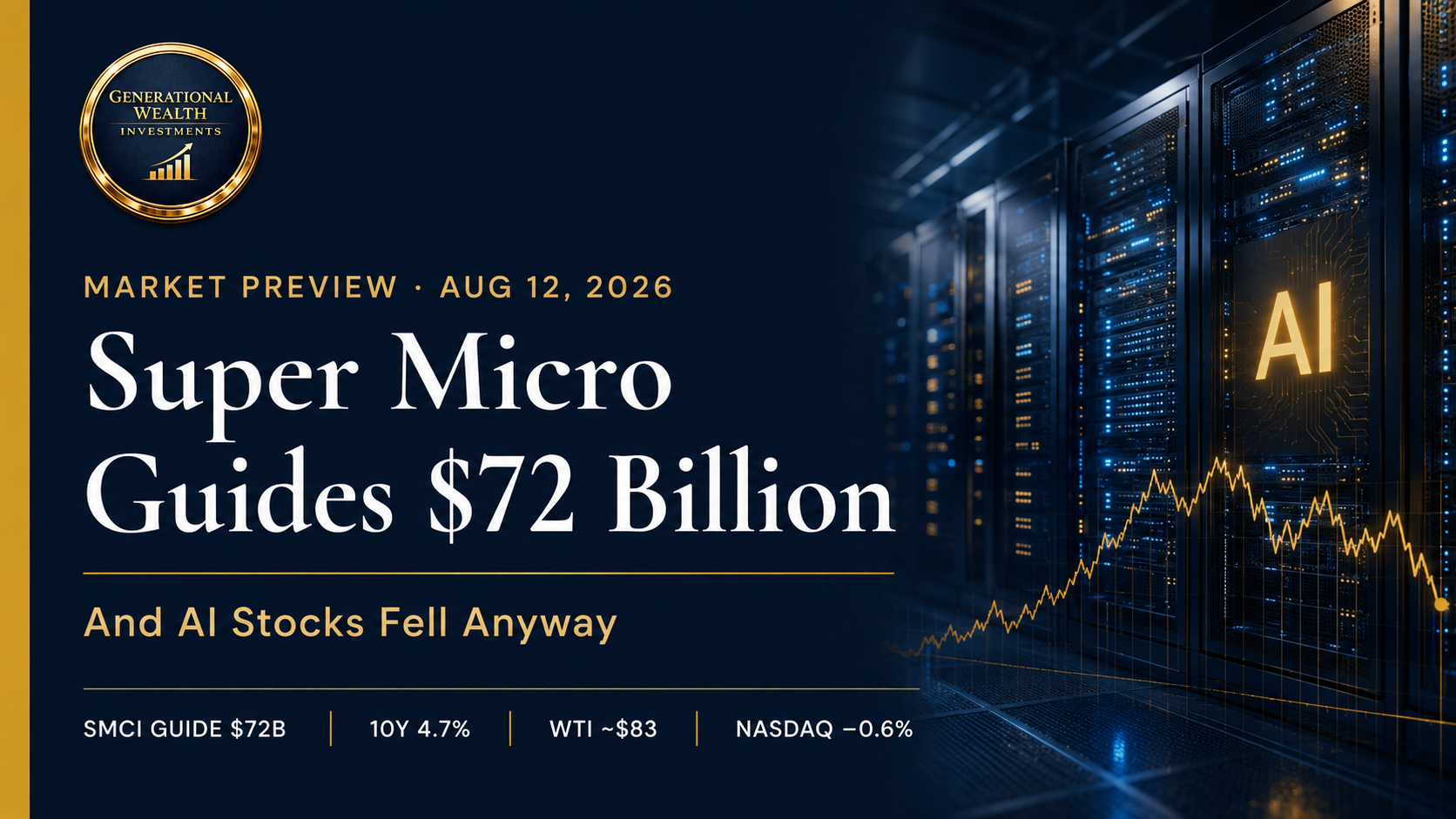
Super Micro Guides $72B as AI Stocks Sell Off Anyway
Super Micro guided to as much as $72 billion in AI server sales next year, roughly $19 billion above Wall Street's model, and the stock jumped about 9% after hours — hours after AI stocks had sold off all day. Today's preview decodes why the doubt has shifted from demand to financing, with yields near 4.7%, crude around $83, and the July inflation report landing at 8:30.
Market Preview: Super Micro Guides $72 Billion as AI Stocks Sell Off Anyway
Super Micro told Wall Street it expects to sell as much as $72 billion of AI servers next year — roughly $19 billion above what analysts were modeling — and the stock jumped about 9% after hours. The strange part is the timing: AI stocks had sold off all day in the regular session. Today's video explains why the doubt on Wall Street is no longer about demand, but about how the buildout gets paid for.

Today's Market Snapshot
Demand Beats, and Then Some
Super Micro guided to as much as $72 billion in AI server sales next year, against roughly $53 billion modeled on Wall Street. The stock rose about 9% after hours. CoreWeave said the same evening that its backlog grew roughly $25 billion in six weeks, and its stock jumped as well.
The Funding Question Takes Over
Hours earlier, AI names sold off all session. Alphabet fell nearly 4% on data center spending worries, Intel priced a $20 billion stock sale upsized from $15 billion, and Nvidia lined up more than $500 billion of outside financing this week. The Nasdaq closed down about 0.6%, a second straight loss.
Yields and Oil Set the Cost
When a buildout runs on borrowed money, the cost of borrowing becomes the story. The 10-year Treasury yield sits near 4.7%. Crude settled around $83, a fourth straight gain, after Iran said the Strait of Hormuz stays shut. Both feed directly into this morning's inflation math.
What Investors Should Be Watching
- The July inflation report at 8:30 this morning, where economists expect headline inflation around 3.4% — a cooler number takes pressure off yields, a hotter one makes every one of these deals pricier.
- Whether the after-hours enthusiasm around Super Micro and CoreWeave carries into the regular session, or whether the financing questions reassert themselves the way they did Tuesday.
- Whether crude can extend a fourth straight gain with the Strait of Hormuz still closed, and what that does to the rate path traders are already pricing near a coin flip for a hike.
Inside Today's Members-Only Daily Market Brief
- The specific levels members are tracking across the 10-year, crude, and the AI complex as the funding story develops.
- Both sides of this morning's inflation print, and what each outcome would mean for a rate decision now priced near even.
- Why the market can sell a demand beat, and what would actually resolve the question of who is holding the paper.
- How the Intel and Nvidia financing structures differ, and which one tells you more about the cycle.
- Where capital is rotating as borrowing costs, not demand, become the constraint on the buildout.
Go Beyond the Headlines
The public video explains what happened. The Generational Wealth Community helps members understand what matters next, where the risks are, and which developments deserve continued attention.
Unlock the Daily Market Brief