


Oil's Biggest Build in 3.5 Years — And Prices Rose Anyway
U.S. crude inventories posted their biggest weekly build in three and a half years — 17.4 million barrels, against expectations for a drawdown — and oil closed higher anyway. Today's preview breaks down why the barrels piled up, what the Strait of Hormuz has to do with it, and why the Fed's next move may be a hike.
Market Preview: Oil Posts Its Biggest Build in 3.5 Years as Prices Climb Anyway
America's oil stockpile just posted its biggest weekly jump in three and a half years — 17.4 million barrels, when forecasters were looking for a drawdown — and crude still closed higher. That combination usually signals something other than weak demand. Today's video explains what the headline inventory number misses, and why it points toward the Federal Reserve.

Today's Market Snapshot
A Record Build, and a Higher Close
Government data showed U.S. crude inventories rose 17.4 million barrels in a single week, the largest build in three and a half years. Forecasters had expected a drawdown. Crude closed slightly higher anyway — the kind of divergence that says the inventory number is measuring something other than demand.
Hormuz Is the Bottleneck
American crude exports fell to their lowest level since the war with Iran began, while imports surged. Barrels piled up because they couldn't ship out. The Strait of Hormuz remains effectively closed, and the IEA now sees the world short roughly 1.8 million barrels a day this quarter.
Energy Reaches the Rate Path
July inflation cooled to 3.4%, but energy is still up nearly 15% from a year ago — which is why September odds now favor a hike near 42% rather than a cut. This morning crude finally cracked, with WTI near $81.60, down about 2%, snapping a five-day run on reopening-deal chatter.
What Investors Should Be Watching
- Wholesale inflation at 8:30 Eastern — the last read before September rate odds firm up, and the number most likely to move a hike-versus-cut debate that is already leaning one way.
- Whether talk of a deal to reopen the Strait of Hormuz can keep pressure on crude, or whether a shortfall the IEA puts near 1.8 million barrels a day reasserts itself.
- Whether the AI trade steadies after the S&P 500 closed at 7,748 on AI earnings, with Cerebras down roughly 17% before the bell — a sign the leadership may be narrowing.
Inside Today's Members-Only Daily Market Brief
- The specific crude levels members are tracking now that WTI has broken a five-day run, and what would confirm the move.
- Both sides of this morning's wholesale inflation print, and what each outcome does to a September decision priced near a coin flip.
- How to read an inventory build that reflects logistics rather than demand — and the tell that separates the two.
- What the shipping response signals about how long the Hormuz constraint is expected to last.
- Where capital is rotating as energy costs, not growth, become the pressure point on the rate path.
Go Beyond the Headlines
The public video explains what happened. The Generational Wealth Community helps members understand what matters next, where the risks are, and which developments deserve continued attention.
Unlock the Daily Market Brief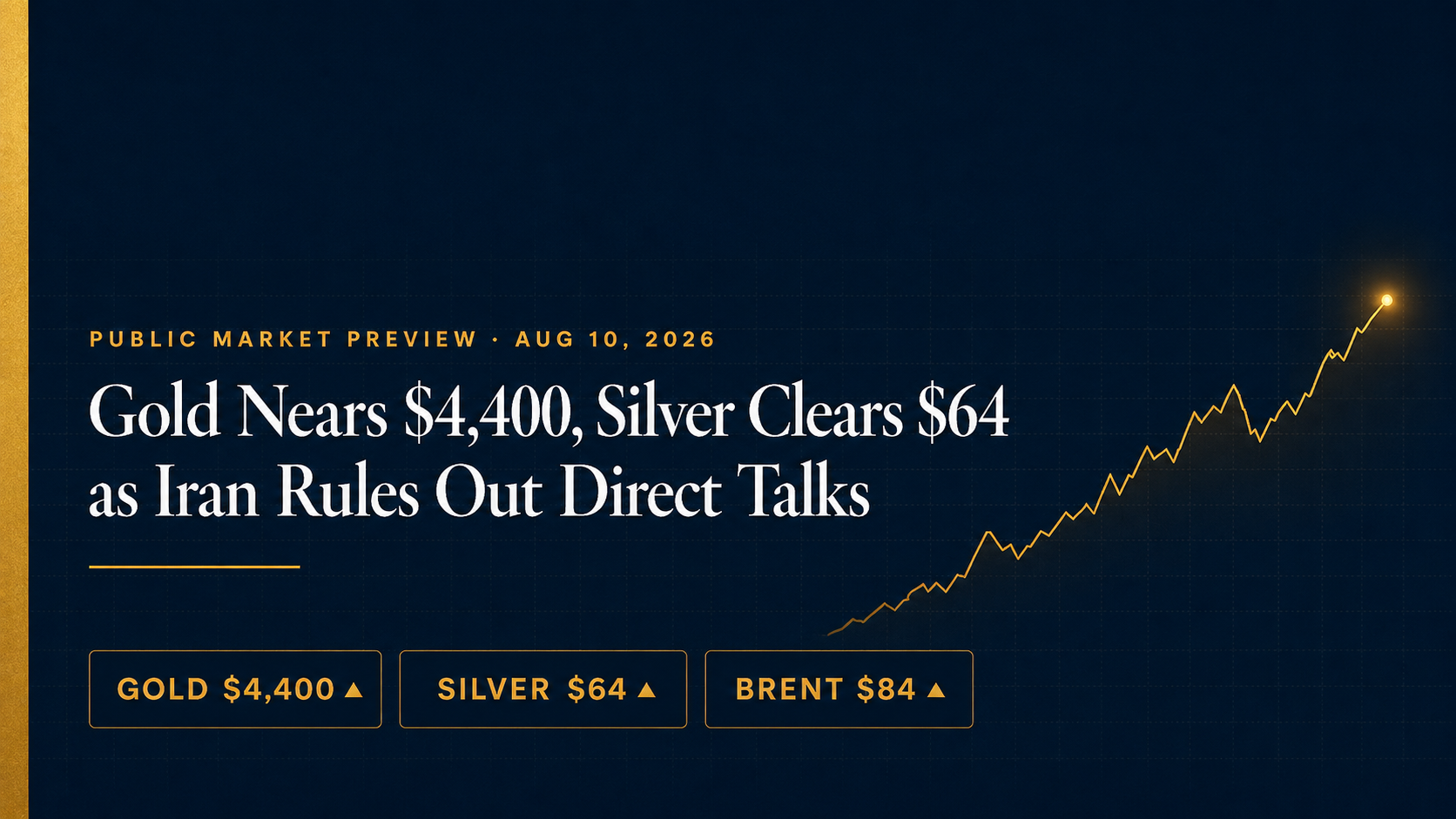
Gold Nears $4,400, Silver Tops $64 as Iran Rules Out Talks
Iran ruled out direct talks with Washington and warned the Strait of Hormuz stays closed without U.S. concessions, sending crude higher for a third straight session and pushing gold toward $4,400 and silver past $64. Today's preview covers the metals move, Friday's record close, and what Wednesday's inflation print could change.
Market Preview: Gold Nears $4,400 and Silver Clears $64 as Iran Rules Out Direct Talks
Iran said Sunday it is not negotiating directly with Washington and that the Strait of Hormuz stays closed without U.S. concessions — and crude climbed for a third straight session. That uncertainty is pushing money into hard assets, with gold near $4,400 and silver up roughly 11% on the week, even as Nasdaq futures lead again ahead of Wednesday's inflation print. Today's video connects the geopolitics, the metals move, and the rate math.

Today's Market Snapshot
Iran Standoff Lifts Crude
Iran's foreign minister said Sunday that Tehran is not in direct negotiations with the United States, and warned the Strait of Hormuz will not reopen without American concessions. Brent for October traded just above $84 overnight, up roughly 0.8%, while WTI held near $79. A confirmed Iran–Oman shipping agreement is the main risk to the move.
Gold and Silver Push Higher
Gold futures traded around $4,400 an ounce overnight, with spot nearer $4,300. Silver pushed past $64, up roughly 11% over the past week. Miners and metals funds could benefit if the move holds — the open question is whether silver can defend its breakout on the first real pullback.
Records, Futures, and Flows
The S&P 500 closed Friday at a record 7,757, up 0.6%, and the Nasdaq Composite added 1.3% for its best week since April after July payrolls fell 23,000. Overnight, Nasdaq futures gained about 0.5% while Dow futures slipped. The Nikkei closed up near 2%; bitcoin held around $65,000.
What Investors Should Be Watching
- Wednesday's July consumer price report, expected near 3.4%. A surprise in either direction would reset the rate math that drove Friday's record close.
- Whether Iran and Oman confirm a shipping agreement, which would return barrels quickly and cut against the crude rally — or whether the standoff hardens instead.
- Whether the rotation into hard assets and AI hardware broadens, with CoreWeave and Super Micro reporting Tuesday and Applied Materials Thursday.
Inside Today's Members-Only Daily Market Brief
- The specific levels and catalysts members are tracking across gold, silver, and crude as the Hormuz standoff drags on.
- Both sides of Wednesday's inflation print, and what each outcome would mean for the September rate path.
- Where capital is rotating as money moves into hard assets and AI hardware while crude-sensitive cyclicals lag.
- What the Bank of Japan's July meeting summary signals for a September move — and why a sharply stronger yen is the risk to Tokyo's rally.
- What steady bitcoin ETF inflows and lagging XRP may be signaling beneath a quiet week in crypto.
Go Beyond the Headlines
The public video explains what happened. The Generational Wealth Community helps members understand what matters next, where the risks are, and which developments deserve continued attention.
Unlock the Daily Market Brief
Gold Hits 6-Week High as SpaceX Sinks 13.6% | Market Preview
Gold jumped about 3% to a six-week high near $4,260 as a Strait of Hormuz corridor agreement pulled crude down 10–12% in five sessions and the Dow closed at a record 54,349. But the Nasdaq slipped, AMD fell 7% on record revenue, and SpaceX sank 13.6% one day before up to 911 million insider shares become sellable.
Market Preview: Gold Rips to a Six-Week High as SpaceX Sinks 13.6% Before 911 Million Shares Unlock
Iran and Oman agreed on coordinates for a Strait of Hormuz shipping corridor, and crude has now fallen 10–12% in five sessions. Cheaper oil means cooler inflation, and spot gold jumped about 3% to a six-week high near $4,260 while the Dow closed at a record. But the Nasdaq fell, SpaceX dropped 13.6% one day before a 911 million share insider unlock, and today's video explains why capital appears to be leaving AI hardware.

Today's Market Snapshot
Energy and Gold: The War Premium Drains Out
Iran said it reached agreement with Oman on coordinates for a Hormuz shipping route — a two-to-four-month corridor, officials said, not a full reopening. Brent trades near $79.70 and WTI near $75.40, both down roughly 10–12% in five sessions. Spot gold rose about 3% Wednesday to its highest since June 22, near $4,260, with silver and miners following.
Equities: A Dow Record and a Widening AI Divide
The Dow closed at a record 54,349, up 0.5%, while the S&P 500 slipped 0.2% and the Nasdaq 0.8%. Musk said SpaceX will build exclusively on Nvidia chips: Nvidia gained about 3.5%, AMD fell 7% despite record revenue near $11.5 billion. SpaceX sank 13.6% on soaring capital spending and Alphabet fell about 4%.
Rates and Jobs: A Weak Print, a Hawkish Tone
Private payrolls added just 44,000 jobs in July, the weakest of the year and below the 75,000 expected. Yet Fed Governor Lisa Cook said after the close she is prepared to support a rate hike if inflation doesn't ease. The 10-year Treasury yield sits near 4.62%, and a hawkish Fed is the primary risk to gold.
What Investors Should Be Watching
- Whether the Hormuz corridor holds. The agreement covers a two-to-four-month route rather than a full reopening, and a tanker crossing the strait reported two explosions overnight. Oil, yields and gold all reprice quickly if that story turns.
- Whether the SpaceX unlock adds pressure. Up to 911 million insider shares become sellable today after a 13.6% drop. How that supply is absorbed says something about investor appetite for heavy AI capital spending.
- Whether crypto keeps drawing flows while equities wobble. Bitcoin held near $64,700 and spot Bitcoin ETFs took in roughly $244 million Wednesday, a third straight inflow day, with ether funds turning positive.
Inside Today's Members-Only Daily Market Brief
- The specific levels and catalysts members are tracking across gold, crude and the 10-year after a six-week high in metals.
- How to weigh a 44,000-job payroll print against a Fed governor openly signaling support for a hike.
- Where capital is rotating as money leaves AI hardware for gold and Dow cyclicals, including the strongest and weakest areas of the tape.
- What the 911 million share SpaceX unlock and Korea's 4.5% KOSPI drop may signal for chip and AI exposure.
- The risks that could reverse this move, plus what to monitor into Friday's July jobs report.
Go Beyond the Headlines
The public video explains what happened. The Generational Wealth Community helps members understand what matters next, where the risks are, and which developments deserve continued attention.
Unlock the Daily Market Brief