


Tesla’s $30B Credit Line: Firepower, Not Debt Yet
Tesla has secured $30 billion in new borrowing capacity while planning more than $25 billion of capital spending this year—but none of the new credit has been drawn yet. The next earnings report should reveal whether Tesla’s spending and free cash flow leave that financial firepower untouched or make it increasingly important.
September 30, 2026
Tesla’s $30 Billion Credit Line — Firepower, Not Debt Yet
Tesla has lined up $30 billion in new borrowing capacity as it prepares for more than $25 billion of capital spending this year. But the headline number can be misleading: Tesla says no loans were outstanding when the facilities were signed and it does not currently plan to draw on them in 2026. The next question is whether spending and free cash flow eventually make that financial firepower necessary.
Watch Today’s Market Breakdown
See what Tesla’s $30 billion credit package actually provides, why it is not $30 billion of new debt today, and what to watch in the company’s next earnings report.
Today’s Market Setup
Tesla’s financing package gives the company substantial borrowing capacity as spending on AI computing, manufacturing and other expansion remains high. The distinction between available credit and money actually borrowed is central to understanding the story.
$30 Billion of Available Credit
The package includes a $20 billion delayed-draw loan and $10 billion of revolving credit. Together, they give Tesla significant financial flexibility if the company decides it needs additional capital.
Capital Spending Above $25 Billion
Tesla expects more than $25 billion of capital spending this year, with much of that investment aimed at AI computing, manufacturing and other expansion. That spending makes the additional borrowing capacity worth monitoring.
No Borrowing Yet
Tesla says no loans were outstanding when the facilities were signed and it does not currently plan to draw on them in 2026. That means the $30 billion represents available firepower rather than $30 billion of new debt today.
What Matters From Here
Tesla’s next earnings report should help show whether its aggressive spending plans can continue without tapping the new credit facilities.
- How does Tesla’s capital spending develop as investment in AI computing, manufacturing and expansion continues?
- What does free cash flow indicate about Tesla’s ability to fund that spending without drawing on the new credit facilities?
- Does the $30 billion remain unused financial flexibility, or does borrowing capacity begin turning into actual debt?
The Headlines Are Only the First Step
The free Market Preview explains what Tesla arranged and why $30 billion of available credit is different from $30 billion of new debt. The members-only Daily Market Brief goes deeper into the catalysts, risks, confirmation signals and financial developments worth monitoring as Tesla’s spending plans evolve.
See What Members GetInside Today’s Members-Only Daily Market Brief
- The capital-spending and free-cash-flow signals that could show whether Tesla’s new borrowing capacity is becoming necessary.
- Why the distinction between available credit and outstanding debt matters when evaluating Tesla’s financing position.
- How Tesla’s spending on AI computing, manufacturing and expansion connects to the broader financing story.
- Why the next earnings report becomes the key checkpoint for seeing whether Tesla is beginning to use the new facilities.
Go Beyond the Headlines
The public Market Preview tells you what happened. The Generational Wealth Community is designed for investors who want to understand what deserves attention next, what could confirm the current setup, what risks could change it and which developments deserve continued monitoring. We don’t chase hype, we decode the market.
Unlock the Daily Market BriefEducational market research designed to help investors understand the setup — not chase headlines.
Your pathway from knowledge to legacy. We don’t chase hype, we decode the market.
Stay Ahead of What Matters Next
Tesla now has $30 billion of additional borrowing capacity. The next earnings report should provide a clearer look at whether capital spending and free cash flow leave that capacity untouched or make it more important.
Join the Generational Wealth Community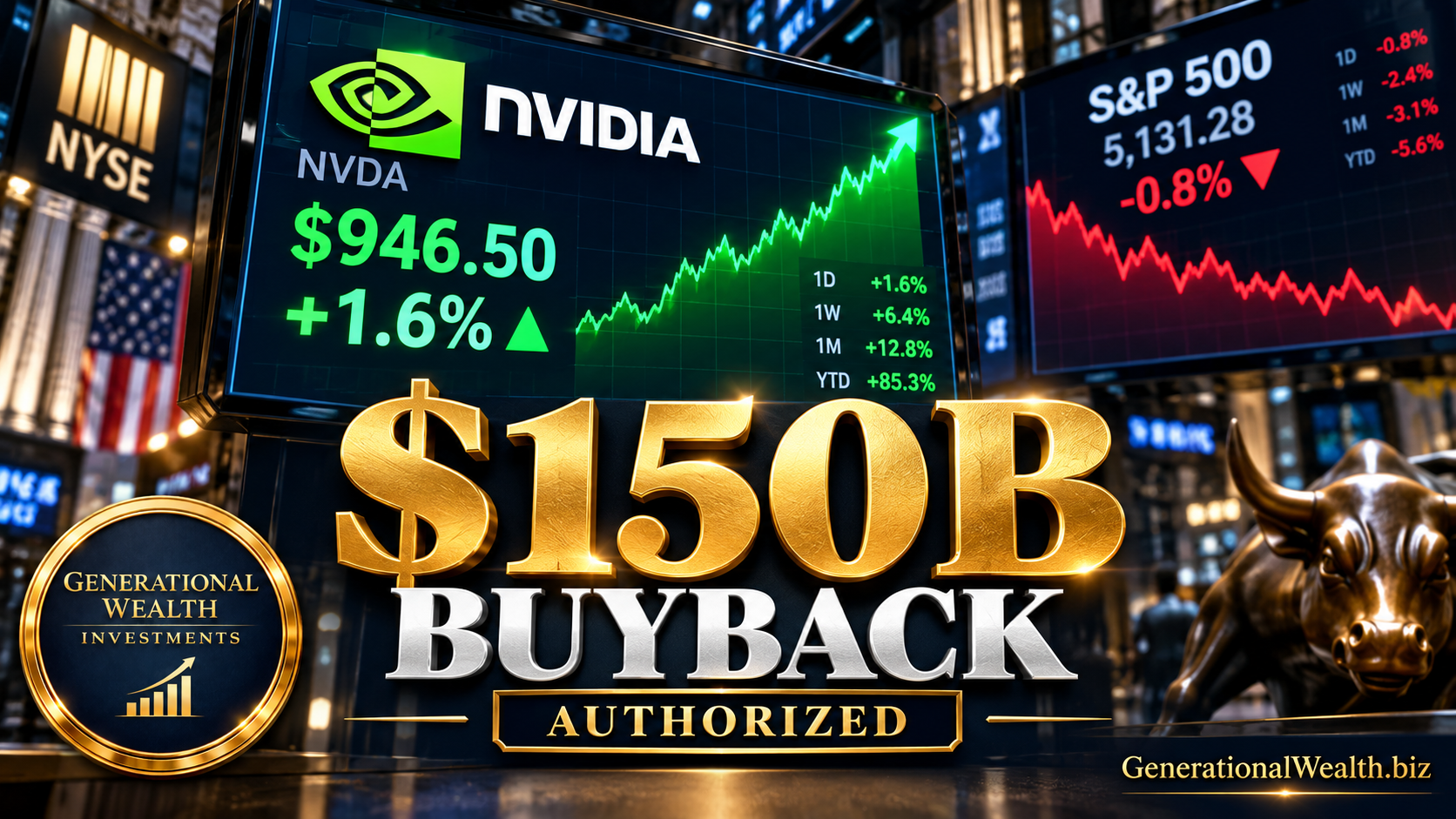
Nvidia’s $150B Buyback Lifts Stock as Market Falls
Nvidia expanded its buyback authorization by $150 billion as its shares rose about 1.6% while the broader market fell. The headline number is enormous, but the more important question is how aggressively Nvidia actually puts that authorization to work.
September 29, 2026
Nvidia’s $150 Billion Buyback — Stock Rises While the Market Falls
Nvidia authorized another $150 billion in share repurchases, bringing its remaining authorization to $235 billion through fiscal 2028. Shares rose about 1.6% Monday even as the S&P 500 fell nearly 0.8%, making Nvidia stand out on a down day. But authorization is not the same as spending — the next quarterly report should show how aggressively Nvidia is actually using it.
Watch Today’s Market Breakdown
See why Nvidia’s record-sized buyback authorization matters, why the stock’s strength stood out against a falling market, and what investors can learn from the company’s next quarterly report.
Today’s Market Setup
Nvidia’s move combines two important signals: enormous capital-return capacity and unusual relative strength on a day when the broader market moved lower. The distinction between an authorized buyback and actual repurchases is what matters next.
Nvidia Added $150 Billion
Nvidia’s board added $150 billion to its share-repurchase program, bringing the remaining authorization to $235 billion through fiscal 2028. The scale signals that the company believes it can continue funding major AI investment while also returning significant capital to shareholders.
Authorization Is Not Spending
The headline number does not mean Nvidia has already spent $150 billion buying its own stock. It gives management the authority to repurchase shares over time, making the actual pace of future purchases more important than the authorization alone.
Nvidia Rose on a Down Day
Nvidia shares gained about 1.6% Monday while the S&P 500 fell nearly 0.8%. That divergence made the stock stand out and suggests investors paid close attention to the company’s ability to return capital even as the broader market weakened.
What Matters From Here
The authorization is large, but the next quarterly report should provide the first meaningful evidence of how Nvidia is actually using it.
- How aggressively does Nvidia repurchase shares under the expanded authorization before its next quarterly report?
- Can Nvidia continue returning enormous amounts of capital while also maintaining the AI investment that has driven its growth story?
- Does Nvidia continue to show relative strength if broader market pressure persists?
The Headlines Are Only the First Step
The free Market Preview explains the $150 billion authorization and why Nvidia’s Monday performance stood out. The members-only Daily Market Brief goes deeper into the catalysts, risks, confirmation signals and developments worth monitoring as investors evaluate how the buyback affects the broader Nvidia story.
See What Members GetInside Today’s Members-Only Daily Market Brief
- What Nvidia’s actual repurchase activity could reveal about how management is using the expanded authorization.
- How the company’s capital-return strategy fits alongside continued investment in artificial intelligence.
- The signals that could show whether Nvidia’s relative strength against the broader market is continuing.
- Why Nvidia’s next quarterly report becomes the key checkpoint for evaluating how aggressively the authorization is being used.
Go Beyond the Headlines
The public Market Preview tells you what happened. The Generational Wealth Community is designed for investors who want to understand what deserves attention next, what could confirm the current market setup, what risks could change it and which developments deserve continued monitoring. We don’t chase hype, we decode the market.
Unlock the Daily Market BriefEducational market research designed to help investors understand the setup — not chase headlines.
Your pathway from knowledge to legacy. We don’t chase hype, we decode the market.
Stay Ahead of What Matters Next
Nvidia’s $150 billion authorization grabbed the headline. The next quarterly report should show whether the company is turning that authorization into meaningful share repurchases.
Join the Generational Wealth Community
Trump Rejects Iran's Hormuz Offer: Will Brent Crude Spike?
President Trump rejected Iran’s proposal to reopen the Strait of Hormuz just as traders were pricing in renewed diplomacy. Now Iran’s latest warning puts the focus on Brent crude’s first trade after the weekend—and whether geopolitical risk returns to the price.
September 27, 2026
Trump Rejects Iran’s Hormuz Offer: Will Brent Crude Spike When Trading Reopens?
President Trump publicly rejected Iran’s proposal to reopen the Strait of Hormuz on Saturday. On Sunday, Iran’s army said it was prepared for renewed U.S. attacks and warned that Tehran would not accept being unable to trade while others use the region’s strategic waterways. Brent settled Friday near $104 after falling more than 2%, so the next crude trade will test whether diplomacy hopes still outweigh renewed geopolitical risk.
Watch Today’s Market Breakdown
See why Trump’s rejection and Iran’s new warning changed the weekend setup, and why Brent crude’s first trade when markets reopen could become the next important signal.
Today’s Market Setup
Friday’s oil decline reflected optimism that diplomacy could reopen the Strait of Hormuz. Trump’s rejection of Iran’s proposal and Tehran’s Sunday warning now create a tougher test: whether traders keep pricing in a path to negotiations or quickly add back geopolitical risk.
Trump Rejected the Hormuz Offer
President Trump said Saturday that he rejected Iran’s proposal to reopen the Strait of Hormuz and end the fighting. That removes, for now, the clearest weekend catalyst behind expectations for a faster reopening.
Iran Issued a New Warning
On Sunday, Iran’s army said it was prepared for renewed U.S. attacks and warned that Tehran would not accept being unable to trade while others use the region’s strategic waterways. That keeps escalation risk in focus.
Brent Closed Near $104
Brent crude fell more than 2% Friday to around $104 as traders focused on diplomacy. With roughly one-fifth of global oil supply moving through Hormuz before the war, the next crude trade carries unusual signaling value.
What Matters From Here
Friday’s market was still leaning toward diplomacy. The question now is whether the weekend’s developments change that calculation when crude trading resumes.
- Does Brent reverse sharply higher when trading resumes after Trump’s rejection of Iran’s reopening proposal?
- Do traders continue betting that negotiations survive despite Iran’s warning and the tougher public positions from both sides?
- Does Tehran’s condition that its demands be met keep a credible path to reopening Hormuz alive, or does the market begin pricing a longer disruption?
The Headlines Are Only the First Step
The free Market Preview explains why the weekend developments matter and why crude’s reopening trade is now the immediate market test. The members-only Daily Market Brief goes deeper into the catalysts, risks, confirmation signals and developments worth monitoring as traders decide whether diplomacy is still credible or geopolitical risk is rebuilding.
See What Members GetInside Today’s Members-Only Daily Market Brief
- The crude-market signals that could show whether Friday’s diplomacy-driven decline is reversing or still holding.
- What to monitor around Hormuz as traders reassess the probability and timing of a reopening.
- The next U.S.-Iran diplomatic or military developments that could strengthen or weaken the current oil-market setup.
- Why Brent’s first move after the weekend could help distinguish a temporary headline reaction from a broader repricing of supply risk.
Go Beyond the Headlines
The public Market Preview tells you what happened. The Generational Wealth Community is designed for investors who want to understand what deserves attention next, what could confirm the current market setup, what risks could change it and which developments deserve continued monitoring. We don’t chase hype, we decode the market.
Unlock the Daily Market BriefEducational market research designed to help investors understand the setup — not chase headlines.
Your pathway from knowledge to legacy. We don’t chase hype, we decode the market.
Stay Ahead of What Matters Next
Friday’s oil market reflected confidence that diplomacy could improve the Hormuz outlook. The next crude trade and the next U.S.-Iran signals will help show whether that confidence survives the weekend.
Join the Generational Wealth Community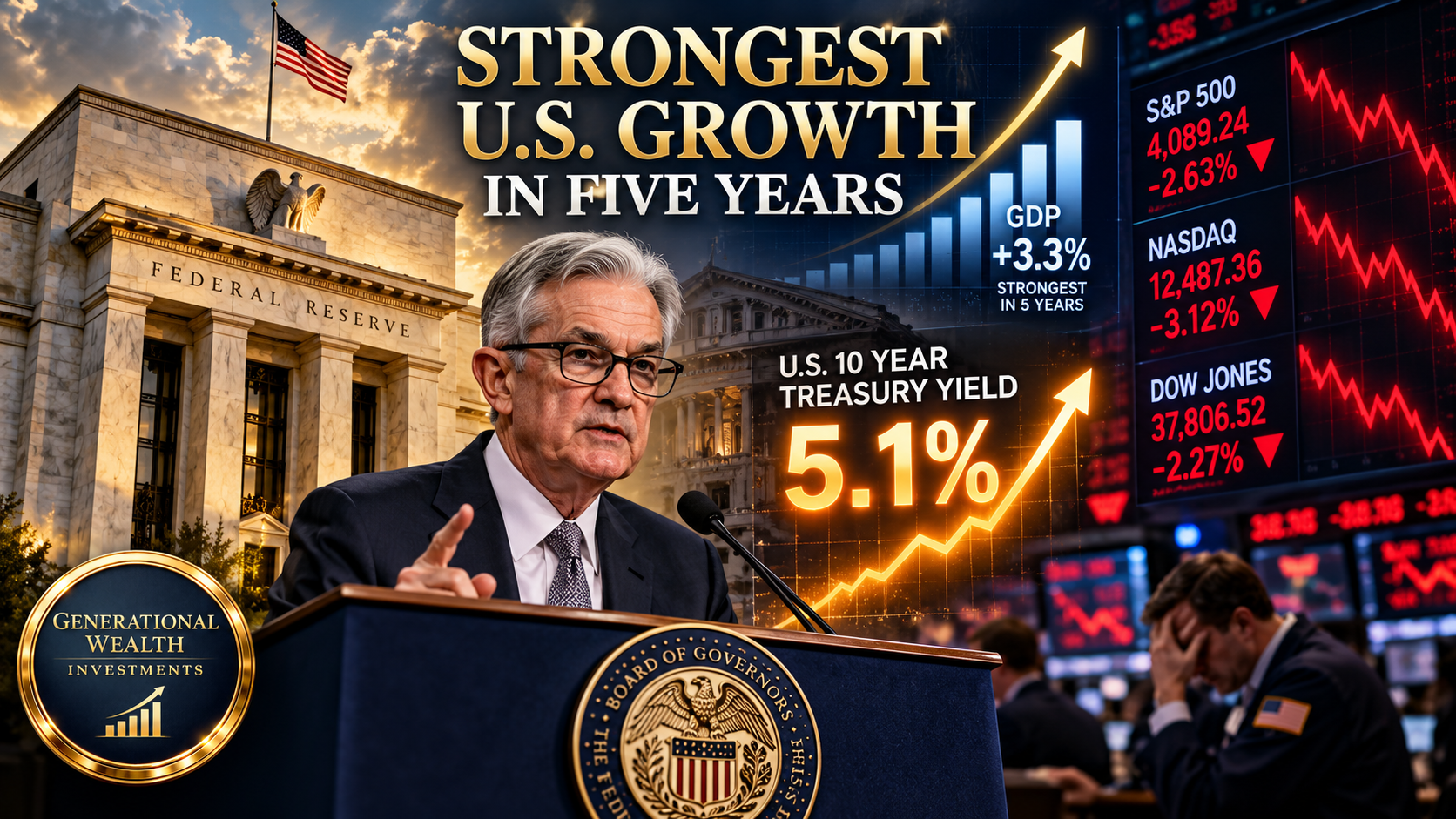
Strong Economy Sends Stocks Lower as Fed Hike Risk Rises
The strongest U.S. growth signal in more than five years sent Treasury yields higher and stocks lower as investors increased expectations for another Federal Reserve rate hike. Now attention turns to the next inflation report and whether it strengthens the case for another move in October.
September 24, 2026
Strongest U.S. Growth Signal in 5 Years Sends Stocks Lower
The economy just delivered its strongest growth signal in more than five years — and Wall Street sold off. U.S. business activity accelerated while business costs climbed at their fastest pace in roughly four years, strengthening the argument for another Federal Reserve rate hike. The question now is whether next week’s inflation data gives the Fed even more reason to tighten.
Watch Today’s Market Breakdown
See why stronger economic growth pushed Treasury yields higher, stocks lower, and expectations for another Federal Reserve rate hike higher.
Today’s Market Setup
Wednesday delivered a reminder that strong economic data is not always immediately bullish for stocks. When growth and inflation pressures rise together, investors also have to consider what that means for interest rates.
Growth Accelerates to a Five-Year High
A key September survey showed U.S. business activity expanding at its strongest pace in more than five years. Normally stronger growth is encouraging, but businesses also reported rapidly rising costs, keeping inflation concerns firmly in the market’s focus.
Treasury Yields Jump
The 10-year Treasury yield finished near 5.1%, its highest level since 2007. Higher Treasury yields can increase borrowing costs throughout the economy and raise the hurdle stocks must clear when investors compare potential returns with bonds.
Another Fed Hike Moves Closer
Traders moved to roughly a 70% probability of another Federal Reserve rate hike in October. The Nasdaq fell more than 1% as investors confronted the possibility that economic strength could keep monetary policy tighter for longer.
What Matters From Here
The market now has to decide whether stronger growth is durable enough to withstand higher borrowing costs — and whether inflation gives the Fed room to stop after its latest increase.
- Does next week’s Federal Reserve inflation gauge reinforce the case for another rate hike in October?
- Can stocks stabilize if the 10-year Treasury yield remains near its highest level since 2007?
- Can strong economic growth continue without creating even more inflation pressure?
The Headlines Are Only the First Step
The free Market Preview explains why unexpectedly strong economic data pushed stocks lower. The members-only Daily Market Brief goes deeper into the rate signals, inflation catalysts, risks and confirmation points worth monitoring as the market evaluates the possibility of another Fed hike.
See What Members GetInside Today’s Members-Only Daily Market Brief
- The interest-rate signals that could strengthen or weaken expectations for another Federal Reserve hike.
- What Treasury yields could reveal about whether tighter financial conditions are becoming a larger problem for stocks.
- The inflation developments that matter most ahead of next week’s key Federal Reserve inflation report.
- What could show whether Wednesday’s stock-market decline was a temporary reaction or part of a broader repricing of interest-rate risk.
Go Beyond the Headlines
The public Market Preview tells you what happened. The Generational Wealth Community is designed for investors who want to understand what deserves attention next, what could confirm the current market setup, what risks could change it and which developments deserve continued monitoring. We don’t chase hype, we decode the market.
Unlock the Daily Market BriefEducational market research designed to help investors understand the setup — not chase headlines.
Your pathway from knowledge to legacy. We don’t chase hype, we decode the market.
Stay Ahead of What Matters Next
Strong growth is usually good news. But when inflation and Treasury yields are rising too, the Federal Reserve can turn that strength into a new challenge for markets.
Join the Generational Wealth Community
Saudi Arabia Attacked—Why Oil Prices Fell Below $100
Weekend attacks on Saudi Arabia would normally add pressure to oil prices, yet WTI fell below $100 as traders focused on recovering Saudi exports and possible U.S.-Iran diplomacy. The next question is whether improving supply and diplomacy can keep oil below that threshold—or whether geopolitical risk takes control again.
September 21, 2026
Saudi Arabia Was Attacked — So Why Did Oil Prices Fall?
Weekend attacks on Saudi Arabia added fresh supply risk, yet West Texas Intermediate crude fell below $100. Traders instead focused on Saudi exports rebounding to just over 4 million barrels a day this month from about 2.4 million in August, along with possible U.S.-Iran diplomacy. The question now is whether those forces can keep pressure on oil prices.
Watch Today’s Market Breakdown
See why oil moved lower despite new attacks, what recovering Saudi exports are changing and why this week’s diplomacy now matters.
Today’s Market Setup
Oil is sending a counterintuitive signal: geopolitical risk remains elevated, but traders are also seeing signs that supply conditions and diplomacy could be improving.
WTI Falls Below $100
West Texas Intermediate crude moved below $100 even after weekend attacks on Saudi Arabia. Instead of reacting only to the attacks, traders are weighing whether improving Saudi exports and possible diplomatic progress could reduce some of the pressure on supply.
Saudi Exports Are Recovering
Saudi crude exports have rebounded to just over 4 million barrels a day this month, compared with roughly 2.4 million in August. That recovery is important because additional supply can change how the market evaluates geopolitical disruptions.
Inflation Pressure Is Back in Focus
Oil above $100 had been feeding inflation fears and expectations for higher interest rates. With crude moving lower and U.S. stock futures higher, investors are now watching whether the change in oil prices can persist.
What Matters From Here
The drop below $100 is important. What happens next depends on whether the forces pushing oil lower continue to outweigh the geopolitical risk.
- Can West Texas Intermediate remain below $100 if attacks and regional supply risks continue?
- Does the recovery in Saudi crude exports continue strongly enough to keep easing supply concerns?
- Does this week’s United Nations diplomacy produce meaningful de-escalation between the United States and Iran?
The Headlines Are Only the First Step
The free Market Preview explains why oil fell despite new attacks. The members-only Daily Market Brief goes deeper into the catalysts, risks, confirmation signals and developments worth monitoring as traders decide whether this oil move can continue.
See What Members GetInside Today’s Members-Only Daily Market Brief
- The signals worth monitoring to determine whether WTI can remain below $100 or begins reversing higher.
- How the recovery in Saudi crude exports changes the supply-risk picture after the weekend attacks.
- The diplomatic developments that could strengthen or weaken the current oil-market setup.
- How changes in oil prices could affect the inflation and interest-rate concerns investors have been watching.
Go Beyond the Headlines
The public Market Preview tells you what happened. The Generational Wealth Community is designed for investors who want to understand what deserves attention next, what could confirm the current setup, what risks could change it and which developments deserve continued monitoring. We don’t chase hype, we decode the market.
Unlock the Daily Market BriefEducational market research designed to help investors understand the setup — not chase headlines.
Your pathway from knowledge to legacy. We don’t chase hype, we decode the market.
Stay Ahead of What Matters Next
The next test is whether this week’s diplomacy produces real de-escalation — and whether WTI can remain below $100.
Join the Generational Wealth Community
SEC Opens Door to 24/7 Stock Trading on Blockchain
The SEC has opened a path for certain tokenized U.S. stocks to trade around the clock while retaining traditional shareholder rights. The next test is whether major companies allow their shares onto blockchain venues — and whether investors actually use them.
September 18, 2026
SEC Opens Door to 24/7 Stock Trading on Blockchain
The SEC has created a path for certain tokenized versions of U.S.-listed stocks to trade on approved blockchain venues under a new five-year exemption. These are not simply synthetic bets: tokenized shares must carry the same rights as traditional stock, including dividends and voting rights. The bigger question now is whether major issuers and investors actually embrace the new structure.
Watch Today’s Market Breakdown
See what the SEC changed, how tokenized stocks could work and why the next phase depends on issuer participation and investor demand.
Today’s Market Setup
The SEC exemption introduces a new structure for trading traditional equities through blockchain technology, but adoption is not automatic.
Tokenized Shares Keep Stockholder Rights
The SEC requires eligible tokenized shares to carry the same rights as traditional stock, including dividends and voting rights. That distinction separates the structure from products that merely track or imitate the price of an underlying company.
Trading Could Move Beyond Market Hours
The structure could allow around-the-clock trading, fractional ownership and near-instant settlement on approved blockchain venues. That creates a potentially different trading experience from the traditional stock-market schedule.
Crypto-Linked Stocks Reacted
Coinbase and Circle each rose about 6% Thursday, while Robinhood gained about 5%. The announcement connected blockchain infrastructure more directly with traditional equities, even as the SEC placed limits on symbols and trading volume.
What Matters From Here
The regulatory path now exists. The next questions are about participation and whether this structure develops into something investors actually use.
- Will major public companies allow tokenized versions of their shares to trade on approved blockchain venues?
- Will investors meaningfully use around-the-clock trading, fractional ownership and faster settlement?
- How much activity develops while the SEC continues limiting the number of symbols and overall trading volume?
The Headlines Are Only the First Step
The free Market Preview explains what the SEC changed and why investors are paying attention. The members-only Daily Market Brief goes deeper into the catalysts, risks, confirmation signals and developments worth monitoring as companies and investors respond to the new structure.
See What Members GetInside Today’s Members-Only Daily Market Brief
- The issuer-participation signals that could show whether tokenized stocks are moving beyond the regulatory-exemption stage.
- What investor adoption could reveal about demand for 24/7 trading, fractional ownership and faster settlement.
- How the SEC’s limits on eligible symbols and trading volume shape the early development of these blockchain venues.
- The developments worth monitoring after Coinbase, Circle and Robinhood reacted to the announcement.
Go Beyond the Headlines
The public Market Preview tells you what happened. The Generational Wealth Community is designed for investors who want to understand what deserves attention next, what could confirm the current setup, what risks could change it and which developments deserve continued monitoring. We don’t chase hype, we decode the market.
Unlock the Daily Market BriefEducational market research designed to help investors understand the setup — not chase headlines.
Your pathway from knowledge to legacy. We don’t chase hype, we decode the market.
Stay Ahead of What Matters Next
Follow the issuer, investor and regulatory developments that could determine how tokenized stock trading develops from here.
Join the Generational Wealth Community
Venezuela’s 1.5M-Barrel Oil Deal: Why Gas Won’t Drop Yet
Venezuela’s new U.S. oil project targets more than 1.5 million barrels a day, but years of underinvestment mean those barrels may not reach the market quickly. At the same time, Russia’s diesel export ban and shifting Strait of Hormuz flows are creating a much more complicated near-term oil setup.
August 30, 2026
Venezuela Targets 1.5M Barrels a Day — Why Cheap Gas Isn’t Here Yet
Venezuela’s new U.S. oil project is targeting more than 1.5 million barrels a day and covers over 65 billion barrels of proven reserves. But years of underinvestment mean substantial new production could still take years, while Russia’s diesel export ban is tightening fuel availability now. The opportunity is enormous — but timing is what matters.
Watch Today’s Market Breakdown
See why Venezuela’s massive oil agreement does not automatically mean cheaper gasoline now, and how Russia, Hormuz and Brent crude complicate the near-term setup.
Today’s Market Setup
The oil market is balancing enormous potential future supply from Venezuela against infrastructure problems and fuel constraints that remain important right now.
Venezuela Targets 1.5M Barrels a Day
Venezuela says the 25-year bilateral project will develop 17 strategic oilfields and targets more than 1.5 million barrels of daily production. The original agreement covers more than 65 billion barrels of proven reserves, creating substantial long-term supply potential.
Infrastructure Is the Near-Term Constraint
Venezuela’s oil industry has suffered from years of underinvestment. Experts cited in the supplied research say major repairs could take years before production rises substantially, meaning headline production targets and actual new barrels may arrive on very different timelines.
Russia Keeps Pressure on Fuel Supply
Russia extended its diesel export ban through September 30 after drone attacks left several refineries offline. Meanwhile, Brent settled Friday at $89.31, down more than 5% for the week as traders weighed improving Hormuz flows and a more hawkish Federal Reserve.
What Matters From Here
The size of Venezuela’s agreement is clear. The bigger issue is how quickly the long-term supply story begins turning into actual production while current fuel constraints remain in place.
- How quickly can Venezuela repair infrastructure and translate the 1.5-million-barrel-a-day target into meaningful new production?
- Does Russia’s diesel export ban offset some of the near-term pressure lower from improving oil flows through the Strait of Hormuz?
- Do the new company agreements expected next week, including talks involving Chevron, begin moving the project from announcement toward execution?
The Headlines Are Only the First Step
The free Market Preview explains why Venezuela’s oil agreement matters and why it does not immediately solve today’s fuel constraints. The members-only Daily Market Brief goes deeper into the catalysts, risks, confirmation signals, and developments worth monitoring as this supply story moves from announcement toward execution.
See What Members GetInside Today’s Members-Only Daily Market Brief
- The developments that could show whether Venezuela’s 1.5-million- barrel-a-day target is beginning to move from headline to execution.
- Why the timing of infrastructure repairs matters to the long-term supply narrative and expectations around future production.
- How Russia’s diesel restrictions and improving Strait of Hormuz flows are pulling the near-term fuel market in opposite directions.
- What the company agreements expected next week could clarify about the pace and credibility of Venezuela’s oil expansion.
Go Beyond the Headlines
The public Market Preview tells you what happened and why investors are paying attention. The Generational Wealth Community is designed for investors who want to understand what deserves attention next, what could confirm the current setup, what risks could change it, and which developments deserve continued monitoring. We don’t chase hype, we decode the market.
Unlock the Daily Market BriefEducational market research designed to help investors understand the setup — not chase headlines.
Your pathway from knowledge to legacy. We don’t chase hype, we decode the market.
Stay Ahead of What Matters Next
Follow the catalysts and risks that matter as Venezuela moves toward new company agreements while Russia, Hormuz and infrastructure constraints continue shaping the oil-market setup.
Join the Generational Wealth Community
Nvidia Adds $442 Billion in One Day as AI Trade Broadens
Nvidia added about $442 billion in market value in a single session as enthusiasm around AI spread into major software stocks. But with market strength still concentrated, Brent crude near $90 and Fed Chair Kevin Warsh in focus, the next question is whether that momentum can broaden and hold.
August 28, 2026
Nvidia Adds $442 Billion in One Day as AI Rally Broadens
Nvidia surged 8.7% Thursday and added about $442 billion in market value after investors digested its forecast for roughly 70% revenue growth next fiscal year. Bloomberg called it the second-largest one-day market-value gain ever by any stock. But beneath the headline, the rally remained heavily concentrated — while oil and interest-rate risk are still pushing in the opposite direction.
Watch Today’s Market Breakdown
See how Nvidia added $442 billion in one session, where the AI trade broadened, and why oil and Federal Reserve policy still matter.
Today’s Market Setup
Nvidia delivered an enormous boost to the major indexes, and stronger software forecasts showed that enthusiasm around AI is spreading. The challenge is determining how broad that strength really is as oil and interest-rate risk remain in focus.
Nvidia Adds About $442 Billion
Nvidia shares jumped 8.7% after investors digested a forecast for roughly 70% revenue growth next fiscal year. The move added about $442 billion to Nvidia’s market value in one session, reinforcing how strongly expectations for continued AI growth can still move the broader market.
AI Strength Spreads to Software
Salesforce surged nearly 23% and CrowdStrike gained more than 20% after both companies raised forecasts. Their gains helped ease fears that the AI trade would reward chipmakers alone, although technology was still the only S&P 500 sector that finished Thursday higher.
Oil Keeps Inflation Risk Alive
Brent crude rebounded about 2% to just under $90 as hopes for a quick U.S.-Iran diplomatic breakthrough faded. That creates another complication for markets as investors turn toward Federal Reserve Chair Kevin Warsh and the outlook for inflation and interest rates.
What Matters From Here
Thursday proved that AI enthusiasm can still move hundreds of billions of dollars quickly. The next question is whether that momentum can become broader and survive competing pressure from inflation and interest rates.
- Can strength broaden beyond technology after it was the only S&P 500 sector to finish Thursday higher?
- Do stronger forecasts from Salesforce and CrowdStrike signal that the AI trade is expanding beyond semiconductor companies?
- What does Fed Chair Kevin Warsh signal at Jackson Hole about inflation, interest rates, and the possibility of another rate hike?
The Headlines Are Only the First Step
The free Market Preview explains why Nvidia’s historic market-value gain matters and why the AI story is beginning to reach beyond chipmakers. The members-only Daily Market Brief goes deeper into the catalysts, risks, confirmation signals, and developments worth monitoring as investors evaluate whether that momentum can continue.
See What Members GetInside Today’s Members-Only Daily Market Brief
- The developments that could show whether Nvidia’s surge is translating into broader market participation or remaining concentrated in technology.
- What stronger forecasts from Salesforce and CrowdStrike could mean for the argument that AI spending is beginning to benefit software companies as well as chipmakers.
- Why Brent crude rebounding toward $90 keeps inflation risk relevant even as AI stocks push major indexes higher.
- What investors will be listening for from Fed Chair Kevin Warsh at Jackson Hole as markets evaluate inflation, interest rates, and the possibility of another rate hike.
Go Beyond the Headlines
The public Market Preview tells you what happened and why investors are paying attention. The Generational Wealth Community is designed for investors who want to understand what deserves attention next, what could confirm the current setup, what risks could change it, and which developments deserve continued monitoring. We don’t chase hype, we decode the market.
Unlock the Daily Market BriefEducational market research designed to help investors understand the setup — not chase headlines.
Your pathway from knowledge to legacy. We don’t chase hype, we decode the market.
Stay Ahead of What Matters Next
Follow the catalysts, risks, and confirmation signals that matter as markets weigh powerful AI momentum against oil, inflation, and the path of interest rates.
Join the Generational Wealth Community