

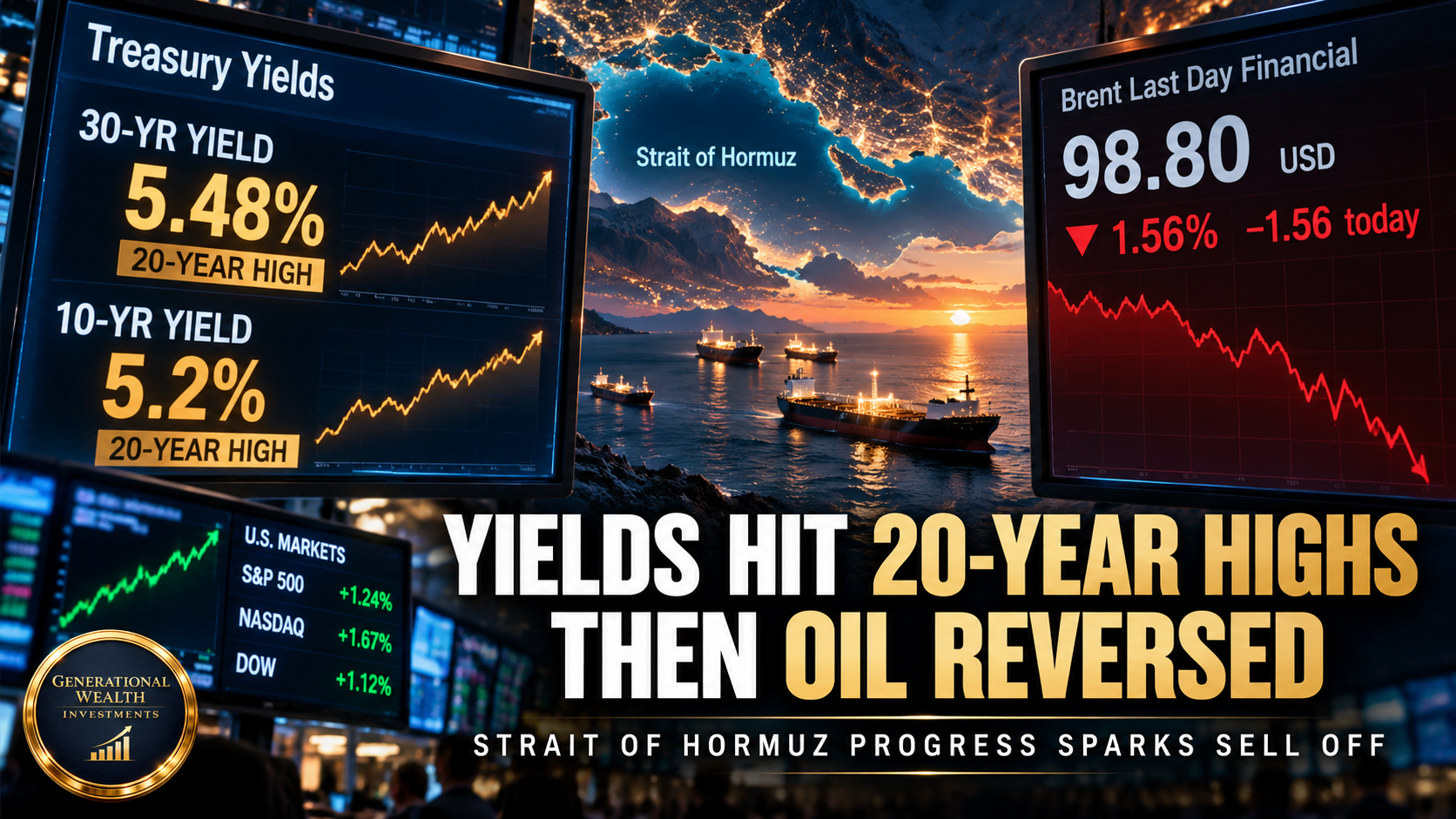
Oil Shock Sends Treasury Yields to 20-Year High
Oil-driven inflation fears pushed long-term Treasury yields to multi-decade highs before a Strait of Hormuz diplomacy headline suddenly reversed crude and helped stocks recover. Now the focus shifts to whether oil stays elevated — and what next week’s inflation and jobs data mean for the rate outlook.
September 25, 2026
Oil Shock Sends Treasury Yields to 20-Year High — Then Hormuz Changes the Setup
Oil-driven inflation fears pushed long-term Treasury yields to levels not seen in roughly two decades Thursday. Then the market changed direction: reports that U.S. and Iranian negotiators were exploring a path to reopen the Strait of Hormuz sent Brent crude sharply lower and helped stocks recover. Now investors have to determine whether that reversal can hold.
Watch Today’s Market Breakdown
See how the oil shock pushed Treasury yields higher, why a Hormuz headline suddenly reversed crude, and what markets are watching next.
Today’s Market Setup
Thursday showed how quickly oil, inflation expectations and interest rates can become one interconnected market story — and how quickly that setup can change when geopolitical expectations shift.
Treasury Yields Reach Multi-Decade Highs
The 30-year Treasury yield reached about 5.48%, its highest since 2004, while the 10-year climbed to around 5.2%, a level last seen in 2007. Rising long-term yields mean higher borrowing costs remain a major pressure point for markets.
Oil Revives Inflation Concerns
Renewed attacks on Saudi Arabia pushed oil higher as investors confronted fresh supply fears. With the U.S. economy remaining strong, another rise in energy prices added to concerns that inflation pressure could remain elevated.
Hormuz Headline Reverses the Move
Reports that U.S. and Iranian negotiators were exploring a path to reopen the Strait of Hormuz changed the market quickly. Brent crude fell roughly three dollars within minutes, while stocks recovered much of their earlier losses.
What Matters From Here
The key question is whether Thursday’s reversal marks a meaningful change in the oil-and-rates setup or only a temporary reaction to a diplomatic headline.
- Does oil remain elevated enough to keep inflation concerns and Treasury yields under pressure?
- Can the decline in crude continue if negotiations over reopening the Strait of Hormuz progress?
- How will next week’s inflation data and jobs report affect a market already confronting historically high long-term Treasury yields?
The Headlines Are Only the First Step
The free Market Preview explains how oil, Treasury yields and the Hormuz headline changed Thursday’s market. The members-only Daily Market Brief goes deeper into the catalysts, risks, confirmation signals and developments worth monitoring as investors evaluate what happens next.
See What Members GetInside Today’s Members-Only Daily Market Brief
- The oil-market developments that could reinforce or weaken the inflation pressure now affecting Treasury yields.
- What to monitor around the Strait of Hormuz as markets evaluate the possibility of reopening the critical shipping route.
- The interest-rate signals that could show whether Thursday’s surge in long-term Treasury yields is continuing or beginning to ease.
- Why next week’s inflation data and jobs report could become the next major tests for the current market setup.
Go Beyond the Headlines
The public Market Preview tells you what happened. The Generational Wealth Community is designed for investors who want to understand what deserves attention next, what could confirm the current market setup, what risks could change it and which developments deserve continued monitoring. We don’t chase hype, we decode the market.
Unlock the Daily Market BriefEducational market research designed to help investors understand the setup — not chase headlines.
Your pathway from knowledge to legacy. We don’t chase hype, we decode the market.
Stay Ahead of What Matters Next
Oil, inflation expectations and Treasury yields are moving together, while developments around the Strait of Hormuz can change that setup quickly. The next major tests arrive with inflation data and the jobs report.
Join the Generational Wealth Community
Retail Sales Drop 0.6% as Small Caps Hit Record High
Retail sales fell 0.6% in July and consumer sentiment sank to 51, yet the Russell 2000 closed at an all-time high as rate-hike fears faded. The bond market disagreed — the ten-year yield rose to 4.68% while oil spiked near $82 on Strait of Hormuz tensions.
Market Preview: Retail Sales Fall 0.6% as Small Caps Close at a Record and Oil Spikes to $82
The American consumer just posted the biggest spending drop in more than a year — and small-cap stocks closed at an all-time high the same session. The bond market didn't go along with it: the ten-year yield rose instead of falling, while oil settled near $82 after drone strikes in the Strait of Hormuz. Today's video explains the tension underneath a record close: cheaper money versus more expensive energy.

Today's Market Snapshot
The Consumer Pulled Back
Retail sales fell six tenths of a percent in July, the biggest drop in more than a year, when economists had expected a small increase. Consumer sentiment sank about 8% to 51, and households now expect 4.3% inflation over the next year.
Small Caps Hit a Record Anyway
After softer inflation reports Wednesday and Thursday, a weaker consumer eased fears the Fed must raise rates again in September. Small caps are the most rate-sensitive corner of the market, and the Russell 2000 closed at an all-time high.
Bonds and Oil Disagreed
The ten-year Treasury yield rose to 4.68% instead of falling on weak data — a signal inflation risk hasn't gone away. Oil settled near $82, up more than 5% on the week after Strait of Hormuz tanker strikes. Energy led all sectors, up roughly 7%.
What Investors Should Be Watching
- The retailers deliver their own verdict this week — Home Depot Tuesday, Target and Lowe's Wednesday, Walmart Thursday. If they confirm shoppers are pulling back, that small-cap record gets much harder to defend.
- Whether the ten-year yield keeps climbing on soft data, which would say the bond market is more worried about inflation than about growth.
- Whether the Strait of Hormuz situation escalates or cools, with gasoline still around $4 a gallon and the naval blockade open-ended.
Inside Today's Members-Only Daily Market Brief
- The levels members are tracking on small caps now that the Russell 2000 is at a record with a weakening consumer underneath it.
- How to read a bond market that rises on bad news — and what that pattern has historically meant for rate expectations.
- What each retailer print this week would do to the September rate debate, and which one carries the most weight.
- Where the energy trade sits after a 7% sector week, and the risks that could reverse it quickly.
- The strongest and weakest areas of the market heading into the next session.
Go Beyond the Headlines
The public video explains what happened. The Generational Wealth Community helps members understand what matters next, where the risks are, and which developments deserve continued attention.
Unlock the Daily Market Brief