

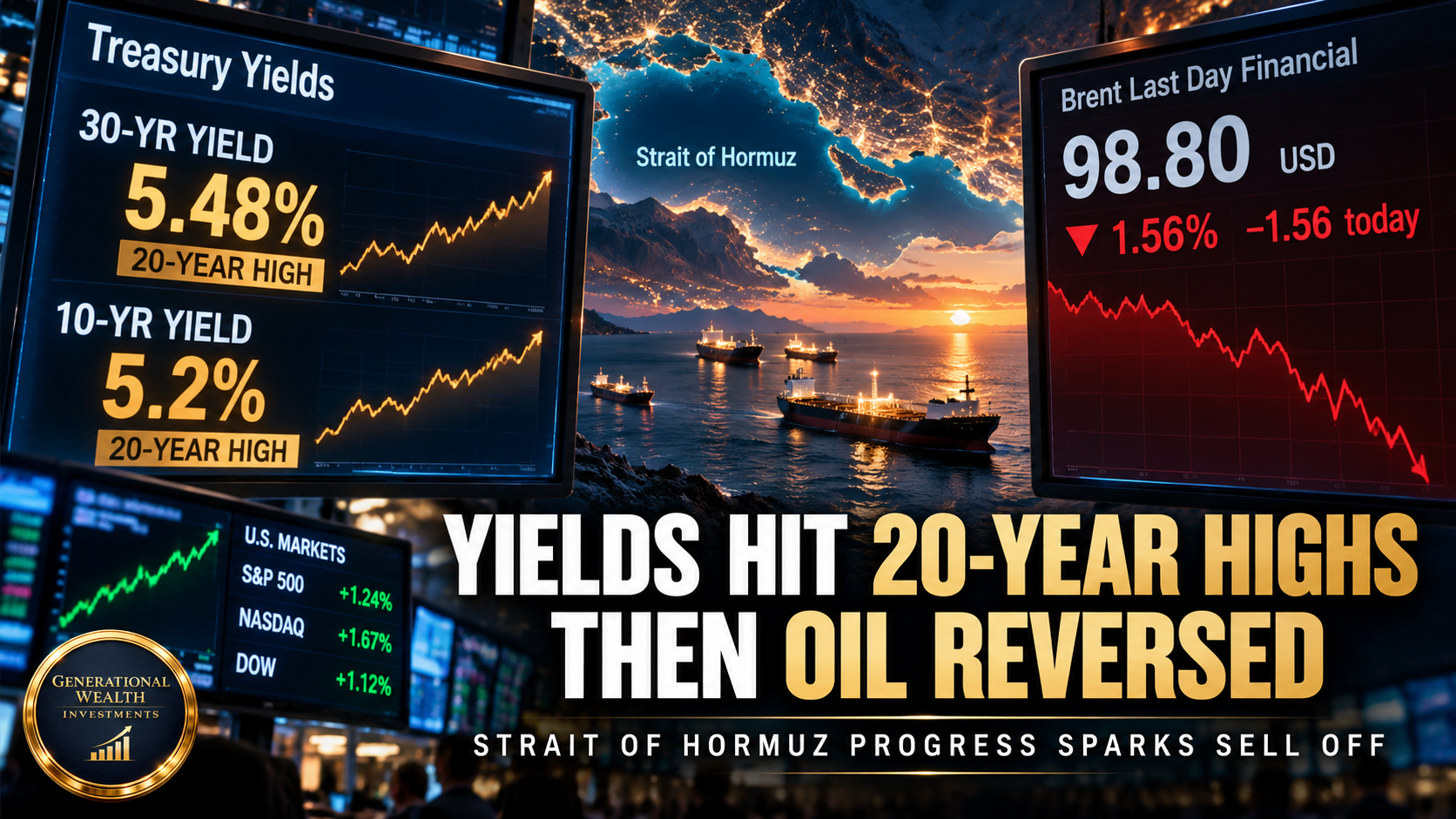
Oil Shock Sends Treasury Yields to 20-Year High
Oil-driven inflation fears pushed long-term Treasury yields to multi-decade highs before a Strait of Hormuz diplomacy headline suddenly reversed crude and helped stocks recover. Now the focus shifts to whether oil stays elevated — and what next week’s inflation and jobs data mean for the rate outlook.
September 25, 2026
Oil Shock Sends Treasury Yields to 20-Year High — Then Hormuz Changes the Setup
Oil-driven inflation fears pushed long-term Treasury yields to levels not seen in roughly two decades Thursday. Then the market changed direction: reports that U.S. and Iranian negotiators were exploring a path to reopen the Strait of Hormuz sent Brent crude sharply lower and helped stocks recover. Now investors have to determine whether that reversal can hold.
Watch Today’s Market Breakdown
See how the oil shock pushed Treasury yields higher, why a Hormuz headline suddenly reversed crude, and what markets are watching next.
Today’s Market Setup
Thursday showed how quickly oil, inflation expectations and interest rates can become one interconnected market story — and how quickly that setup can change when geopolitical expectations shift.
Treasury Yields Reach Multi-Decade Highs
The 30-year Treasury yield reached about 5.48%, its highest since 2004, while the 10-year climbed to around 5.2%, a level last seen in 2007. Rising long-term yields mean higher borrowing costs remain a major pressure point for markets.
Oil Revives Inflation Concerns
Renewed attacks on Saudi Arabia pushed oil higher as investors confronted fresh supply fears. With the U.S. economy remaining strong, another rise in energy prices added to concerns that inflation pressure could remain elevated.
Hormuz Headline Reverses the Move
Reports that U.S. and Iranian negotiators were exploring a path to reopen the Strait of Hormuz changed the market quickly. Brent crude fell roughly three dollars within minutes, while stocks recovered much of their earlier losses.
What Matters From Here
The key question is whether Thursday’s reversal marks a meaningful change in the oil-and-rates setup or only a temporary reaction to a diplomatic headline.
- Does oil remain elevated enough to keep inflation concerns and Treasury yields under pressure?
- Can the decline in crude continue if negotiations over reopening the Strait of Hormuz progress?
- How will next week’s inflation data and jobs report affect a market already confronting historically high long-term Treasury yields?
The Headlines Are Only the First Step
The free Market Preview explains how oil, Treasury yields and the Hormuz headline changed Thursday’s market. The members-only Daily Market Brief goes deeper into the catalysts, risks, confirmation signals and developments worth monitoring as investors evaluate what happens next.
See What Members GetInside Today’s Members-Only Daily Market Brief
- The oil-market developments that could reinforce or weaken the inflation pressure now affecting Treasury yields.
- What to monitor around the Strait of Hormuz as markets evaluate the possibility of reopening the critical shipping route.
- The interest-rate signals that could show whether Thursday’s surge in long-term Treasury yields is continuing or beginning to ease.
- Why next week’s inflation data and jobs report could become the next major tests for the current market setup.
Go Beyond the Headlines
The public Market Preview tells you what happened. The Generational Wealth Community is designed for investors who want to understand what deserves attention next, what could confirm the current market setup, what risks could change it and which developments deserve continued monitoring. We don’t chase hype, we decode the market.
Unlock the Daily Market BriefEducational market research designed to help investors understand the setup — not chase headlines.
Your pathway from knowledge to legacy. We don’t chase hype, we decode the market.
Stay Ahead of What Matters Next
Oil, inflation expectations and Treasury yields are moving together, while developments around the Strait of Hormuz can change that setup quickly. The next major tests arrive with inflation data and the jobs report.
Join the Generational Wealth Community
Oil Jumps 5% as 10-Year Yield Hits 4.81% and Gold Falls
Oil surged as renewed fighting near the Strait of Hormuz pushed energy prices higher while the 10-year Treasury yield reached about 4.81%. Gold’s decline reveals the bigger market tension as investors weigh geopolitical risk against higher yields, a stronger dollar and the next test from U.S. labor data.
September 2, 2026
Oil Jumps 5% as Treasury Yields Hit 4.81% — So Why Is Gold Falling?
Oil surged after renewed U.S.-Iran fighting near the Strait of Hormuz, pushing Brent to $94.65 Tuesday and briefly near $97 overnight. At the same time, the 10-year Treasury yield reached about 4.81%, its highest since 2023. Yet gold moved the opposite direction, falling to a more than three-week low as higher yields and a stronger dollar outweighed safe-haven demand. Now labor data could test the entire setup.
Watch Today’s Market Breakdown
See how the Hormuz oil shock is feeding into inflation expectations, Treasury yields, stock valuations and gold ahead of the ADP employment report.
Today’s Market Setup
The market is dealing with one connected chain of pressure: geopolitical risk is lifting oil, higher oil is keeping inflation concerns alive, and rising rate expectations are pushing Treasury yields higher.
Oil Surges on Hormuz Risk
Brent settled Tuesday at $94.65, up 4.6%, while WTI gained 5.2%. Brent then briefly touched $97 overnight before easing near $95. Renewed U.S.-Iran fighting near Hormuz is keeping supply risk at the center of the inflation outlook.
Treasury Yields Reach New Highs
The 10-year Treasury yield reached about 4.81%, its highest since 2023, while the 2-year climbed near 4.41%. Higher energy costs can keep inflation elevated, strengthening the market’s focus on whether the Federal Reserve may need to raise rates again.
Gold Breaks the Safe-Haven Pattern
Spot gold fell near $4,324, a more than three-week low, despite the geopolitical tension. Higher Treasury yields and a stronger dollar outweighed safe-haven demand, showing why geopolitical risk alone has not been enough to push gold higher.
What Matters From Here
Oil, rates, stocks and gold are now reacting to the same inflation question. The next test is whether incoming labor data reinforces the higher-rate narrative or begins to challenge it.
- Does the ADP private-payrolls report strengthen the case for another Federal Reserve rate hike, or complicate the market’s current expectations?
- Can oil remain near current levels if fighting around the Strait of Hormuz continues to threaten supply?
- Will higher Treasury yields and a stronger dollar continue to outweigh safe-haven demand for gold?
The Headlines Are Only the First Step
The free Market Preview explains why oil, Treasury yields, stocks and gold are moving the way they are. The members-only Daily Market Brief goes deeper into the catalysts, risks, confirmation signals and developments worth monitoring as the market determines whether this inflation-and-rates pressure continues.
See What Members GetInside Today’s Members-Only Daily Market Brief
- The developments that could confirm whether the current oil-driven inflation pressure is continuing or beginning to ease.
- How the ADP employment report fits into the market’s changing expectations for Federal Reserve policy.
- The Treasury-yield signals worth following as the 10-year trades around its highest level since 2023.
- What gold’s weakness may reveal about the competition between safe-haven demand, higher yields and a stronger dollar.
- The next developments that could change the relationship between energy prices, interest rates and stock valuations.
Go Beyond the Headlines
The public Market Preview tells you what happened and why investors are paying attention. The Generational Wealth Community is designed for investors who want to understand what deserves attention next, what could confirm the current market setup, what risks could change it and which developments deserve continued monitoring. We don’t chase hype, we decode the market.
Unlock the Daily Market BriefEducational market research designed to help investors understand the setup — not chase headlines.
Your pathway from knowledge to legacy. We don’t chase hype, we decode the market.
Stay Ahead of What Matters Next
Follow the catalysts that matter as markets weigh oil near $95, Treasury yields around 4.81%, gold weakness and the next test from U.S. labor data.
Join the Generational Wealth Community
Oil Tops $90 After Hormuz Strike as Hike Odds Hit 57%
Oil moved above $90 after a U.S. strike near the Strait of Hormuz put one of the world’s most important energy routes back in focus. With September rate-hike odds now at 57%, the next question is whether higher energy prices or Friday’s jobs report has the bigger impact on Fed expectations.
August 31, 2026
Oil Blows Past $90 After Hormuz Strike — Rate Hike Odds Jump to 57%
Oil moved above $90 after American forces struck Iranian launchers near the Strait of Hormuz, putting one of the world’s most important energy routes back at the center of the market. The complication is that inflation pressure is already colliding with rising expectations for a September Fed rate increase. Now investors have two major risks to track: energy disruption and Friday’s jobs report.
Watch Today’s Market Breakdown
See why the Hormuz strike pushed oil above $90, how it connects to inflation and rate expectations, and why Friday’s jobs report matters.
Oil Blows Past $90 After Hormuz Strike — Rate Hike Odds Jump to 57% Watch Today’s Market BriefingToday’s Market Setup
The market is dealing with a renewed geopolitical oil shock while interest-rate expectations are already moving in a more restrictive direction.
Hormuz Risk Sends Oil Above $90
American forces struck two Iranian launchers on Larak Island after officials said Revolutionary Guard forces were preparing rockets carrying sea mines into the Strait of Hormuz. Iran then attacked American forces in Jordan. Brent futures climbed about 2% overnight and moved above $90 a barrel.
Oil Adds to the Inflation Problem
Fed Chair Kevin Warsh said Friday that the Fed still has work to do if inflation is not moving clearly toward 2%. Markets raised the implied probability of a September rate increase to 57%, while the two-year Treasury yield is near 4.34% after rising almost 12 basis points Friday.
Friday’s Jobs Report Becomes the Next Test
President Trump said Venezuelan oil from the new American agreement will help refill the Strategic Petroleum Reserve, but additional Venezuelan production requires investment. That leaves the immediate Hormuz risk unresolved while markets wait to see whether Friday’s labor data changes rate-hike expectations.
What Matters From Here
Oil above $90 explains what changed overnight. The more important issue now is how long the pressure lasts and whether it reinforces the Fed’s inflation concerns.
- Does the Strait of Hormuz remain disrupted enough to keep upward pressure on oil, or does the immediate geopolitical risk begin to ease?
- Does higher oil strengthen the inflation argument enough to keep September rate-hike expectations elevated?
- Could a weaker-than-expected jobs report on Friday cool those expectations even if energy prices remain under pressure?
The Headlines Are Only the First Step
The free Market Preview explains why oil, inflation and interest-rate expectations are colliding today. The members-only Daily Market Brief goes deeper into the catalysts, risks, confirmation signals and developments worth monitoring as the Hormuz story and Friday’s jobs report reshape the market setup.
See What Members GetInside Today’s Members-Only Daily Market Brief
- The Hormuz developments that could strengthen or weaken the current oil-supply risk.
- How renewed energy inflation interacts with the market’s 57% September rate-hike probability.
- Why the two-year Treasury yield matters as investors reassess the Fed’s next move.
- What Friday’s jobs report could change about the current interest-rate setup.
- How Venezuela’s longer-term supply story fits against the immediate geopolitical pressure in the Strait of Hormuz.
Go Beyond the Headlines
The public Market Preview tells you what happened and why investors are paying attention. The Generational Wealth Community is built for investors who want to understand what deserves attention next, what could confirm the current setup, what risks could change it, and which developments deserve continued monitoring. We don’t chase hype, we decode the market.
Unlock the Daily Market BriefEducational market research designed to help investors understand the setup — not chase headlines.
Your pathway from knowledge to legacy. We don’t chase hype, we decode the market.
Stay Ahead of What Matters Next
Follow the catalysts that matter as markets weigh renewed Hormuz risk, oil above $90, higher rate-hike expectations and Friday’s jobs report.
Join the Generational Wealth Community
Brent Crude Falls to $86 as Hormuz Talks Lower Yields
Brent crude has dropped more than 6% in two sessions as Iran and Oman discuss a temporary shipping corridor through the Strait of Hormuz. Treasury yields are falling too, but limited vessel traffic and this morning’s PCE inflation report will test whether the relief can hold.
August 26, 2026
Brent Crude Falls to $86 as Hormuz Reopening Talks Begin — Yields Drop Too
Brent crude has fallen more than 6% in two sessions as Iran and Oman discuss a temporary shipping corridor through the Strait of Hormuz and an agreement to clear mines. Oil is now around $86 a barrel, potentially easing a major inflation pressure as Treasury yields fall. But Hormuz is not fully open, and this morning’s PCE inflation report is the next major test.
Watch Today’s Market Breakdown
See why Hormuz reopening talks are moving oil, how falling crude connects to Treasury yields, and why PCE inflation matters next.
Today’s Market Setup
The market is reacting to the possibility that one of the world’s most important oil routes could begin reopening, but the physical shipping data still shows significant disruption.
Brent Crude Drops Toward $86
Brent settled down nearly 4% Tuesday and fell again this morning to around $86 a barrel. Iran and Oman are discussing a temporary shipping corridor through Hormuz, where roughly one-fifth of the world’s traded oil moved before the war.
Treasury Yields Move Lower
Lower oil can reduce a major source of inflation pressure. The 10-year Treasury yield fell about eight basis points Tuesday to roughly 4.63%, while the 30-year declined to around 5.16%. The S&P 500 gained about 0.3% and the Nasdaq rose roughly 0.7%.
Hormuz Is Still Far From Normal
Only five commodity vessels reportedly transited the strait Tuesday, far below recent normal levels. A tanker was also disabled near Hormuz after an unidentified projectile strike. The reopening narrative is developing faster than normal shipping activity has returned.
What Matters From Here
Falling oil and yields have changed the market setup, but the next signals will determine whether that relief is reinforced or challenged.
- Do the Hormuz discussions translate into meaningfully higher vessel traffic through the strait?
- Does this morning’s PCE inflation report reinforce the easing in oil and Treasury yields, or challenge it with a hotter reading?
- Can the stock-market response hold if shipping disruptions remain significant even as crude prices continue falling?
The Headlines Are Only the First Step
The free Market Preview explains why oil, Hormuz and Treasury yields matter today. The members-only Daily Market Brief goes deeper into the catalysts, risks, confirmation signals and developments worth monitoring as investors evaluate whether the current relief is becoming more durable.
See What Members GetInside Today’s Members-Only Daily Market Brief
- The shipping and vessel-flow developments that could confirm or weaken the Hormuz reopening narrative.
- How falling crude, PCE inflation and Treasury yields fit together in the current market setup.
- What continued disruption near the strait could mean for the relief already appearing across oil, bonds and equities.
- The next developments worth monitoring as markets test whether lower inflation pressure can persist.
Go Beyond the Headlines
The public Market Preview tells you what happened and why investors are paying attention. The Generational Wealth Community is designed for investors who want to understand what deserves attention next, what could confirm the current setup, what risks could change it, and which developments deserve continued monitoring. We don’t chase hype, we decode the market.
Unlock the Daily Market BriefEducational market research designed to help investors understand the setup — not chase headlines.
Your pathway from knowledge to legacy. We don’t chase hype, we decode the market.
Stay Ahead of What Matters Next
Follow the catalysts, risks and confirmation signals that matter as markets evaluate falling oil, Hormuz shipping conditions, inflation and Treasury yields.
Join the Generational Wealth Community
Retail Sales Drop 0.6% as Small Caps Hit Record High
Retail sales fell 0.6% in July and consumer sentiment sank to 51, yet the Russell 2000 closed at an all-time high as rate-hike fears faded. The bond market disagreed — the ten-year yield rose to 4.68% while oil spiked near $82 on Strait of Hormuz tensions.
Market Preview: Retail Sales Fall 0.6% as Small Caps Close at a Record and Oil Spikes to $82
The American consumer just posted the biggest spending drop in more than a year — and small-cap stocks closed at an all-time high the same session. The bond market didn't go along with it: the ten-year yield rose instead of falling, while oil settled near $82 after drone strikes in the Strait of Hormuz. Today's video explains the tension underneath a record close: cheaper money versus more expensive energy.

Today's Market Snapshot
The Consumer Pulled Back
Retail sales fell six tenths of a percent in July, the biggest drop in more than a year, when economists had expected a small increase. Consumer sentiment sank about 8% to 51, and households now expect 4.3% inflation over the next year.
Small Caps Hit a Record Anyway
After softer inflation reports Wednesday and Thursday, a weaker consumer eased fears the Fed must raise rates again in September. Small caps are the most rate-sensitive corner of the market, and the Russell 2000 closed at an all-time high.
Bonds and Oil Disagreed
The ten-year Treasury yield rose to 4.68% instead of falling on weak data — a signal inflation risk hasn't gone away. Oil settled near $82, up more than 5% on the week after Strait of Hormuz tanker strikes. Energy led all sectors, up roughly 7%.
What Investors Should Be Watching
- The retailers deliver their own verdict this week — Home Depot Tuesday, Target and Lowe's Wednesday, Walmart Thursday. If they confirm shoppers are pulling back, that small-cap record gets much harder to defend.
- Whether the ten-year yield keeps climbing on soft data, which would say the bond market is more worried about inflation than about growth.
- Whether the Strait of Hormuz situation escalates or cools, with gasoline still around $4 a gallon and the naval blockade open-ended.
Inside Today's Members-Only Daily Market Brief
- The levels members are tracking on small caps now that the Russell 2000 is at a record with a weakening consumer underneath it.
- How to read a bond market that rises on bad news — and what that pattern has historically meant for rate expectations.
- What each retailer print this week would do to the September rate debate, and which one carries the most weight.
- Where the energy trade sits after a 7% sector week, and the risks that could reverse it quickly.
- The strongest and weakest areas of the market heading into the next session.
Go Beyond the Headlines
The public video explains what happened. The Generational Wealth Community helps members understand what matters next, where the risks are, and which developments deserve continued attention.
Unlock the Daily Market Brief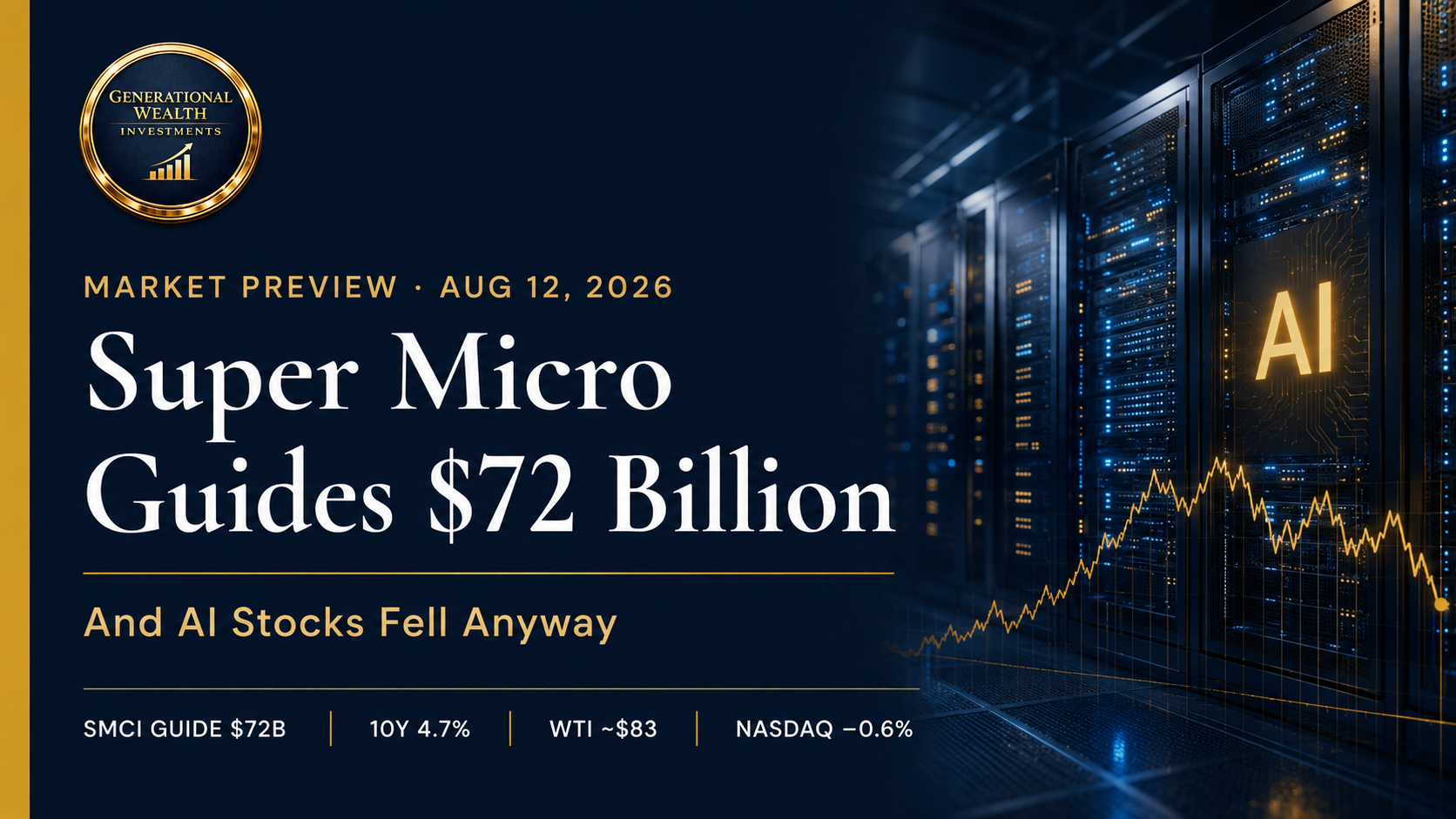
Super Micro Guides $72B as AI Stocks Sell Off Anyway
Super Micro guided to as much as $72 billion in AI server sales next year, roughly $19 billion above Wall Street's model, and the stock jumped about 9% after hours — hours after AI stocks had sold off all day. Today's preview decodes why the doubt has shifted from demand to financing, with yields near 4.7%, crude around $83, and the July inflation report landing at 8:30.
Market Preview: Super Micro Guides $72 Billion as AI Stocks Sell Off Anyway
Super Micro told Wall Street it expects to sell as much as $72 billion of AI servers next year — roughly $19 billion above what analysts were modeling — and the stock jumped about 9% after hours. The strange part is the timing: AI stocks had sold off all day in the regular session. Today's video explains why the doubt on Wall Street is no longer about demand, but about how the buildout gets paid for.

Today's Market Snapshot
Demand Beats, and Then Some
Super Micro guided to as much as $72 billion in AI server sales next year, against roughly $53 billion modeled on Wall Street. The stock rose about 9% after hours. CoreWeave said the same evening that its backlog grew roughly $25 billion in six weeks, and its stock jumped as well.
The Funding Question Takes Over
Hours earlier, AI names sold off all session. Alphabet fell nearly 4% on data center spending worries, Intel priced a $20 billion stock sale upsized from $15 billion, and Nvidia lined up more than $500 billion of outside financing this week. The Nasdaq closed down about 0.6%, a second straight loss.
Yields and Oil Set the Cost
When a buildout runs on borrowed money, the cost of borrowing becomes the story. The 10-year Treasury yield sits near 4.7%. Crude settled around $83, a fourth straight gain, after Iran said the Strait of Hormuz stays shut. Both feed directly into this morning's inflation math.
What Investors Should Be Watching
- The July inflation report at 8:30 this morning, where economists expect headline inflation around 3.4% — a cooler number takes pressure off yields, a hotter one makes every one of these deals pricier.
- Whether the after-hours enthusiasm around Super Micro and CoreWeave carries into the regular session, or whether the financing questions reassert themselves the way they did Tuesday.
- Whether crude can extend a fourth straight gain with the Strait of Hormuz still closed, and what that does to the rate path traders are already pricing near a coin flip for a hike.
Inside Today's Members-Only Daily Market Brief
- The specific levels members are tracking across the 10-year, crude, and the AI complex as the funding story develops.
- Both sides of this morning's inflation print, and what each outcome would mean for a rate decision now priced near even.
- Why the market can sell a demand beat, and what would actually resolve the question of who is holding the paper.
- How the Intel and Nvidia financing structures differ, and which one tells you more about the cycle.
- Where capital is rotating as borrowing costs, not demand, become the constraint on the buildout.
Go Beyond the Headlines
The public video explains what happened. The Generational Wealth Community helps members understand what matters next, where the risks are, and which developments deserve continued attention.
Unlock the Daily Market Brief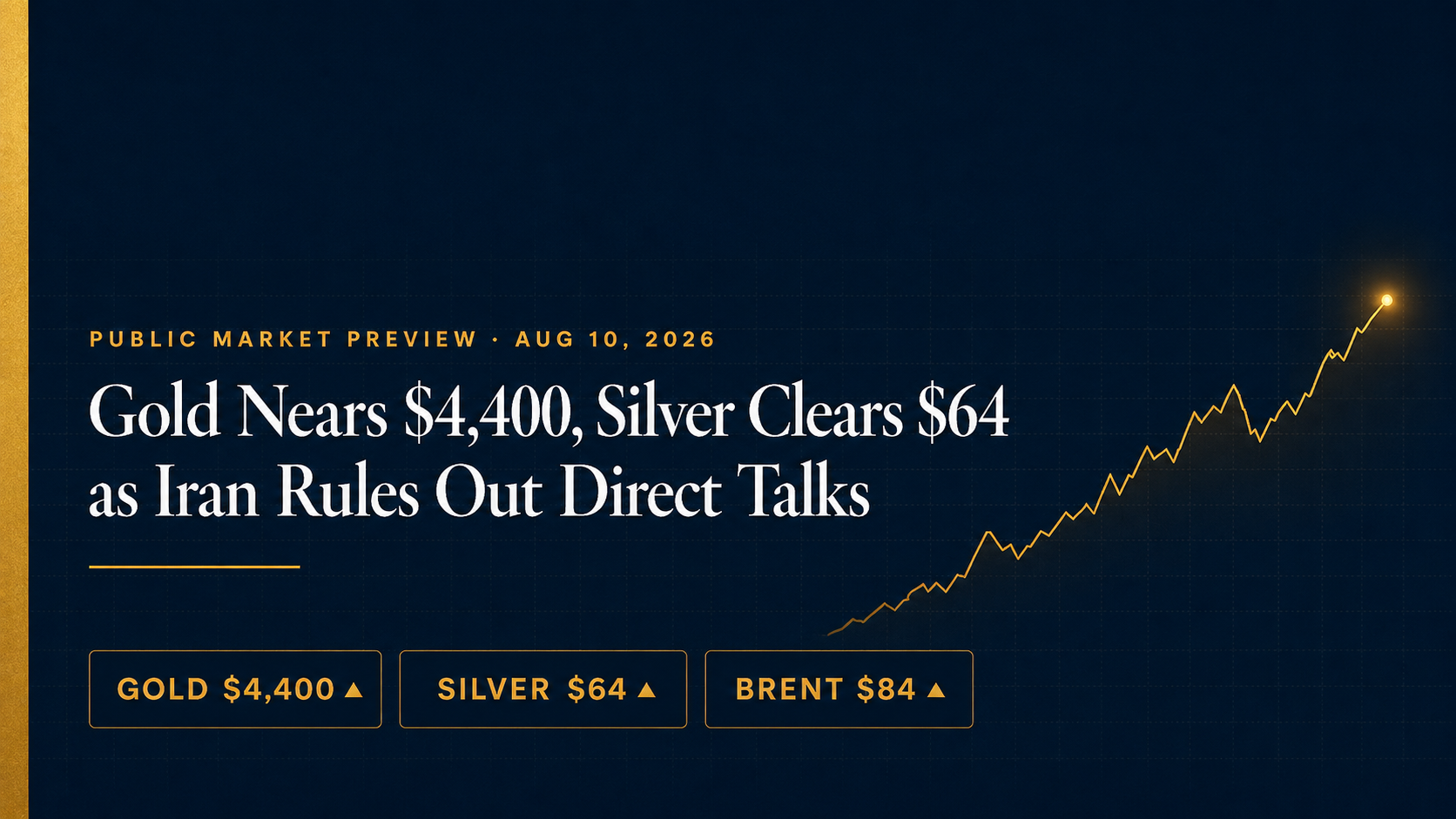
Gold Nears $4,400, Silver Tops $64 as Iran Rules Out Talks
Iran ruled out direct talks with Washington and warned the Strait of Hormuz stays closed without U.S. concessions, sending crude higher for a third straight session and pushing gold toward $4,400 and silver past $64. Today's preview covers the metals move, Friday's record close, and what Wednesday's inflation print could change.
Market Preview: Gold Nears $4,400 and Silver Clears $64 as Iran Rules Out Direct Talks
Iran said Sunday it is not negotiating directly with Washington and that the Strait of Hormuz stays closed without U.S. concessions — and crude climbed for a third straight session. That uncertainty is pushing money into hard assets, with gold near $4,400 and silver up roughly 11% on the week, even as Nasdaq futures lead again ahead of Wednesday's inflation print. Today's video connects the geopolitics, the metals move, and the rate math.

Today's Market Snapshot
Iran Standoff Lifts Crude
Iran's foreign minister said Sunday that Tehran is not in direct negotiations with the United States, and warned the Strait of Hormuz will not reopen without American concessions. Brent for October traded just above $84 overnight, up roughly 0.8%, while WTI held near $79. A confirmed Iran–Oman shipping agreement is the main risk to the move.
Gold and Silver Push Higher
Gold futures traded around $4,400 an ounce overnight, with spot nearer $4,300. Silver pushed past $64, up roughly 11% over the past week. Miners and metals funds could benefit if the move holds — the open question is whether silver can defend its breakout on the first real pullback.
Records, Futures, and Flows
The S&P 500 closed Friday at a record 7,757, up 0.6%, and the Nasdaq Composite added 1.3% for its best week since April after July payrolls fell 23,000. Overnight, Nasdaq futures gained about 0.5% while Dow futures slipped. The Nikkei closed up near 2%; bitcoin held around $65,000.
What Investors Should Be Watching
- Wednesday's July consumer price report, expected near 3.4%. A surprise in either direction would reset the rate math that drove Friday's record close.
- Whether Iran and Oman confirm a shipping agreement, which would return barrels quickly and cut against the crude rally — or whether the standoff hardens instead.
- Whether the rotation into hard assets and AI hardware broadens, with CoreWeave and Super Micro reporting Tuesday and Applied Materials Thursday.
Inside Today's Members-Only Daily Market Brief
- The specific levels and catalysts members are tracking across gold, silver, and crude as the Hormuz standoff drags on.
- Both sides of Wednesday's inflation print, and what each outcome would mean for the September rate path.
- Where capital is rotating as money moves into hard assets and AI hardware while crude-sensitive cyclicals lag.
- What the Bank of Japan's July meeting summary signals for a September move — and why a sharply stronger yen is the risk to Tokyo's rally.
- What steady bitcoin ETF inflows and lagging XRP may be signaling beneath a quiet week in crypto.
Go Beyond the Headlines
The public video explains what happened. The Generational Wealth Community helps members understand what matters next, where the risks are, and which developments deserve continued attention.
Unlock the Daily Market Brief