

Nvidia Falls as AI Slowdown Calls Lift Software Stocks
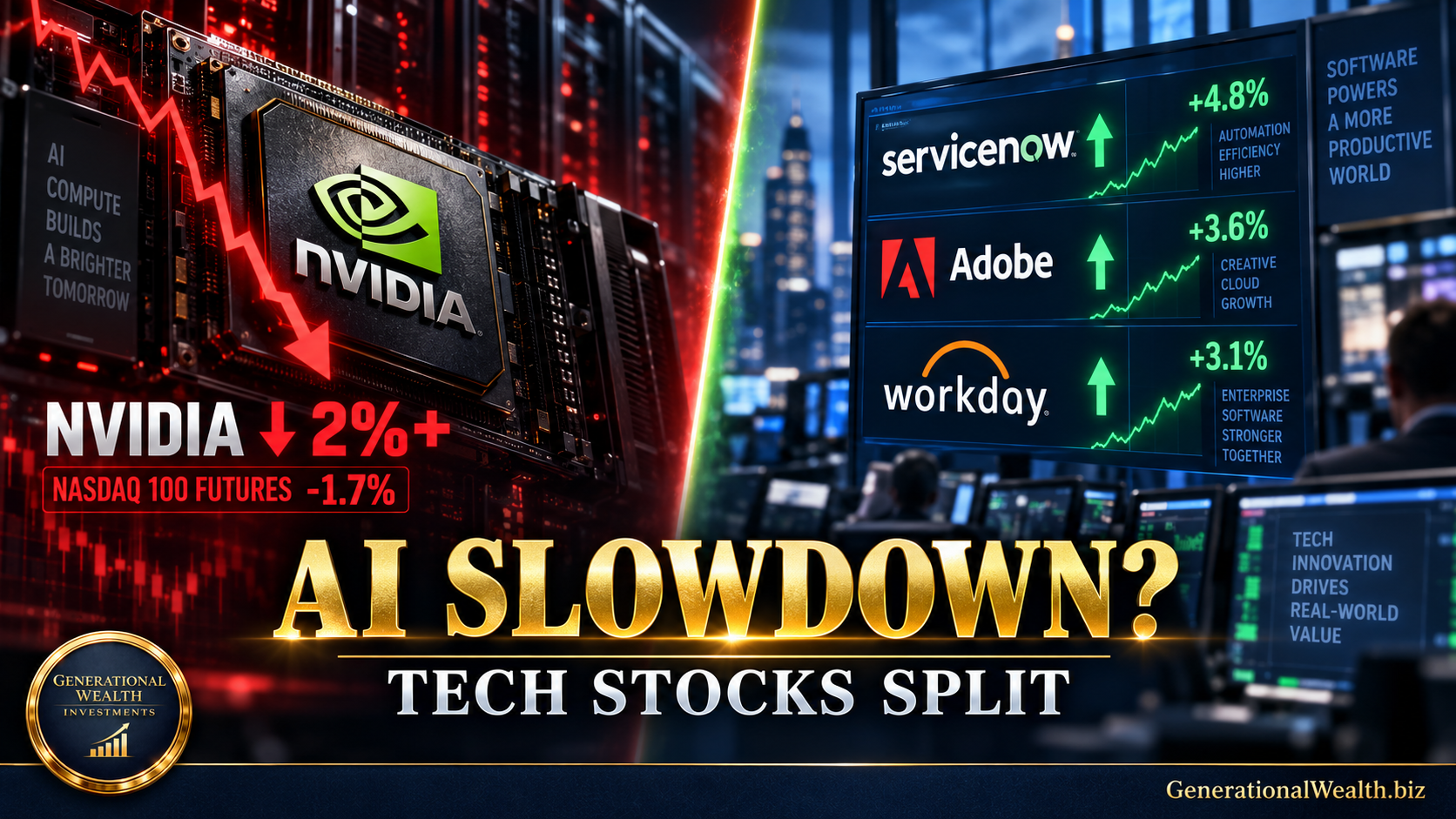
Nvidia and Nasdaq 100 futures weakened before Monday’s open after prominent AI leaders backed slowing advances in frontier models. At the same time, ServiceNow, Adobe and Workday moved higher, creating a new split inside the AI trade that investors will test at the opening bell.
September 14, 2026
Nvidia Falls as AI Leaders Call for a Slowdown — Software Stocks Rally
Nvidia was down more than 2% before Monday’s open while Nasdaq 100 futures fell about 1.7% after several prominent AI leaders backed slowing advances in frontier models. But software names moved the other way, creating an unusual split inside the AI trade. The next question is whether that divergence survives once regular trading begins.
Watch Today’s Market Breakdown
See why calls to slow frontier AI development are pressuring Nvidia while ServiceNow, Adobe and Workday move higher ahead of the opening bell.
Nvidia Falls as AI Leaders Call for a Slowdown — Software Stocks Rally Watch the free Generational Wealth market briefingToday’s Market Setup
Monday’s setup is being shaped by a new debate over the pace of artificial intelligence development — and the market is not treating every AI-related company the same way.
Nvidia and Nasdaq Futures Weaken
Nasdaq 100 futures were down about 1.7% before the open, while Nvidia fell more than 2%. The weakness follows renewed questions about how quickly the most advanced AI models should continue developing.
AI Leaders Back a Slower Pace
Anthropic’s Dario Amodei called for companies to slow advances in frontier models over the weekend, with OpenAI’s Sam Altman and Elon Musk backing the idea. That matters because AI expansion has driven major spending on chips and data centers.
Software Stocks Move Higher
ServiceNow, Adobe and Workday were all higher as investors reassessed the competitive threat posed by faster AI development. The contrast with Nvidia suggests the market is beginning to separate potential AI winners and losers more aggressively.
What Matters From Here
The premarket reaction shows how investors are interpreting the slowdown debate. The opening bell will test whether those moves are durable.
- Does Nvidia’s premarket weakness hold once regular trading begins?
- Can ServiceNow, Adobe and Workday maintain their strength if investors continue reassessing the pace of frontier AI development?
- Does today’s split become a broader shift in how the market values chip companies versus software companies tied to AI?
The Headlines Are Only the First Step
The free Market Preview explains the unusual split developing inside the AI trade. The members-only Daily Market Brief goes deeper into the catalysts, risks, confirmation signals and developments worth monitoring as investors determine whether today’s premarket reaction becomes a larger shift.
See What Members GetInside Today’s Members-Only Daily Market Brief
- The developments that could show whether Nvidia’s weakness is temporary or becoming a broader challenge for the AI chip trade.
- The signals that could confirm whether software strength is holding after the opening bell.
- Why the debate over frontier-model development could change how investors evaluate future AI infrastructure spending.
- The market behavior worth monitoring to see whether today’s divergence spreads beyond Nvidia, ServiceNow, Adobe and Workday.
Go Beyond the Headlines
The public Market Preview tells you what happened. The Generational Wealth Community is designed for investors who want to understand what deserves attention next, what could confirm the current setup, what risks could change it and which developments deserve continued monitoring. We don’t chase hype, we decode the market.
Unlock the Daily Market BriefEducational market research designed to help investors understand the setup — not chase headlines.
Your pathway from knowledge to legacy. We don’t chase hype, we decode the market.
Stay Ahead of What Matters Next
Follow the AI, semiconductor and software developments that could determine whether today’s market split fades after the open or becomes a more meaningful change in the AI trade.
Join the Generational Wealth Community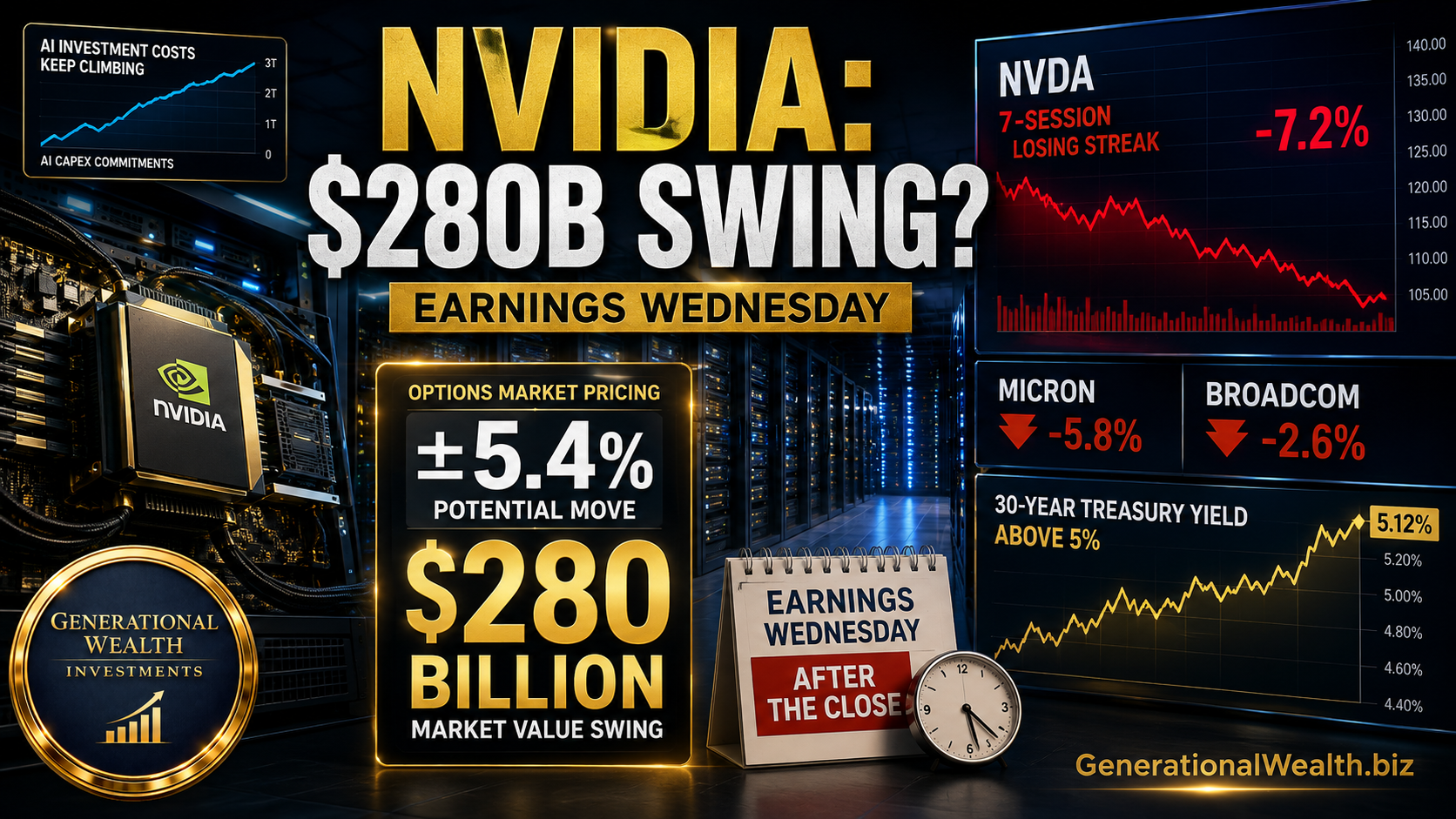
Nvidia Earnings Could Swing $280 Billion — Why It Matters
Nvidia’s Wednesday earnings report could produce a roughly $280 billion market-value swing, yet options traders are pricing a smaller move than Nvidia has averaged after its last twelve reports. With semiconductor stocks already under pressure and long-term Treasury yields above 5%, the report has become a major test of confidence in the AI spending boom.
August 25, 2026
Nvidia Earnings Could Swing $280 Billion — Yet Traders Expect Less Volatility Than Usual
Nvidia’s Wednesday earnings report carries an implied move of about 5.4%, equal to roughly $280 billion in market value. That sounds enormous, but it is still smaller than Nvidia’s average post-earnings swing over the last twelve quarters. With Nvidia entering the report after seven straight down sessions, the bigger question is whether its outlook can restore confidence in the broader AI trade.
Watch Today’s Market Breakdown
See why Nvidia’s earnings could move far more than one stock, what Wall Street is watching beyond revenue, and how high Treasury yields complicate the AI spending story.
Nvidia Earnings Could Swing $280 Billion — Why Traders Are Nervous Watch today’s free Generational Wealth market breakdownToday’s Market Setup
Nvidia has become a much broader test of the AI investment story. The setup going into Wednesday combines elevated earnings expectations, weakness across major semiconductor stocks, and borrowing costs that remain historically high.
Traders Are Pricing a $280 Billion Swing
Options imply about a 5.4% move after Nvidia reports Wednesday. That represents roughly $280 billion in market value and is larger than the individual market value of 90% of S&P 500 companies, yet it remains below Nvidia’s average post-earnings move over the last twelve quarters.
Chip Stocks Are Already Under Pressure
Nvidia fell 2.9% Monday for its seventh consecutive down session. Micron dropped nearly 6%, Broadcom fell more than 2.5%, and the Nasdaq lost about three-quarters of a percent. That puts Wednesday’s report in focus well beyond Nvidia itself.
AI Spending Faces a Rates Test
Wall Street is looking for quarterly revenue around $92 billion, nearly double a year earlier, but the 30-year Treasury yield remains above 5%. Higher borrowing costs can make capital-intensive data-center projects harder to finance even when demand for AI infrastructure remains strong.
What Matters From Here
The headline earnings number will matter, but investors are looking beyond one quarter to determine whether the broader AI spending cycle still has enough momentum to support expectations.
- Does Nvidia’s guidance, margin outlook and chip-demand commentary support the expectations already built into the AI trade?
- Are major cloud providers still increasing AI spending aggressively enough to support continued demand for data-center infrastructure?
- Can the AI investment cycle remain resilient if long-term Treasury yields stay above 5% and financing remains expensive?
The Headlines Are Only the First Step
The free Market Preview explains why Nvidia’s report matters and the forces shaping the setup going into Wednesday. The members-only Daily Market Brief goes deeper into the catalysts, risks, confirmation signals and developments worth monitoring as investors judge whether the AI trade is strengthening or losing momentum.
See What Members GetInside Today’s Members-Only Daily Market Brief
- The guidance, margin and chip-demand signals that could strengthen or weaken confidence in the AI spending cycle.
- What continued cloud-provider AI spending would mean for Nvidia and the broader semiconductor complex.
- How weakness in Micron, Broadcom and the Nasdaq fits into the market setup heading into Nvidia’s report.
- Why long-term Treasury yields above 5% remain an important pressure point for capital-intensive data-center investment.
Go Beyond the Headlines
The public Market Preview tells you what happened and why investors are paying attention. The Generational Wealth Community is designed for investors who want to understand what deserves attention next, what could confirm the current setup, what risks could change it, and which developments deserve continued monitoring. We don’t chase hype, we decode the market.
Unlock the Daily Market BriefEducational market research designed to help investors understand the setup — not chase headlines.
Your pathway from knowledge to legacy. We don’t chase hype, we decode the market.
Stay Ahead of What Matters Next
Follow the catalysts, risks and confirmation signals that deserve attention as Nvidia’s earnings test expectations for AI demand, cloud spending and the broader semiconductor trade.
Join the Generational Wealth Community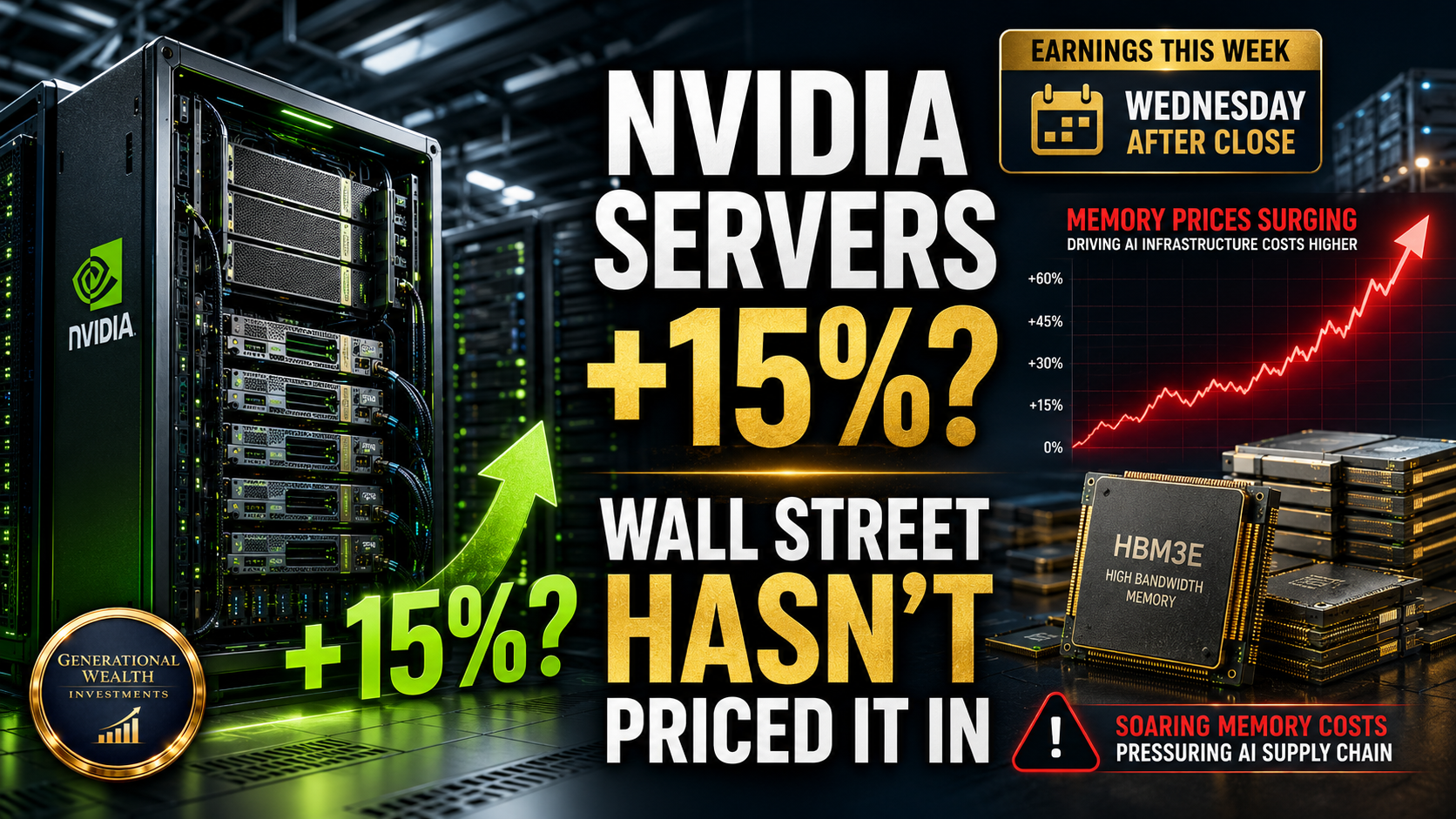
A weekend report says some Nvidia AI server prices could rise more than 15% as soaring memory costs move through the AI infrastructure supply chain. Nvidia shares get their first chance to react Monday, just two days before earnings put margins, pricing power, and data-center spending in focus.
August 23, 2026
Nvidia Server Prices May Jump 15% — Before the Stock Can React
Some Nvidia AI servers may soon cost more than 15% more as memory-chip prices climb, according to a Saturday report that Nvidia had not yet confirmed. Because the news arrived while markets were closed, Nvidia shares have not reacted. Monday brings the first test — followed by an even bigger one when Nvidia reports earnings Wednesday after the closing bell.
Watch Today’s Market Breakdown
See why rising memory costs could affect Nvidia’s AI-server pricing, data-center spending, semiconductor margins, and the market setup heading into earnings.
Today’s Market Setup
The report puts a new variable into the AI trade just days before Nvidia earnings: the cost of building the infrastructure powering the boom may be rising.
Nvidia Server Prices Could Rise Sharply
Bloomberg reported Saturday that some major Nvidia customers were told server prices could rise more than 15% in many cases because memory-chip costs are soaring. Reuters could not independently verify the report, and Nvidia had not commented.
The Pressure Extends Beyond Nvidia
The affected systems reportedly include Vera Rubin and Grace Blackwell platforms shipping early next year. Server builders supplying Microsoft, Google and Oracle have also reportedly warned customers about increases, raising questions about the cost of already enormous AI data-center budgets.
Memory Makers Sit on the Other Side
Higher memory prices could strengthen Samsung, SK Hynix and Micron even as they increase costs elsewhere in the AI supply chain. Nvidia lists memory and component expenses within cost of revenue, putting margins and pricing power directly in focus.
What Matters From Here
The reported price increases are important. The bigger issue is how much of those costs Nvidia can pass through — and whether the market sees them as a margin problem, a pricing-power signal, or both.
- Does Nvidia confirm the reported server-price increases, and how much of the higher memory cost will customers absorb?
- How does Nvidia stock react Monday when investors get their first opportunity to trade on the weekend report?
- What does Wednesday’s fiscal second-quarter report reveal about margins, pricing power, and the cost of the next phase of the AI infrastructure buildout?
The Headlines Are Only the First Step
The free Market Preview explains why rising memory costs could matter for Nvidia and the broader AI trade. The members-only Daily Market Brief goes deeper into the catalysts, risks, confirmation signals, and developments worth monitoring as Nvidia moves from Monday’s market reaction into Wednesday’s earnings report.
See What Members GetInside Today’s Members-Only Daily Market Brief
- What to monitor when Nvidia shares get their first chance to react to the weekend server-pricing report on Monday.
- The signals that could help determine whether higher memory costs are becoming a broader AI-infrastructure issue.
- Why Nvidia’s pricing power and margin commentary will matter when the company reports Wednesday after the closing bell.
- How Micron, Samsung and SK Hynix fit into the other side of the same memory-cost story.
Go Beyond the Headlines
The public Market Preview tells you what happened and why investors are paying attention. The Generational Wealth Community is designed for investors who want to understand what deserves attention next, what could confirm the current market narrative, what risks could change the setup, and which developments deserve continued monitoring. We don’t chase hype, we decode the market.
Unlock the Daily Market BriefEducational market research designed to help investors understand the setup — not chase headlines.
Your pathway from knowledge to legacy. We don’t chase hype, we decode the market.
Stay Ahead of What Matters Next
Follow the catalysts, risks, and confirmation signals that deserve attention as Nvidia, memory-chip costs, AI spending, and Wednesday’s earnings report test the next phase of the AI trade.
Join the Generational Wealth Community