

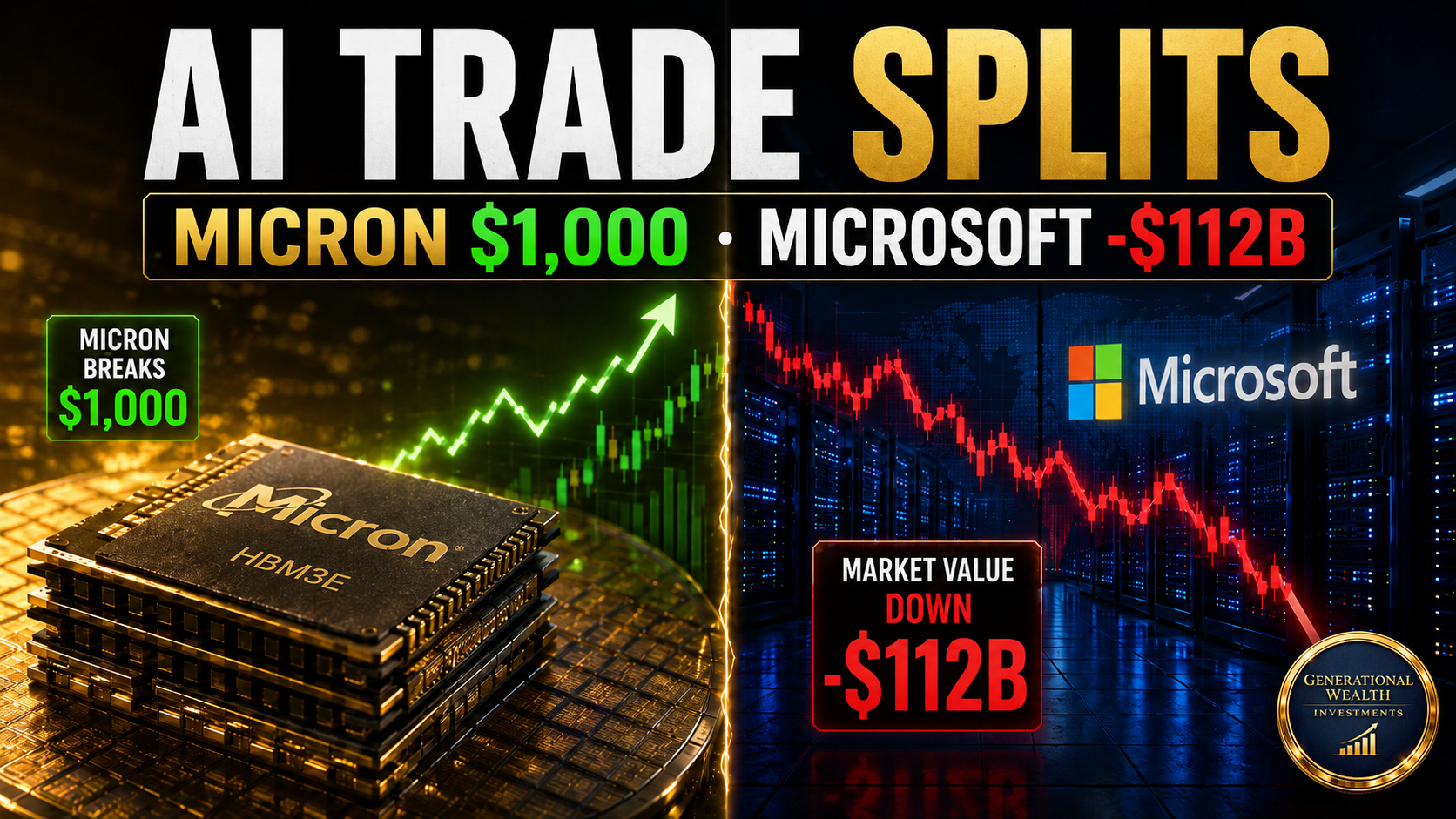
Micron Hits $1,000 as Microsoft Loses $112 Billion
Micron surged above $1,000 while Microsoft lost roughly $112 billion in market value as investors separated the companies selling the AI buildout from those paying for it. Rising memory costs, higher Treasury yields, and Wednesday’s Fed minutes could determine whether that divide grows wider.
August 18, 2026
Micron Hits $1,000 While Microsoft Loses $112 Billion — The AI Trade Just Split
Micron closed above $1,000 a share for the first time since early July while Microsoft lost roughly $112 billion in market value. The split reveals an important change inside the AI trade: investors rewarded companies selling the infrastructure while punishing some of the companies paying for it. Now rising memory costs, higher Treasury yields, and Wednesday’s Fed minutes are testing whether that divide gets wider.
Watch Today’s Market Breakdown
See why Micron surged while Microsoft fell, how semiconductor suppliers separated from major AI spenders, and why Wednesday’s Fed minutes matter next.
Today’s Market Setup
Monday’s action was less about technology broadly falling and more about investors separating the companies supplying the AI buildout from some of the companies absorbing its rising costs.
Memory Becomes the Winning Side
Micron gained about 4% as memory prices climbed and the administration opposed Apple buying Chinese memory chips. With supply already tight, the development kept attention on Micron and the companies positioned to sell increasingly expensive components into the AI buildout.
AI Spending Becomes the Pressure Point
Microsoft fell about 3% and Oracle dropped more than 2.5%, while Applied Materials gained more than 5% and Lam Research and Taiwan Semiconductor also advanced. Investors were not abandoning technology altogether; they were distinguishing between companies selling AI infrastructure and companies paying for it.
Financing Costs Add Another Test
The 30-year Treasury yield closed at 5.31%, its highest level of 2026. Nasdaq 100 futures were down about 1.1% this morning as yields and oil climbed, adding another layer of pressure as AI components themselves become more expensive.
What Matters From Here
Understanding Monday’s rotation is only the first part of the story. The next question is whether the forces behind it continue to reinforce one another.
- Can semiconductor suppliers keep outperforming if elevated memory costs continue pressuring the companies funding massive AI data-center buildouts?
- Does a 30-year Treasury yield at 5.31% deepen the divide between companies selling AI infrastructure and those financing it?
- What will Wednesday’s July Fed minutes reveal about how much support existed for a rate hike after three officials dissented?
The Headlines Are Only the First Step
The free Market Preview explains why the AI trade split. The members-only Daily Market Brief goes deeper into the levels, catalysts, risks, confirmation signals, and developments that can help determine whether today’s rotation is strengthening, weakening, or changing character.
See What Members GetInside Today’s Members-Only Daily Market Brief
- The signals that could confirm whether strength is continuing across Micron and other semiconductor suppliers.
- The Treasury-yield developments that could intensify or ease financing pressure across the AI buildout.
- What to monitor in Wednesday’s Fed minutes after three officials dissented in favor of a rate hike.
- The signs that help distinguish a targeted AI rotation from a broader deterioration in technology.
- The developments worth tracking if memory prices and infrastructure costs remain elevated.
Go Beyond the Headlines
The public Market Preview tells you what happened. The Generational Wealth Community is designed for investors who want to understand what deserves attention next, what could confirm the current setup, what risks could change it, and which developments deserve continued monitoring. We don’t chase hype, we decode the market.
Unlock the Daily Market BriefEducational market research designed to help investors understand the setup — not chase headlines.
Your pathway from knowledge to legacy. We don’t chase hype, we decode the market.
Stay Ahead of What Matters Next
Follow the market beyond the initial headline and understand the catalysts, risks, and signals that deserve continued attention.
Join the Generational Wealth Community
Applied Materials Falls on Margins as S&P 500 Hits Record
Applied Materials posted the biggest quarter-to-quarter revenue jump in its history and the stock fell about 5% anyway — the second straight day a beat-and-raise was punished over margins. Today's preview breaks down what that pattern says about the AI trade, and why the S&P 500 still closed at a record.
Market Preview: Applied Materials Posts Record Revenue and Drops Anyway as the S&P 500 Closes at a High
Applied Materials just reported the biggest quarter-to-quarter revenue jump in its history — and the stock fell about 5% after hours. That's two days running where a company beat, raised guidance, and sold off anyway, and both times the market pointed at the same line item. Today's video explains what margins are saying about the AI trade, and why the index closed at a record regardless.

Today's Market Snapshot
Record Revenue, Falling Stock
Applied Materials posted record revenue just over $9 billion, up 25% from a year ago, beat on earnings, and raised its outlook. The stock still fell about 5% after hours. Management guided to flat gross margins next quarter, and that single line outweighed everything else in the report.
Two Days, Same Story
Cisco beat and guided above estimates, then dropped 8.4% Thursday. Analysts kept returning to margins: gross margin slipped to roughly 66% from 68%, partly because the memory inside AI hardware has grown more expensive. Investors aren't questioning AI demand — they're questioning what it costs to meet it.
The Index Barely Blinked
Micron, which sells that memory, rose more than 4% the same day — the cost is moving through the AI trade, not ending it. Meanwhile the S&P 500 closed at a record just under 7,800 after wholesale inflation came in flat for July and traders trimmed September rate-hike odds.
What Investors Should Be Watching
- July retail sales at 8:30 Eastern — the read on the consumer landing right after a flat wholesale inflation print already pulled September rate-hike odds lower.
- The SEC votes at 10 on its first formal crypto rulemaking, with Bitcoin near $63,000.
- Whether the Applied Materials drop holds at the open, or whether buyers treat a margin warning inside record revenue differently in daylight.
Inside Today's Members-Only Daily Market Brief
- The levels members are tracking on Applied Materials as an after-hours drop meets the cash open.
- How to read a margin squeeze that travels through the AI supply chain — and which side of it is absorbing the cost.
- What each retail sales outcome would do to September rate expectations now that a hike has been trimmed back.
- Why the SEC's first formal crypto rulemaking deserves attention beyond today's headline.
- Where the strongest and weakest parts of the market sit with the index at a record.
Go Beyond the Headlines
The public video explains what happened. The Generational Wealth Community helps members understand what matters next, where the risks are, and which developments deserve continued attention.
Unlock the Daily Market Brief
Nvidia's $500B AI War Chest as Oil Surges | Aug 11, 2026
Nvidia lined up more than $500 billion from six Wall Street giants for AI data centers, and the stock fell anyway on circular financing concerns. Crude surged roughly 5% as Hormuz talks stalled, the 10-year yield topped 4.7%, and September rate hike odds moved to roughly even ahead of Wednesday's CPI.
Market Preview: Nvidia Lines Up $500 Billion for AI as Oil Surges and Rate Hike Odds Climb
Nvidia announced partnerships with six of the largest firms on Wall Street to mobilize more than $500 billion for AI data centers — and the stock fell anyway. Meanwhile crude jumped roughly 5%, the 10-year Treasury yield pushed above 4.7%, and traders now put roughly even odds on a Federal Reserve rate hike in September. Today's video connects the energy move, the AI financing question, and the rate math heading into Wednesday's inflation print.

Today's Market Snapshot
Crude Jumps as Hormuz Talks Stall
West Texas Intermediate settled up about 5% Monday near $82 a barrel, with Brent near $88, after President Trump demanded Iran pay compensation and talks to reopen the Strait of Hormuz stalled. Both moved higher again this morning, Brent near its highest since late July. Producers and refiners benefit if it holds.
Nvidia's $500 Billion Question
Nvidia announced partnerships with Apollo, BlackRock, Blackstone, Brookfield, Goldman Sachs and KKR to mobilize over $500 billion for AI data centers. Shares still fell roughly 2–3% as investors questioned circular financing, recovering slightly overnight. Intel dropped nearly 4% on a $15 billion dilutive stock offering.
Yields Rise, Stocks Slip
Higher oil lifted inflation expectations and the 10-year Treasury yield climbed above 4.7%, near its highest since January. September hike odds moved to roughly even from about 44% Monday, and Cleveland Fed President Hammack said several increases may be needed. The S&P 500 closed down 0.1% at 7,752.
What Investors Should Be Watching
- Wednesday's consumer price index, now the week's real catalyst after oil and yields reset expectations for the September meeting.
- Whether AI spending confirmation arrives, with CoreWeave reporting today and Applied Materials Thursday — or whether the financing questions around Nvidia's announcement keep pressure on leadership.
- Whether the crude rally holds, and what a sudden deal reopening the Strait of Hormuz would do to the energy trade.
Inside Today's Members-Only Daily Market Brief
- The specific levels and catalysts members are tracking across crude, gold, and rates as the Hormuz standoff drags on.
- Both sides of Wednesday's inflation print, and what each outcome would mean for a September hike now priced near a coin flip.
- Why circular financing is drawing scrutiny, and what would actually confirm or break the AI spending story this week.
- The bitcoin level analysts say shifts sentiment, plus what recent fund flows suggest beneath a heavy tape.
- Where capital is rotating as money moves toward energy and hard assets while AI leadership wobbles.
Go Beyond the Headlines
The public video explains what happened. The Generational Wealth Community helps members understand what matters next, where the risks are, and which developments deserve continued attention.
Unlock the Daily Market Brief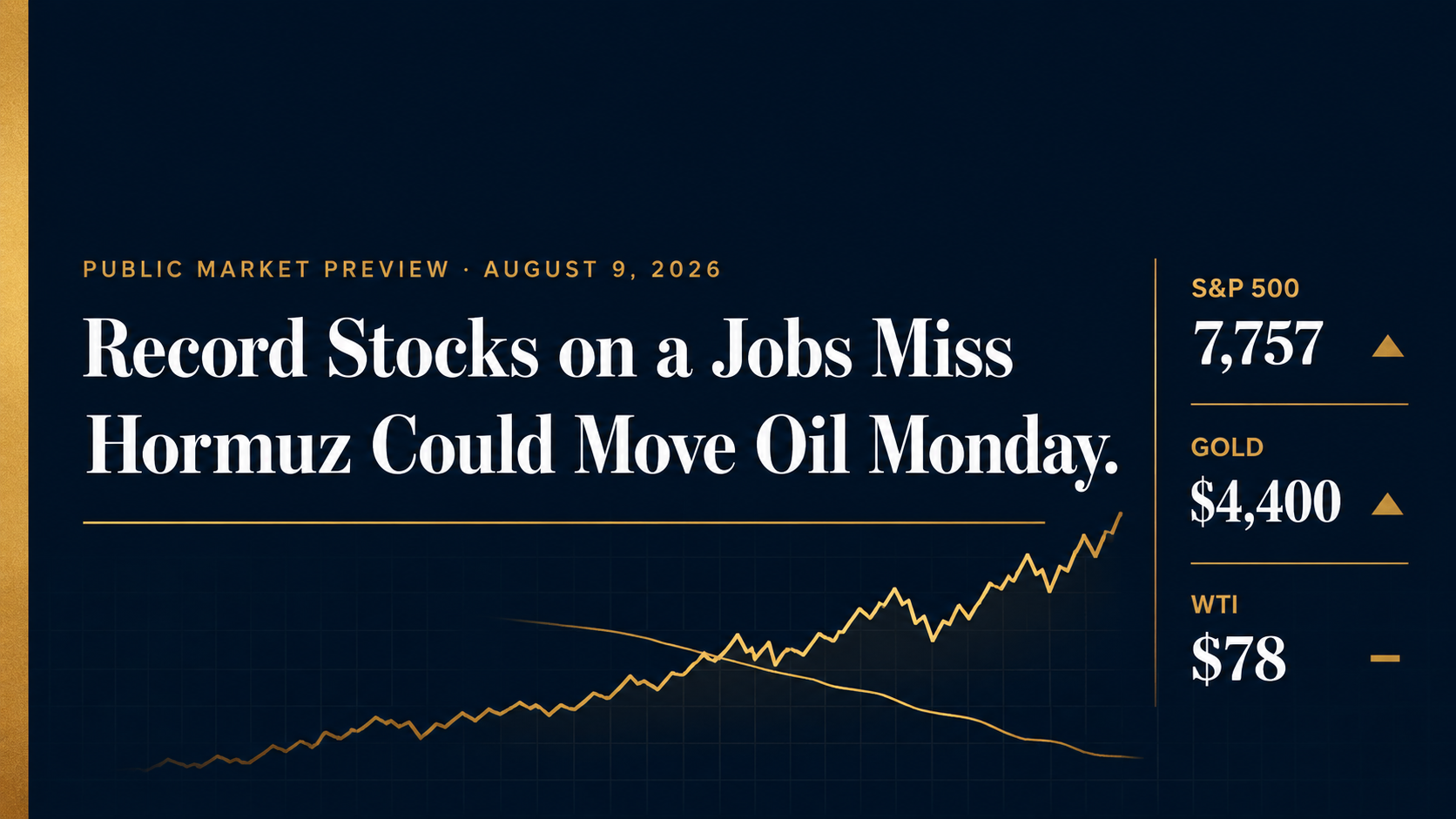
Market Preview: Record Stocks, Jobs Miss, Hormuz Oil Risk
The U.S. economy lost 23,000 jobs in July and the S&P 500 still closed at a record 7,757, as investors read the miss as taking a September rate hike off the table. Today's preview covers the software rotation, gold's seven-week high, and the Strait of Hormuz headlines that could move oil Monday.
Market Preview: Stocks Close at Records on a Jobs Miss as Strait of Hormuz Headlines Could Move Oil Monday
The economy lost jobs in July and equities finished Friday at a record anyway — investors read the miss as taking a September rate hike off the table. That repricing landed hardest in software, where one name closed up roughly 35%. Meanwhile, weekend developments around the Strait of Hormuz set up energy markets for a live Monday. Today's video walks through what connects all three.

Today's Market Snapshot
Jobs Data Resets the Rate Path
July payrolls fell by 23,000 against expectations for a gain near 80,000, while unemployment ticked down to 4.1%. Investors read that as taking a September hike off the table. The S&P 500 closed at a record 7,757, the Nasdaq added 1.3% to 26,690, and the 10-year yield eased to about 4.66%.
Software Leads as Money Rotates
Atlassian closed up roughly 35% after 28% revenue growth and beat guidance. Twilio rose about 27% and Cloudflare about 9%, while Nvidia gained more than 11% on the week. Capital appears to be rotating toward growth and AI names; energy shares lagged even as crude rose.
Oil, Gold, and Crypto Flows
Iran said it is close to a navigation deal with Oman, but its foreign minister warned that alone would not reopen the Strait of Hormuz. WTI settled near $78. December gold settled near $4,400, a seven-week high. Bitcoin held near $64,900 as spot funds took in over $750 million last week.
What Investors Should Be Watching
- Wednesday's July inflation report. A hot print would revive hike talk and challenge the rate math that drove Friday's record close.
- Whether the Hormuz situation moves toward a genuine reopening or a breakdown in talks — one path eases energy costs, the other does the opposite.
- Whether the software and AI rotation broadens, with cloud guidance holding up as the confirmation traders are looking for.
Inside Today's Members-Only Daily Market Brief
- The specific levels and catalysts members are tracking across gold, oil, and the September rate path.
- Both sides of Wednesday's inflation print, plus what to monitor around Cisco, CoreWeave, and Applied Materials earnings.
- Where capital is rotating as money moves out of energy and into growth and AI names — the strongest and weakest areas of the tape.
- What the divergence in crypto fund flows may be signaling, including the collapse in XRP inflows against steady bitcoin demand.
- The risks that could reverse a record week, and why a seven-week high in gold may still read as recovery rather than breakout.
Go Beyond the Headlines
The public video explains what happened. The Generational Wealth Community helps members understand what matters next, where the risks are, and which developments deserve continued attention.
Unlock the Daily Market Brief