


Oil Tops $90 After Hormuz Strike as Hike Odds Hit 57%
Oil moved above $90 after a U.S. strike near the Strait of Hormuz put one of the world’s most important energy routes back in focus. With September rate-hike odds now at 57%, the next question is whether higher energy prices or Friday’s jobs report has the bigger impact on Fed expectations.
August 31, 2026
Oil Blows Past $90 After Hormuz Strike — Rate Hike Odds Jump to 57%
Oil moved above $90 after American forces struck Iranian launchers near the Strait of Hormuz, putting one of the world’s most important energy routes back at the center of the market. The complication is that inflation pressure is already colliding with rising expectations for a September Fed rate increase. Now investors have two major risks to track: energy disruption and Friday’s jobs report.
Watch Today’s Market Breakdown
See why the Hormuz strike pushed oil above $90, how it connects to inflation and rate expectations, and why Friday’s jobs report matters.
Oil Blows Past $90 After Hormuz Strike — Rate Hike Odds Jump to 57% Watch Today’s Market BriefingToday’s Market Setup
The market is dealing with a renewed geopolitical oil shock while interest-rate expectations are already moving in a more restrictive direction.
Hormuz Risk Sends Oil Above $90
American forces struck two Iranian launchers on Larak Island after officials said Revolutionary Guard forces were preparing rockets carrying sea mines into the Strait of Hormuz. Iran then attacked American forces in Jordan. Brent futures climbed about 2% overnight and moved above $90 a barrel.
Oil Adds to the Inflation Problem
Fed Chair Kevin Warsh said Friday that the Fed still has work to do if inflation is not moving clearly toward 2%. Markets raised the implied probability of a September rate increase to 57%, while the two-year Treasury yield is near 4.34% after rising almost 12 basis points Friday.
Friday’s Jobs Report Becomes the Next Test
President Trump said Venezuelan oil from the new American agreement will help refill the Strategic Petroleum Reserve, but additional Venezuelan production requires investment. That leaves the immediate Hormuz risk unresolved while markets wait to see whether Friday’s labor data changes rate-hike expectations.
What Matters From Here
Oil above $90 explains what changed overnight. The more important issue now is how long the pressure lasts and whether it reinforces the Fed’s inflation concerns.
- Does the Strait of Hormuz remain disrupted enough to keep upward pressure on oil, or does the immediate geopolitical risk begin to ease?
- Does higher oil strengthen the inflation argument enough to keep September rate-hike expectations elevated?
- Could a weaker-than-expected jobs report on Friday cool those expectations even if energy prices remain under pressure?
The Headlines Are Only the First Step
The free Market Preview explains why oil, inflation and interest-rate expectations are colliding today. The members-only Daily Market Brief goes deeper into the catalysts, risks, confirmation signals and developments worth monitoring as the Hormuz story and Friday’s jobs report reshape the market setup.
See What Members GetInside Today’s Members-Only Daily Market Brief
- The Hormuz developments that could strengthen or weaken the current oil-supply risk.
- How renewed energy inflation interacts with the market’s 57% September rate-hike probability.
- Why the two-year Treasury yield matters as investors reassess the Fed’s next move.
- What Friday’s jobs report could change about the current interest-rate setup.
- How Venezuela’s longer-term supply story fits against the immediate geopolitical pressure in the Strait of Hormuz.
Go Beyond the Headlines
The public Market Preview tells you what happened and why investors are paying attention. The Generational Wealth Community is built for investors who want to understand what deserves attention next, what could confirm the current setup, what risks could change it, and which developments deserve continued monitoring. We don’t chase hype, we decode the market.
Unlock the Daily Market BriefEducational market research designed to help investors understand the setup — not chase headlines.
Your pathway from knowledge to legacy. We don’t chase hype, we decode the market.
Stay Ahead of What Matters Next
Follow the catalysts that matter as markets weigh renewed Hormuz risk, oil above $90, higher rate-hike expectations and Friday’s jobs report.
Join the Generational Wealth Community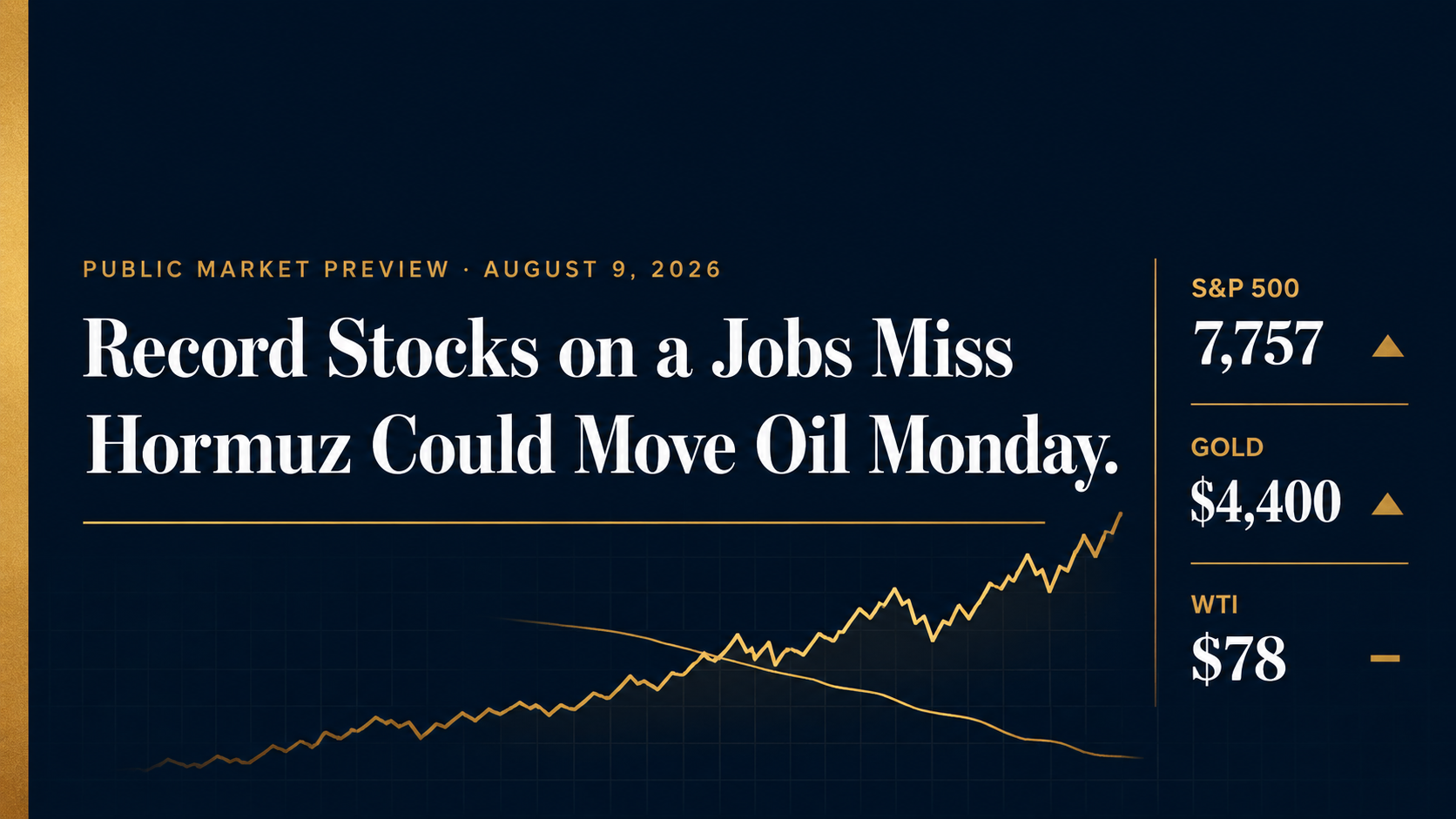
Market Preview: Record Stocks, Jobs Miss, Hormuz Oil Risk
The U.S. economy lost 23,000 jobs in July and the S&P 500 still closed at a record 7,757, as investors read the miss as taking a September rate hike off the table. Today's preview covers the software rotation, gold's seven-week high, and the Strait of Hormuz headlines that could move oil Monday.
Market Preview: Stocks Close at Records on a Jobs Miss as Strait of Hormuz Headlines Could Move Oil Monday
The economy lost jobs in July and equities finished Friday at a record anyway — investors read the miss as taking a September rate hike off the table. That repricing landed hardest in software, where one name closed up roughly 35%. Meanwhile, weekend developments around the Strait of Hormuz set up energy markets for a live Monday. Today's video walks through what connects all three.

Today's Market Snapshot
Jobs Data Resets the Rate Path
July payrolls fell by 23,000 against expectations for a gain near 80,000, while unemployment ticked down to 4.1%. Investors read that as taking a September hike off the table. The S&P 500 closed at a record 7,757, the Nasdaq added 1.3% to 26,690, and the 10-year yield eased to about 4.66%.
Software Leads as Money Rotates
Atlassian closed up roughly 35% after 28% revenue growth and beat guidance. Twilio rose about 27% and Cloudflare about 9%, while Nvidia gained more than 11% on the week. Capital appears to be rotating toward growth and AI names; energy shares lagged even as crude rose.
Oil, Gold, and Crypto Flows
Iran said it is close to a navigation deal with Oman, but its foreign minister warned that alone would not reopen the Strait of Hormuz. WTI settled near $78. December gold settled near $4,400, a seven-week high. Bitcoin held near $64,900 as spot funds took in over $750 million last week.
What Investors Should Be Watching
- Wednesday's July inflation report. A hot print would revive hike talk and challenge the rate math that drove Friday's record close.
- Whether the Hormuz situation moves toward a genuine reopening or a breakdown in talks — one path eases energy costs, the other does the opposite.
- Whether the software and AI rotation broadens, with cloud guidance holding up as the confirmation traders are looking for.
Inside Today's Members-Only Daily Market Brief
- The specific levels and catalysts members are tracking across gold, oil, and the September rate path.
- Both sides of Wednesday's inflation print, plus what to monitor around Cisco, CoreWeave, and Applied Materials earnings.
- Where capital is rotating as money moves out of energy and into growth and AI names — the strongest and weakest areas of the tape.
- What the divergence in crypto fund flows may be signaling, including the collapse in XRP inflows against steady bitcoin demand.
- The risks that could reverse a record week, and why a seven-week high in gold may still read as recovery rather than breakout.
Go Beyond the Headlines
The public video explains what happened. The Generational Wealth Community helps members understand what matters next, where the risks are, and which developments deserve continued attention.
Unlock the Daily Market Brief
Oil Spikes on Hormuz Plan as Gold Nears Best Week Since Jan
A single Iranian document on Strait of Hormuz shipping sent Brent up 3.8%, pushed the 10-year yield above 4.67%, and ended the Dow's record streak — while gold ran to its best week since January. Today's preview covers the memory chip selloff, where capital is rotating, and what the July jobs report could change.
Two things worth flagging: the snapshot figures are session-specific and will read stale within a day or two, so if you want this page to have a longer shelf life on the blog, say the word and I'll swap in an evergreen variant. And if you want the header banner and social thumbnail assets to match, I can build those next.
Market Preview: Oil Spikes on a Hormuz Document as Gold Heads for Its Best Week Since January
Iranian state media published a draft plan restricting ship traffic through the Strait of Hormuz, and Brent settled up about 3.8% — reversing a week of steep declines. Higher energy costs pushed the 10-year yield above 4.67% and lifted September Fed rate hike odds to roughly 58%, ending the Dow's record streak. Today's video breaks down why memory chip stocks sold off despite strong results, and why gold is having its best week since January.

Today's Market Snapshot
Energy and Rates: One Document Moves Everything
Iranian state media published a draft plan restricting Strait of Hormuz ship traffic. Brent settled up roughly 3.8% near $82.49 and WTI near $77.29, reversing a week of steep declines. Higher energy costs fed inflation expectations: the 10-year Treasury yield climbed more than five basis points to about 4.67%, and September rate hike odds sit near 58%.
Equities: Memory Chips Break the Record Streak
The Dow fell 464 points, or 0.85%, to 53,885, ending its record run. The S&P 500 slipped just under 7,710 and the Nasdaq was nearly flat. Western Digital dropped about 13% and SanDisk near 7% despite both beating results — guidance disappointed. Selling spread to Asia, where SK Hynix fell sharply. AppLovin tumbled roughly 19%.
Metals and Crypto: Rotation Into Hard Assets
Gold traded near $4,254 an ounce, up roughly 5% on the week and on pace for its best week since January, with silver around $62. Crypto stayed quiet: Bitcoin near $64,700 and still capped below $65,000, Ether near $1,910, XRP around $1.03. Cardano was the standout, up about 6.5%.
What Investors Should Be Watching
- The July jobs report at 8:30 a.m. Eastern. Economists expect roughly 80,000 jobs after 57,000 in June, with unemployment near 4.2%. A hot print strengthens the September hike case; a weak one does the opposite.
- Whether the memory chip selling stays contained. Western Digital grew revenue about 44% and still fell 13%, which suggests investors are repricing how much AI growth is already built into these names.
- Whether the Hormuz restrictions hold. The move in oil came from a published draft plan, and crude, yields and gold all reprice quickly if that story changes direction again.
Inside Today's Members-Only Daily Market Brief
- The specific levels and catalysts members are tracking across crude, gold and the 10-year as rate hike odds climb toward 58%.
- How members are reading the memory chip selloff, including the confirmation signal that would tell us whether this is sector-specific or the start of a broader AI valuation reset.
- Where capital is rotating as money moves out of crowded AI trades and into rate-sensitive and hard assets — the strongest and weakest areas of the tape.
- The risks that could reverse a 5% weekly move in gold, and why chasing a sharp run carries added risk.
- Both sides of the July jobs report, and what to monitor into the next session depending on which way the number lands.
Go Beyond the Headlines
The public video explains what happened. The Generational Wealth Community helps members understand what matters next, where the risks are, and which developments deserve continued attention.
Unlock the Daily Market Brief