


Retail Sales Drop 0.6% as Small Caps Hit Record High
Retail sales fell 0.6% in July and consumer sentiment sank to 51, yet the Russell 2000 closed at an all-time high as rate-hike fears faded. The bond market disagreed — the ten-year yield rose to 4.68% while oil spiked near $82 on Strait of Hormuz tensions.
Market Preview: Retail Sales Fall 0.6% as Small Caps Close at a Record and Oil Spikes to $82
The American consumer just posted the biggest spending drop in more than a year — and small-cap stocks closed at an all-time high the same session. The bond market didn't go along with it: the ten-year yield rose instead of falling, while oil settled near $82 after drone strikes in the Strait of Hormuz. Today's video explains the tension underneath a record close: cheaper money versus more expensive energy.

Today's Market Snapshot
The Consumer Pulled Back
Retail sales fell six tenths of a percent in July, the biggest drop in more than a year, when economists had expected a small increase. Consumer sentiment sank about 8% to 51, and households now expect 4.3% inflation over the next year.
Small Caps Hit a Record Anyway
After softer inflation reports Wednesday and Thursday, a weaker consumer eased fears the Fed must raise rates again in September. Small caps are the most rate-sensitive corner of the market, and the Russell 2000 closed at an all-time high.
Bonds and Oil Disagreed
The ten-year Treasury yield rose to 4.68% instead of falling on weak data — a signal inflation risk hasn't gone away. Oil settled near $82, up more than 5% on the week after Strait of Hormuz tanker strikes. Energy led all sectors, up roughly 7%.
What Investors Should Be Watching
- The retailers deliver their own verdict this week — Home Depot Tuesday, Target and Lowe's Wednesday, Walmart Thursday. If they confirm shoppers are pulling back, that small-cap record gets much harder to defend.
- Whether the ten-year yield keeps climbing on soft data, which would say the bond market is more worried about inflation than about growth.
- Whether the Strait of Hormuz situation escalates or cools, with gasoline still around $4 a gallon and the naval blockade open-ended.
Inside Today's Members-Only Daily Market Brief
- The levels members are tracking on small caps now that the Russell 2000 is at a record with a weakening consumer underneath it.
- How to read a bond market that rises on bad news — and what that pattern has historically meant for rate expectations.
- What each retailer print this week would do to the September rate debate, and which one carries the most weight.
- Where the energy trade sits after a 7% sector week, and the risks that could reverse it quickly.
- The strongest and weakest areas of the market heading into the next session.
Go Beyond the Headlines
The public video explains what happened. The Generational Wealth Community helps members understand what matters next, where the risks are, and which developments deserve continued attention.
Unlock the Daily Market Brief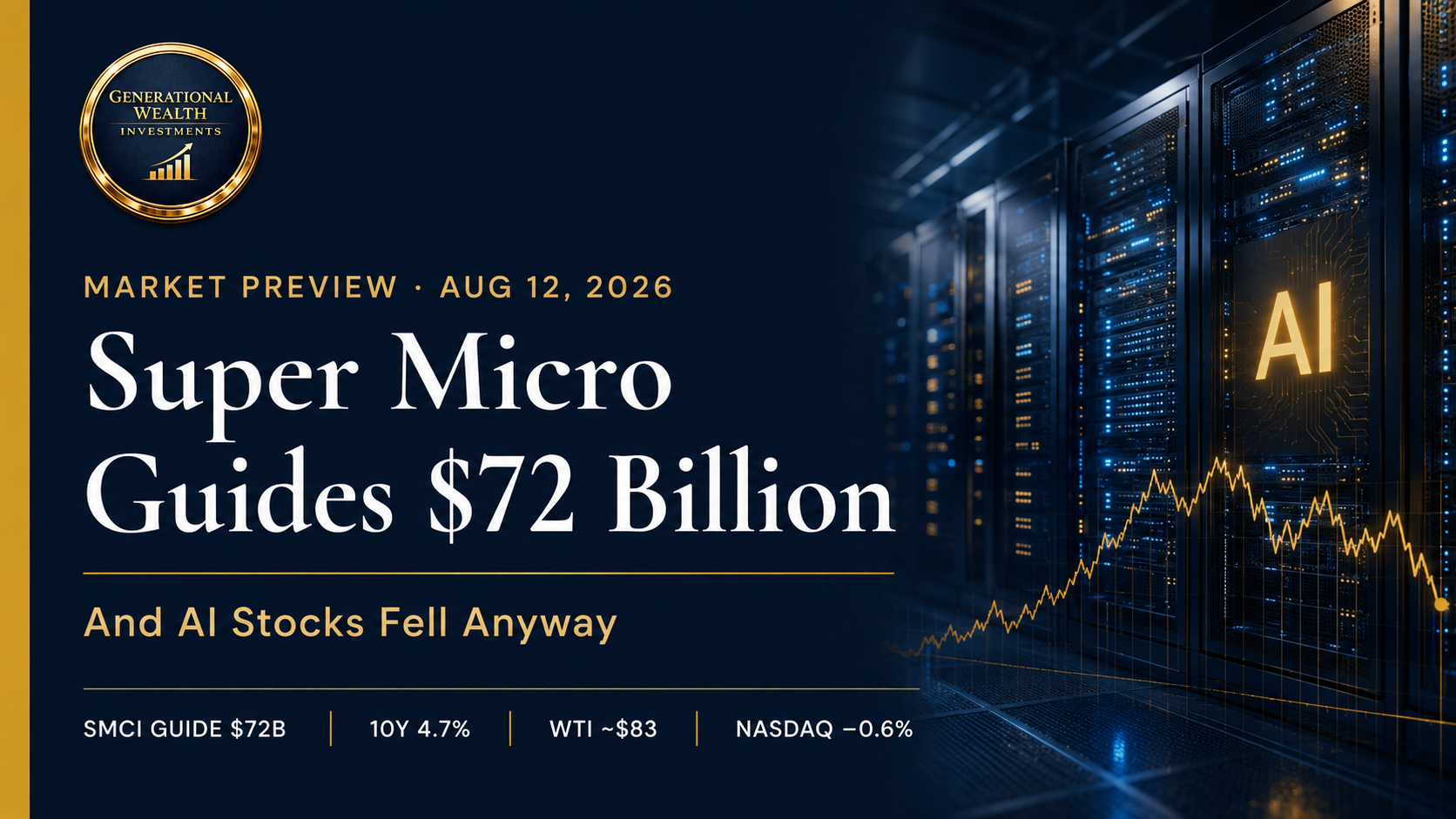
Super Micro Guides $72B as AI Stocks Sell Off Anyway
Super Micro guided to as much as $72 billion in AI server sales next year, roughly $19 billion above Wall Street's model, and the stock jumped about 9% after hours — hours after AI stocks had sold off all day. Today's preview decodes why the doubt has shifted from demand to financing, with yields near 4.7%, crude around $83, and the July inflation report landing at 8:30.
Market Preview: Super Micro Guides $72 Billion as AI Stocks Sell Off Anyway
Super Micro told Wall Street it expects to sell as much as $72 billion of AI servers next year — roughly $19 billion above what analysts were modeling — and the stock jumped about 9% after hours. The strange part is the timing: AI stocks had sold off all day in the regular session. Today's video explains why the doubt on Wall Street is no longer about demand, but about how the buildout gets paid for.

Today's Market Snapshot
Demand Beats, and Then Some
Super Micro guided to as much as $72 billion in AI server sales next year, against roughly $53 billion modeled on Wall Street. The stock rose about 9% after hours. CoreWeave said the same evening that its backlog grew roughly $25 billion in six weeks, and its stock jumped as well.
The Funding Question Takes Over
Hours earlier, AI names sold off all session. Alphabet fell nearly 4% on data center spending worries, Intel priced a $20 billion stock sale upsized from $15 billion, and Nvidia lined up more than $500 billion of outside financing this week. The Nasdaq closed down about 0.6%, a second straight loss.
Yields and Oil Set the Cost
When a buildout runs on borrowed money, the cost of borrowing becomes the story. The 10-year Treasury yield sits near 4.7%. Crude settled around $83, a fourth straight gain, after Iran said the Strait of Hormuz stays shut. Both feed directly into this morning's inflation math.
What Investors Should Be Watching
- The July inflation report at 8:30 this morning, where economists expect headline inflation around 3.4% — a cooler number takes pressure off yields, a hotter one makes every one of these deals pricier.
- Whether the after-hours enthusiasm around Super Micro and CoreWeave carries into the regular session, or whether the financing questions reassert themselves the way they did Tuesday.
- Whether crude can extend a fourth straight gain with the Strait of Hormuz still closed, and what that does to the rate path traders are already pricing near a coin flip for a hike.
Inside Today's Members-Only Daily Market Brief
- The specific levels members are tracking across the 10-year, crude, and the AI complex as the funding story develops.
- Both sides of this morning's inflation print, and what each outcome would mean for a rate decision now priced near even.
- Why the market can sell a demand beat, and what would actually resolve the question of who is holding the paper.
- How the Intel and Nvidia financing structures differ, and which one tells you more about the cycle.
- Where capital is rotating as borrowing costs, not demand, become the constraint on the buildout.
Go Beyond the Headlines
The public video explains what happened. The Generational Wealth Community helps members understand what matters next, where the risks are, and which developments deserve continued attention.
Unlock the Daily Market Brief